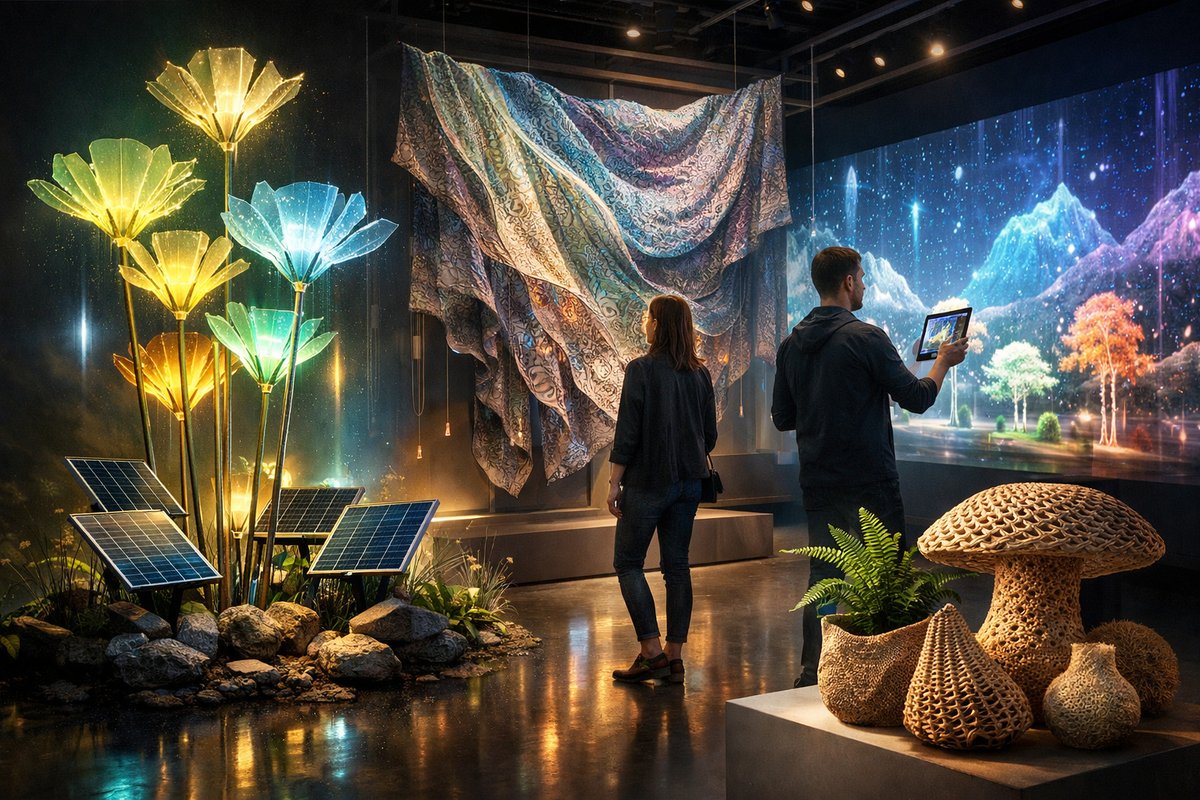

Across gallery walls and public plazas, a new chapter in art and design is unfolding-one that embraces digital intelligence and environmental stewardship without sacrificing the emotional power of hand-crafted experience. In one urban square, a sculptural installation powered entirely by rooftop solar panels transforms midday sun into cascading beams of refracted light. Nearby, a pop-up exhibition reveals textiles woven not from conventional fibers but from algae-derived biofabrications. This convergence of code and canvas, plastic and pigment, marks a pivotal moment for creators and audiences alike.
At the recently opened GreenLight Pavilion, visitors don lightweight augmented reality headsets that overlay kinetic patterns onto minimalist metal frames. The project’s lead designer emphasizes that these virtual embellishments shift in real time, responding to individual eye-tracking data and biometric feedback. An observer’s heartbeat unleashes flurries of digital petals, while subtle shifts in gaze reveal hidden geometric mandalas. The result is a co-creative dialogue: the piece only completes itself through human presence.
Meanwhile, across the exhibition hall, textile innovators are deconstructing the centuries-old loom. Instead of cotton or polyester, they’re spinning fibers extracted from algae blooms-an abundant and renewable resource that also helps purify waterways. Paired with modular dye cartridges that use pigment blends derived from food waste, the new fabrics boast vibrant hues and the promise of a closed-loop production cycle. Each swatch tells a story of regeneration, reminding audiences that beauty and sustainability need not be at odds.
Digital tools are equally reshaping sculptural practice. At an adjacent presentation, a collective of artists demonstrates an open-source software platform for 3D printing with compostable plastics. The system’s user interface guides novices through the process of designing organic shapes: plant-like forms, fluid contours, architectural facades. Once rendered, the digital file feeds directly to a desktop 3D printer loaded with polylactic acid filament derived from corn starch. The printed objects can be composted when their exhibition run concludes, closing the resource loop once more.
This ethos of circularity extends to lighting design as well. A recent commission for an outdoor art festival saw a series of kinetic light poles fabricated from reclaimed aluminum scraps. Each pole houses a network of programmable LEDs that trace ever-evolving patterns across the night sky. Motion sensors detect pedestrian traffic, causing the poles to pulse in rhythmic unison as people pass. By day, the skeletal structures recall abstract sculptures; by night, they become living, breathing constellations.
At the heart of these experiments lies a fascination with interactivity and responsiveness. Designers are tapping into sensors, cameras, and machine-learning algorithms to ensure their creations adapt to context and crowd. One installation employs thermal imaging to map group movement and then projects color gradients onto a cascading water curtain. Each ripple and refracted light play becomes a fleeting collaboration between technology and the human impulse to explore.
Technology isn’t limited to flashy hardware or algorithmic art. It’s also seeping into more subtle aspects of creative workflow. Several studios have adopted digital drawing tablets with advanced pressure-sensitive pens, allowing illustrators to blend analog-style brushwork with infinite layering and undo functions. Designers laud the freedom to experiment without fear of irreversible mistakes, while still preserving the texture and nuance of traditional media. These hybrid workflows enable rapid prototyping of logos, posters, and packaging materials, injecting fresh energy into branding projects.
Yet for all this innovation, practitioners insist that the core of visual expression remains an emotional bridge between maker and viewer. Viewers at the recent biennial reported moments of genuine wonder: a slow-motion projection that simulates pollen drifting through sunlight; a series of sculpted masks that shift expression according to ambient soundscapes; a floor installation made of stacked books that slowly shifts shape underfoot. Such works underscore that novelty alone doesn’t suffice-technology must serve narrative, metaphor, and the shared human longing for beauty.
The push toward sustainability is equally nuanced. Rather than simply adopting eco-friendly materials as a marketing ploy, many creators conduct life-cycle analyses to ensure every step-from raw material sourcing to end-of-life disposal-aligns with regenerative principles. Workshops at design schools now teach students to calculate the carbon footprint of a single chair leg, to evaluate the toxicity of different pigments, and to prototype biodegradable packaging that still meets durability and aesthetic standards.
Economic forces are also stirring change. Collectors and institutions are increasingly drawn to works that not only question societal norms but also demonstrate tangible environmental benefits. Museums are hosting panels on ethical supply chains, commissioned art pieces that fund reforestation projects, and residencies focused on climate resilience. Brand collaborations no longer revolve solely around logos and ad campaigns but seek meaningful partnerships that align with shared values.
At a recent roundtable, a curator outlined a vision for future exhibitions: “We want guests to leave not only inspired by imagery but empowered to make eco-positive choices in their own lives. If a simple sculpture can spark conversations about renewable energy or sustainable textiles, that’s real impact.”
From grassroots studios to grand institutions, the narrative is clear. Art and design can no longer exist in isolation from the pressing challenges of our time. By weaving together code and compost, light and life, creators are redefining the role of the artist as both storyteller and steward.
This fusion of tech-driven interactivity and earth-friendly ethos invites curiosity and compassion in equal measure. It reminds us that every sketch, every code snippet, every printed filament has the potential to ripple outward-shaping perceptions, behaviors, and even policy.
As galleries dim their lights and open their doors to tomorrow’s innovations, one truth emerges: when canvas meets code, the possibilities are as boundless as our collective imagination.
If you’re inspired to explore these frontiers yourself, consider tools and materials that bridge digital freedom with eco-conscious practice. Whether sketching early concepts or crafting immersive installations, these items can support your journey-helping you transform fleeting ideas into lasting impressions.
-
Vtuber Drawing Tablet Asset | Wacom Cintiq (pack 2) - Etsy - Etsy
This Digital Drawings & Illustrations item by LemonStxDesign has 438 favorites from Etsy shoppers. Ships from United States. Listed on Aug 3, 2026. -
ABS Children's Educational Drawing Board Electronic Drawing Tablet
You'll love the Miuer ABS Children's Educational Drawing Board Electronic Drawing Tablet at Wayfair - Great Deals on all products with Free Shipping on most ... -
XPPen Latest 10 in Graphic Tablet Deco 01V2 Digital Drawing Pad ...
Buy XPPen Latest 10 in Graphic Tablet Deco 01V2 Digital Drawing Pad with Battery-Free Stylus Pen for Chromebook Andriod Mac (Green) at Walmart.com.