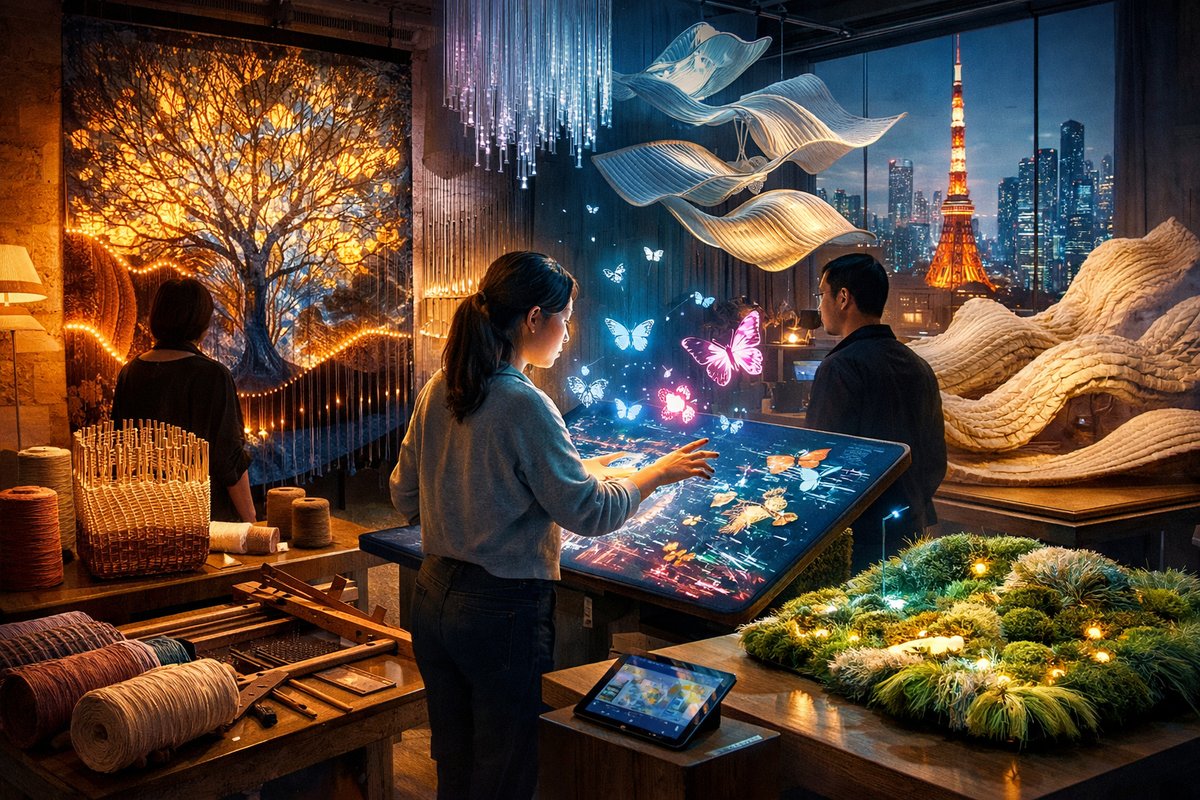

A new generation of art and design exhibitions is stretching the boundaries between fiber and firmware, sculpture and software. From a generative tapestry installation in Paris to augmented reality scrolls in Tokyo, curators and makers are partnering with engineers and biologists to create work that responds to movement, temperature, and even the metabolic processes of living organisms. These shows arrive at a moment when audiences crave both the tactile warmth of traditional craft and the infinite possibilities offered by sensors, microcontrollers, and artificial intelligence.
In the heart of Paris’s gallery district, a collective known only as Resonant Loom unveiled an interactive tapestry woven on a digital jacquard loom. Visitors step up to touchpoints along its edges, and pressure sensors translate their gestures into abstract patterns of light projected across folds of silk and wool. Generated motifs ripple outward, transforming an age-old weaving technique into a dynamic canvas that carries the fingerprints of every passerby. The group collaborated with textile engineers to embed conductive yarn and thermochromic dyes, allowing strands to shift from deep indigo to crimson with the warmth of a human hand.
Across the Channel, an open-air pavilion installed in London’s Hyde Park invites pedestrians to become co-authors of a kinetic textile canopy. When footsteps on pressure plates are detected below, lightweight panels of woven mylar and organic cotton rise and fall like breathing lungs. A network of servomotors and fiber-optic cables guides the movement, while solar panels atop the pavilion store energy by day to power the installation after sunset. The interplay of light, motion, and ambient sound captures the park’s seasonal rhythms, weaving a dialogue between the built environment and the bodies that move through it.
Meanwhile in Tokyo, an exhibition space once reserved for antique scrolls now hosts digital screens that overlay generative patterns onto centuries-old paper backdrops. Armed with handheld tablets, visitors can layer brush-stroke algorithms in real time, producing compositions that merge calligraphic traditions with neural-style transfer models. Select pieces respond to changes in air quality, slowly altering their color palette when ozone levels rise or when pollen counts tick upward, highlighting the intimate link between ecological health and visual expression.
Over in Berlin’s Mitte district, Studio PolyFiber displayed a fleet of kinetic sculptures spun from bungee cord, steel, and smart threads coated in organic pigments. Each sculpture pulses in time with a nearby speaker emitting low-frequency tones programmed to mimic the sound of a beating heart. Deployed across two large halls, the works gently sway in unison whenever a visitor crosses an infrared threshold, creating an uncanny sense of empathy between human and mechanism. By applying algae-based inks harvested from urban bioreactors, the studio underlined its commitment to sustainable materials, forging an aesthetic that feels both futuristic and responsibly rooted.
Sustainability lies at the heart of this movement. Several exhibitions have turned to living pigments derived from microalgae and fungi, while others incorporate biodegradable polymers and recycled textile offcuts. One Milan-based collaboration used discarded fishing nets reclaimed from coastal waters to cast 3D-printed wall reliefs, combining ocean-cleanup initiatives with digital workshops open to local communities. Solar-powered microcontrollers drive low-energy LEDs, and interactive elements are designed to function long after a show closes, so pieces can be repurposed or migrated to new venues without generating electronic waste.
“What excites me is the emotional intelligence embedded in these systems,” says a curator who has worked with several of the featured artists. “We’re not just building gadgets; we’re creating experiences that play with memory, touch, and even smell. These works draw upon centuries of craft knowledge, yet they also invite us to question our relationship with technology, to feel the hum in a thread or sense the pulse in a pixel.” This philosophy of blending humility with innovation has reshaped how audiences engage with form and function, encouraging a slower, more mindful approach to digital stimuli.
The roots of this trend can be traced back to early experiments in electronic textiles and interactive art over a decade ago. What’s new today is the convergence of open-source hardware, affordable fabrication tools, and advances in machine learning. Hackerspaces and community labs provide access to laser cutters, 3D printers, and soldering stations alongside looms and sewing machines, fostering cross-disciplinary collaborations. Emergent artists no longer need massive budgets or large studio spaces; many begin by hacking together basic transistor kits, weaving sensors into scrap fabrics, and crowdsourcing code snippets from global forums.
Technically, these installations rely on modular microcontroller boards, capacitive touch sensors, stepper motors, and thermochromic or photochromic materials. Custom firmware can transform a simple rotary encoder into an expressive gesture microphone. Some projects integrate Bluetooth-enabled modules to stream data to companion apps, while others use local mesh networks so installations can react collectively to visitor input. The interplay between hardware and software is more fluid than ever, and open documentation means each new work builds upon the communal knowledge base.
Yet this hybrid realm faces challenges. Electronic components still risk obsolescence, and the skill gap between traditional artisans and tech-savvy makers can slow collaboration. Accessibility is another concern: while pop-up exhibitions in flagship art districts draw crowds, outreach to underserved communities remains uneven. Curators and funders are now exploring mobile workshops and traveling toolkits to democratize access, ensuring that the craft-tech conversation doesn’t become an insular trend.
Looking ahead, the dialog between analog textures and digital logic seems poised to deepen. Portable design kits allow makers to assemble interactive tapestries in their living rooms, while online platforms host code libraries specifically for textile applications. Community-led residencies are emerging in repurposed industrial sites, where artists work alongside climate scientists and social entrepreneurs. Augmented-reality overlays may soon be downloadable via smartphone, turning any fabric surface into a responsive interface.
In this evolving landscape, the boundary between object and software dissolves, inviting us to reconsider what it means to touch, see, and participate. As these exhibitions travel from city to city-transforming old warehouses, public parks, and heritage halls-they weave new threads between tradition and transformation. And in doing so, they remind us that the act of creation itself remains a profoundly human endeavor, one that flourishes when curiosity, compassion, and sustainability come together in every stitch and code snippet.