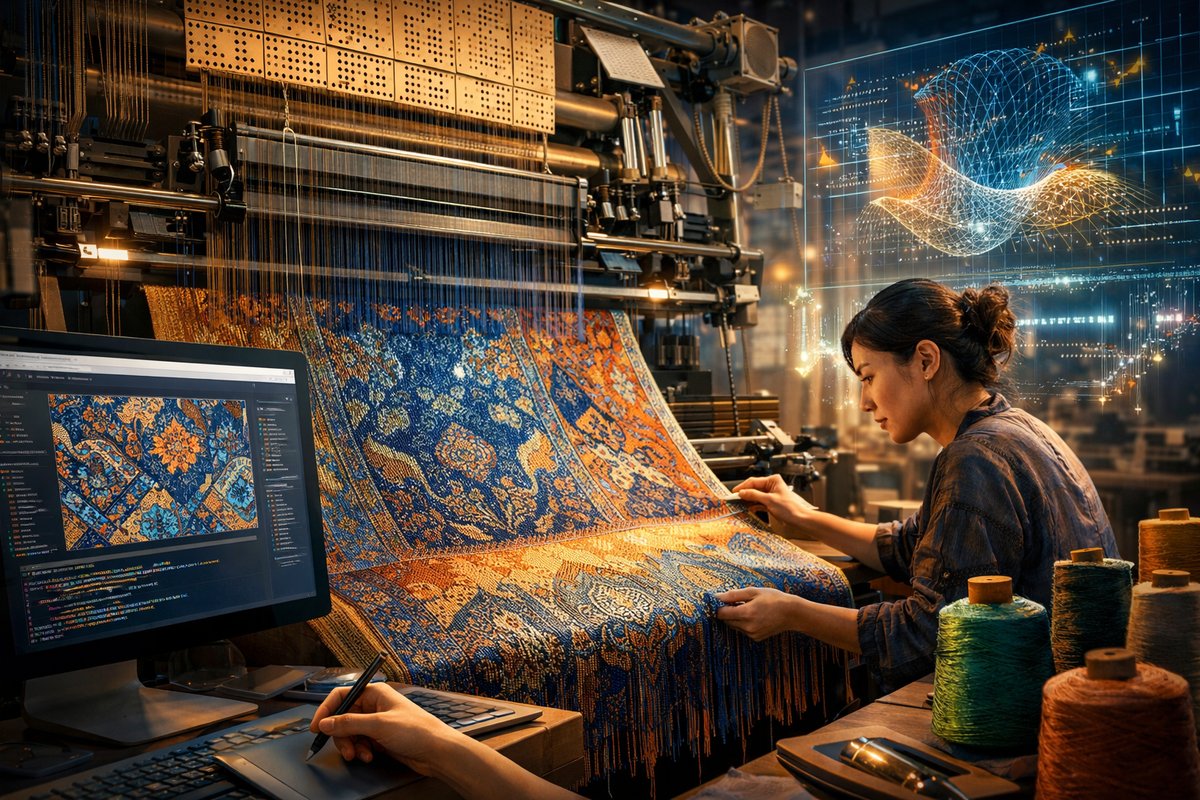

In a spacious hall at the latest Art & Tech Biennale in Berlin, visitors pause before a towering tapestry that shifts in hue and pattern every few minutes. What appears as a kinetic light installation is in fact a handwoven textile programmed by generative AI, brought to life on a modern electronic jacquard loom. Here, centuries of weaving tradition intersect with algorithms trained to invent endlessly evolving motifs, offering a glimpse into the future of textile art.
Weaving has always occupied a unique space between craft, utility, and artistic expression. Traditional looms have produced functional fabrics for millennia, while master weavers turned cloth into canvases of ritual, narrative, and status. From the intricate ikats of Central Asia to the tapestries of medieval Europe, woven textiles carried stories in thread. Today, a new chapter unfolds as designers train neural networks on vast collections of historical patterns, cultural motifs, and color studies, then translate those algorithmic designs into physical weaves with unprecedented precision.
Generative AI, which once appeared confined to digital sketches, music tracks, and language models, has begun to infiltrate the realm of textile creation. Artists feed networks with thousands of pattern samples, from eighteenth-century chintz to modern geometrics, then prompt the system to reimagine shapes, repeat sequences, and propose new color palettes in real time. The outputs can be exported as grid maps-digital blueprints that dictate how each yarn is placed on the loom, row by row and stitch by stitch.
This convergence of code and craft is not mere spectacle. Designers describe it as a collaborative process where human intuition guides the AI’s exploratory leaps. During a live demonstration at the biennale, a designer adjusted color sliders on a tablet interface while the model generated dozens of pattern variations in seconds. The operator selected a design that felt balanced, then sent it to the loom’s control panel. Within hours, the handloom-now fitted with electronic actuators-lifted its hooks in precise sequences, weaving the new tapestry under the watchful gaze of an intrigued audience.
One standout installation, “Echo Loom,” emerged from a collective of weavers based in rural Catalonia. They incorporated locally sourced sheep’s wool, dyed in plant-based pigments, into digitally driven designs. The result is a series of tapestries that pulse with gradient shifts and delicate motifs derived from both Mediterranean flora and binary code. Visitors noted how the pieces evoked the region’s traditional pastoral scenes, yet with an abstract edge that felt distinctly contemporary.
To ensure the craft element remains central, master weavers guide each AI-generated draft. In workshops that bridge urban studios and remote villages, artisans adapt the digital instructions to account for yarn thickness, tension variations, and hand finishing techniques. “The AI gives us ideas we never imagined,” says one veteran weaver. “But we still choose how the yarn moves under our hands. The machine does not replace the craft; it amplifies it.”
The pipeline from AI design to physical output involves multiple stages. First, patterns are generated or refined in a design environment that supports neural-network plugins. Next, these patterns are converted into loom-ready files-often through open-source tools that transform images into pixel maps aligned with warp and weft axes. Then comes test weaving: samples are produced on sample looms to verify color fidelity and repeat accuracy. Finally, the full-scale weaving begins, with master weavers overseeing the electronic looms and making manual corrections at key junctions.
Beyond aesthetic innovation, this hybrid approach offers environmental benefits. By using locally sourced natural fibers and plant-based dyes, the eco-footprint remains low. The AI-driven process also reduces waste: digital prototyping eliminates the need for multiple physical samples, and looms can switch designs on the fly without discarding incomplete runs. Some studios report a 40 percent reduction in material overage compared to conventional pattern development.
Challenges persist, of course. Training AI on cultural designs raises questions about intellectual property and cultural appropriation. Transparency in the data sets and credit to original artisans are hot topics among ethicists and curators. Technical hurdles also remain: not every pattern generated by the AI translates smoothly to a loom’s mechanical constraints, and manual intervention is often needed to avoid snags or tension issues. Yet advocates see these challenges as growing pains in a field still in its early experimentation phase.
Looking ahead, some designers envision networked looms in remote communities that receive new pattern files and produce textiles on demand, creating a distributed fabric-making economy. Others are exploring responsive textiles that change structure or color when exposed to heat or light, combining AI-designed patterns with smart yarns. Still more imagine virtual marketplaces where collectors bid on limited-edition digital drafts and have the woven art shipped directly from artisan cooperatives across the globe.
As the tapestry in Berlin fades from azure grids to rose-gold fractals, the crowd applauds the fusion of machine learning and human touch. It is a testament to how creativity can flourish when curiosity meets technology, and it signals a new era for textile art-one where every thread bears the imprint of algorithms and every hand still shapes the final work. In these threads of tomorrow, code and craft weave side by side, forging patterns that could never exist without both.
-
Huion Kamvas 16 (2021) Graphics Tablet, 15.6 inch, 120 ... - Walmart
Unleash your creativity with Huion Kamvas 16 (2021) Graphics Drawing Tablet. 120% sRGB, 15.6 inch, USB-C ready! -
NIMO 2026 15.6" Laptop, AMD R7 7735HS Up to 4.75GHz, Beat i7 ...
Buy NIMO 2026 15.6" Laptop, AMD R7 7735HS Up to 4.75GHz, Beat i7-12650H) 16GB DDR5 RAM 512GB SSD Gaming Laptop with Radeon 680M GPU,FHD Display, 180° View, ... -
Tranquility 15lb Cooling Reversible Removable Cover Cozy ...
Pros · Durable material. Soft and silky texture · Temperature control. Cooling for sleeping · Evenly distributed weight · Removable and machine washable. -
(3 pack) Garnier Nutrisse Ultra Nourishing Hair Color Creme ...
Buy (3 pack) Garnier Nutrisse Ultra Nourishing Hair Color Creme,Permanent Hair Dye, IN1 Dark Intense Indigo, 1 Kit at Walmart.com. -
Artograph LED LightTracer II Light Box, 12" x 18" Surface 25375
Tcwhniev Sand Painting Light Box, 16" Sensory Light Table, Adjustable ... Rechargeable A4 Copy Tracing Light Pad with Type-C Port, Ultra-Thin Painting Light Board ...