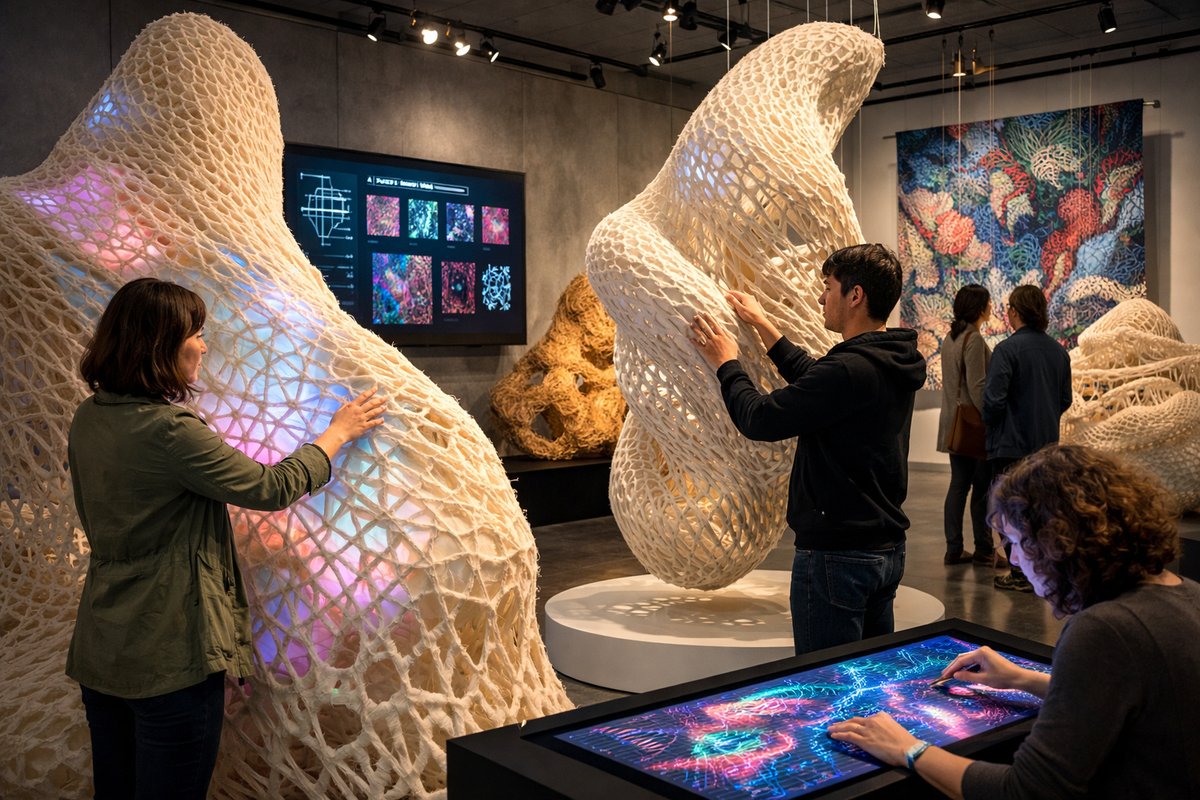

An unprecedented encounter between craft tradition and computational innovation is underway in one of the world’s leading modern art spaces. The exhibition “Tactile Futures” unfolds across two floors, transforming gallery walls and open atrium spaces into living laboratories of texture, form, and light. Rather than presenting textiles as static, framed objects, this show invites audiences to feel, bend, and even reconfigure the works themselves, all while discovering the ecological and technological narratives woven into every fiber.
At the heart of the display are a series of large-scale panels made from an algae-based biopolymer blended with recycled ocean plastics. Each panel is embedded with microscopic sensors and LED filaments, enabling surfaces to shift color or pattern in response to changes in room temperature and humidity. A silent orchestra of code interprets environmental data-sourced from sensors placed in the gallery’s rooftop garden-and triggers real-time alterations in the panels’ organic motifs. One moment, rippling coral-like tendrils in soft emerald tones; the next, fractal leaf patterns glowing amber under a pulse of light.
Nearby, another section of the show explores the marriage of generative algorithms and hand-weaving. Artists enrolled in a dedicated residency collaborated with software designers to develop custom pattern generators. These programs draw from archives of traditional weaving motifs-such as Scandinavian twills and West African indigo stripes-and recombine them through a set of rules inspired by natural growth processes. The resulting designs are then translated into thread-by-thread instructions for programmable looms. The viewer is confronted with textiles that balance symmetry and randomness, recalling cellular structures as much as ancient tapestries.
A central installation titled “Living Cloth” takes the concept further by incorporating living microorganisms. Dyed fibers are treated with a substrate that supports bacterial colonies. Under controlled lighting, the bacteria produce pigments that slowly evolve the colors of the fabric over several days. Small orchids and ferns are planted around the edges of the textile, creating a micro-ecosystem where light, moisture, and microbial life play out a symbiotic performance. Curators have framed this work as a meditation on the porous boundary between the natural and the synthetic, inviting reflection on how future textiles might be grown rather than manufactured.
Interactive stations scattered throughout the gallery provide hands-on workshops led by designers and biofabrication experts. Participants can experiment with 3D printing pens loaded with thermoplastic elastomers to sketch free-form stitches onto recycled canvas. Digital drawing tablets allow them to generate their own patterns using a simplified version of the exhibition’s algorithm. Those who prefer analog methods can mix up small batches of natural dye derived from local plants-such as nettles, madder root, and onion skins-and then imprint patterns with handmade stamps.
The curatorial statement emphasizes sustainability at every stage: from sourcing biodegradable substrate materials to designing modular display systems that can be reconfigured for future venues. Exhibit walls rest on re-purposed scaffolding, while lighting rigs are powered by the building’s solar canopy. Even the visitor guides are printed on seed paper-each brochure embedded with wildflower seeds that can be planted at home following the visit.
Throughout the galleries, quiet stations equipped with augmented reality headsets offer a digital layer of interpretation. Through these headsets, visitors can see how a given textile panel was generated step by step: from the initial code snippet to the loom’s weaving shuttle in motion. A stream of metadata floats around each virtual object, listing dye recipes, algorithm parameters, and microbial culture conditions. While the headsets fill the visual field with information, thoughtful sound design ensures an immersive yet meditative atmosphere: gentle hums, distant birdsong, and brief bursts of digital instrumentation marking pattern transitions.
The exhibition’s designers partnered with a local architecture firm to create flexible pavilions in the atrium. These semi-transparent tents, woven from recycled polyester mesh, host nightly panel discussions, film screenings, and live demonstrations. At a recent event, bioengineers took apart a patch of algae-based biopolymer in real time, illustrating how the material can be recast into rigid or elastic forms. Another evening featured a generative fashion showcase: garments that adjust their weave density and color according to crowd movement and ambient sound levels.
In an adjacent gallery, a series of collaborative installations highlights community-driven approaches to sustainable textiles. A group of residents from a nearby neighborhood contributed personal textiles-old garments, family quilts, and vintage upholstery-into a collective tapestry. Digital imaging equipment scanned fragments of each textile, extracting motifs that were algorithmically woven into a new composite wall hanging. The final piece, spanning 15 feet, evokes a patchwork of memories while embracing a forward-looking design ethos.
Educational partnerships play a significant role throughout the run of the exhibition. Local high school art classes and university textile programs have access to immersive workshops where they learn about open-source patterning software and biofabrication techniques. A pop-up maker lab in the museum’s lower level offers free access to 3D printers, laser cutters, and digital looms for young designers to prototype their own sustainable textile experiments.
Critics have praised “Tactile Futures” for bringing substance to what can sometimes feel like art-world buzzwords. Rather than a superficial marriage of technology and tradition, the show maintains a rigorous focus on materiality, process, and ecological impact. By foregrounding tactile engagement, visitors gain a visceral understanding of how textiles are constructed and how they might evolve in the decades ahead.
Audience response reflects a mix of wonder and contemplation. Some visitors express astonishment at the living microbial dyes, while others marvel at the speed with which code can transform centuries-old weaving patterns. Many leave with the conviction that textiles-long confined to fashion runways or cozy interiors-are poised to become dynamic interfaces between humans, machines, and ecosystems.
As museums and galleries worldwide grapple with the challenges of climate change and ethical resource use, “Tactile Futures” offers a hopeful model. It demonstrates that art and design can converge in ways that are technically ambitious, emotionally resonant, and environmentally responsible. Whether you’re a fiber artist, a software developer, or a curious museumgoer, this exhibition invites you to touch tomorrow’s textiles today.
If you’re planning a visit or seeking to explore similar practices in your own studio, the show provides ample inspiration. From hands-on workshops to digital open-source tools, “Tactile Futures” opens pathways for makers of all backgrounds to experiment with sustainable materials and generative design. The lesson is clear: the fabric of the future will be as alive and adaptive as the ecosystems it draws inspiration from, and its creation will depend on the collaborative ingenuity of artists, scientists, and communities working in concert.
In an era when many digital experiences push users toward screens, this exhibition stands out by celebrating the tactile. It challenges the assumption that high-tech must be intangible and underscores the profound value of hands-on creativity. As visitors depart, many pause to feel the exhibition’s textile samples one last time, mindful that this encounter may forever change how they think about the clothes they wear, the carpets underfoot, and the very notion of what a fabric can be.
“Tactile Futures” continues at the venue’s gallery wings through the season, with plans to travel to partner institutions across Europe and Asia. Whether in London, Milan, or Tokyo, the show promises to bring its immersive blend of biomaterials and algorithmic design to new audiences, fostering a global conversation about the next generation of textiles.