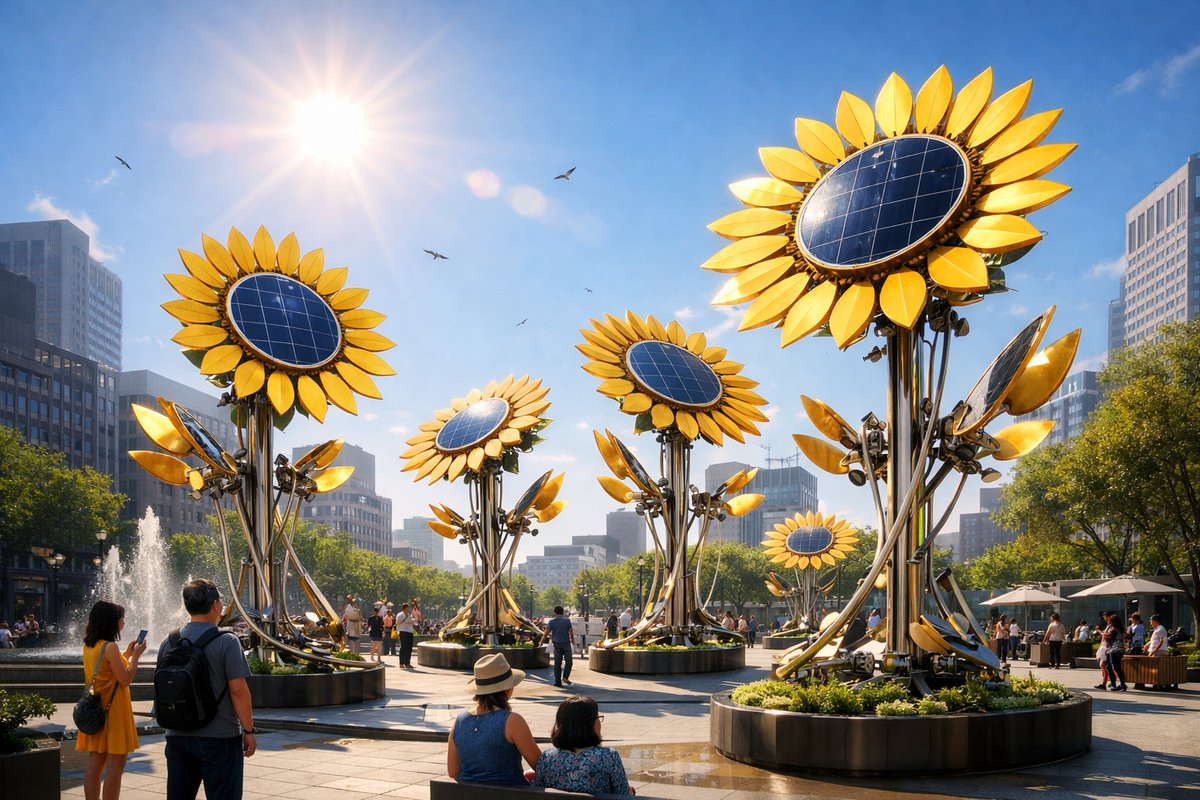

At the heart of Helsinki’s Central Plaza this spring, dozens of slender metal stems crowned with bright yellow disks catch the morning sun. As the light shifts, the disks undulate in a delicate choreography, their motion driven entirely by embedded solar sensors and motors. Onlookers pause, smartphones tucked away, drawn in by a mesmerizing interplay of light, form, and movement.
This installation, called “Daylight Bloom,” is part of a growing trend in which artists and engineers come together to create public artworks that not only reflect their environments but become powered by them. Unlike static murals or sculptures, kinetic pieces respond in real time to weather, temperature, and solar input. When the sun is strongest, the blossoms rotate more vigorously, casting playful shadows on the pavement. Cloudy days slow the dance to a gentle sway. These living sculptures demonstrate how sustainable design principles can merge seamlessly with interactive aesthetics.
“People often tell me they feel a deeper connection to the city when they witness pieces like this,” says one of the lead designers from a collective known as Radiant Bloom. “It’s not just a decorative object. It’s a system of flows-energy, light, and human curiosity-intersecting in public space.” Radiant Bloom is funded by a coalition of local arts councils and a nonprofit focused on urban sustainability. After Helsinki, the collective plans to tour the concept to Copenhagen, Amsterdam, and Melbourne.
Beyond the poetic aspects, there’s serious technical ingenuity at work. Each sunflower head contains a small photovoltaic panel feeding a storage capacitor. A microcontroller measures the charge and triggers a miniature motor to tilt or rotate the disk toward peak illumination. A simple algorithm ensures the movements remain fluid and unhurried. Because the electronics are sealed inside weatherproof enclosures, the sculptures can endure rain, snow, and gusting winds. Maintenance teams check on each piece monthly, synchronizing firmware updates over the air to refine motion patterns.
This marriage of art and engineering is part of a larger shift in public installations. Cities worldwide have begun issuing grants specifically for works that incorporate renewable energy or environmental sensors. In Seoul, a recent exhibit displayed benches that charge devices via solar roofs. In Buenos Aires, fountains equipped with tiny turbines turn spilled water into electrical feedback, powering colored LEDs at night. Each of these projects invites viewers to consider how energy circulates in familiar urban contexts.
Critics of public art often argue that it can be expensive or disconnected from everyday life. But the economic case for solar kinetic installations is gaining traction: after the initial outlay for materials and labor, ongoing power costs are zero, and the novelty attracts foot traffic, boosting nearby cafés and shops. A preliminary study in Helsinki reported a 15 percent increase in pedestrian dwell time around Central Plaza during the first month of the exhibit. Local business owners noted customers lingering around the sunflowers long enough to stop for a coffee or browse pop-up art stalls.
Beyond commerce, there’s an educational dimension. By situating visible solar panels in plain sight-or disguised as sunflower petals-these artworks demystify the technology. Children studying science can watch real-time demonstrations of how solar conversion works, while adults often engage in conversation about renewable solutions for homes and public infrastructure. The pieces become conversation starters, subtly prompting viewers to consider where else solar power might belong.
Designing for scale was a challenge. The collective experimented with models ranging from small desktop prototypes to oversized 20-foot-high installations. Ultimately, they settled on stems about 8 feet tall-tall enough to catch unobstructed sunlight in open plazas but still within reach for maintenance crews. Disassembly is built into the design: a ratcheting joint at the base allows each stem to fold down for storm preparation or transport. When packed into reusable crates, the entire exhibit can be shipped by rail, minimizing its carbon footprint.
Inside the local maker spaces that helped build Daylight Bloom, volunteer programmers and welders worked alongside horticulturists advising on color palettes. Instead of a typical shiny metal finish, the disks were coated with eco-friendly paint derived from plant oils, chosen for vibrancy and weather resistance. Raw materials include recycled aluminum for the stems and non-toxic plastics for the photovoltaic housing. By documenting every sourcing decision online, Radiant Bloom hopes to inspire other teams to adopt transparent, low-impact practices.
“The best public artworks are those that reflect the values of a community,” says a city planner overseeing the program. “Helsinki citizens asked for more green, more interactivity, and greater sustainability. This project answered that call on all three fronts.” In the months since installation, residents have formed guided “sunflower walks,” local artists have created sidewalk chalk renditions of the sculptures, and neighborhood schools have scheduled field trips to study the exhibit up close.
Some observers have compared the kinetic sunflowers to the famous sun-tracking photovoltaic arrays used in commercial solar farms. But whereas industrial trackers optimize for maximum electricity yields, these sculptures emphasize nuance and expression. The movements are deliberately calibrated to mimic plant phototropism-slow, responsive bending toward light-rather than relentless mechanical pursuit. Here, the art doesn’t chase perfection, but rather embraces unpredictability: a passing cloud might trigger a sudden tilt, a gust of wind might knock a blossom slightly askew, and these variations become part of the installation’s evolving narrative.
Looking ahead, Radiant Bloom is exploring hybrid installations that integrate air-quality sensors, particle counters, and humidity gauges. The data would be visualized through subtle changes in movement or light color. A dusty day might produce muted gold tones; a high-humidity afternoon could trigger a gentle pulsing. By layering environmental information into the gestures of sculpture, the team hopes to cultivate a heightened awareness of local conditions-transforming invisible metrics into tangible, multisensory experiences.
This intersection of design, sustainability, and technology speaks to a broader curiosity about how art can shape our relationship with the natural world. In cities where concrete and steel often dominate, these kinetic sunflowers beckon viewers to notice light, track its path, and reflect on the energy that powers our daily lives. As they sway in the breeze and track the sun, they remind us that even in urban centers, nature’s rhythms are never far away.
When asked what drives the collective forward, one member offers a simple answer: “We wanted to see art move, literally, and have that motion fueled by the same star that makes life possible on Earth.” With that ambition realized, the sunflowers stand as a testament to creativity unbound by static forms-and to a future in which public art and renewable energy grow hand in hand.
Readers hoping to bring a spark of solar kinetic art into their own creative practice can explore open-source schematics and code samples shared by Radiant Bloom, available on the collective’s website. Whether you’re an urban planner, a hobbyist tinkerer, or an art enthusiast, the tools to experiment with light-driven motion are more accessible than ever. After all, every sunny day holds the potential for a new bloom.