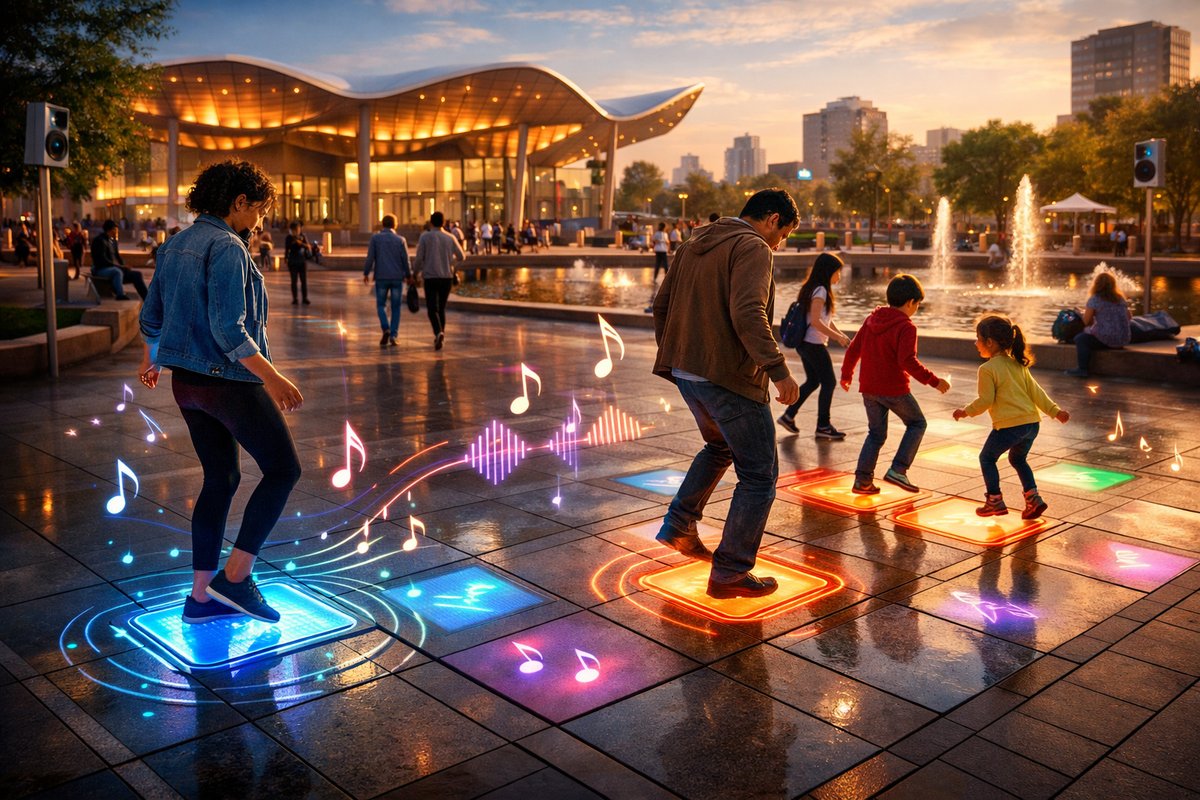

On a sunny afternoon in a bustling city center, pedestrians paused to explore a plaza that seemed to hum beneath their feet. Rather than plain stone pavers, the square was composed of mosaic-like wooden panels and modular tiles, each rigged with hidden piezoelectric sensors. As people walked or danced across the surface, the floor responded with melodies, percussive clicks, and ambient drones calibrated to footfall patterns. This novel installation, dubbed “Symphony Surface,” marks a turning point in how architectural materials and sound technology can merge to create living, interactive spaces.
The idea of kinetic flooring isn’t entirely new, but the convergence of affordable sensors, open-source audio software, and lightweight structural panels has unlocked a wave of possibilities. At the core of Symphony Surface lies a network of discreet piezo elements beneath each panel, wired to a local control hub hidden below the plaza. When pressure is applied-by a passerby’s shoe or a playful leap-the sensors convert mechanical stress into electrical signals. Those signals are then routed through a digital audio workstation set to respond with curated sonic samples and generative tones.
In collaboration with local sound artists, landscape architects designed custom compositions that range from rhythmic claps to ethereal swells. Early visitors described the effect as both magical and empowering. One user remarked, “It’s like playing an invisible piano with my feet,” while another noted how the collective movement of the crowd generated evolving harmonies, effectively turning the plaza into a spontaneous orchestra pit.
Beyond the immediate delight of public engagement, kinetic soundfloors are prompting a reconsideration of how cities shape social interaction. Traditional plazas serve as static backdrops for gatherings, but when the ground itself becomes expressive, the space encourages un-choreographed performances, cooperative exploration, and a heightened sense of presence. City planners envision a future in which urban squares double as community instruments, forging stronger connections among diverse populations.
Material innovation has been crucial to realizing this vision. Early prototypes relied on heavy concrete slabs with surface-mounted sensors, which proved costly and difficult to maintain. The current generation of panels uses sustainably sourced hardwood veneers bonded to a sandwich of lightweight composite layers. This assembly not only houses the sensor array but also amplifies the acoustic output, creating a more resonant tone without external speakers.
To address weather and wear concerns, engineers treated the wood with eco-friendly sealants that resist moisture and UV damage. Beneath the surface, rigid supports maintain tile alignment under heavy foot traffic, while quick-release clamps let maintenance teams swap out faulty modules within minutes. The modular approach accelerates repair cycles and enables future upgrades-whether new sensor types or fresh audio libraries-without reconstructing the entire plaza.
During the pilot phase, the installation logged more than 50,000 footsteps within its first week. Data scientists tracking real-time metrics observed patterns in traffic flow, dwell times, and collective behavior. These insights not only inform sound mapping choices but also offer urban planners a new lens on how public spaces are used. By anonymizing and aggregating footfall signals, researchers can map popular routes, identify underutilized zones, and design more inclusive layouts.
Experts believe that as sensor costs continue to fall, we’ll see kinetic floors extend beyond high-profile plazas into airports, museums, schools, and retail environments. In educational settings, soundfloors could be programmed with musical scales or language drills, turning movement into a playful learning experience. In office lobbies, they might generate calming ambient sound based on occupancy levels. The flexibility of open-source audio platforms means designers can rapidly prototype new auditory behaviors tied to any number of inputs-including temperature, light, or air quality sensors.
Of course, realizing these scenarios raises questions around privacy, maintenance, and accessibility. While piezoelectric sensors collect only pressure data, there is potential for more intrusive modules, such as cameras or weight scales, to be integrated. Thoughtful governance models and transparent data policies will be essential to ensure public trust. From a maintenance standpoint, standardizing tile dimensions and sensor interfaces across installations can reduce costs, but it may also limit artistic freedom. Striking a balance between modular efficiency and custom expression will be a key challenge for designers.
Accessibility advocates have lauded the installation’s inclusive design. Low-profile transitions between tiles ensure wheelchair-friendly surfaces, and customized audio mappings can cater to visitors with hearing impairments-for instance, by pairing induced vibrations with tactile flooring elements. In one test, participants who rely on touch and vibration reported a deeper connection to the space when subtle pulses were synced to bass frequencies beneath the floor.
The emergence of kinetic soundfloors reflects a broader shift in how we think about public art and participatory design. No longer confined to static murals or isolated sculptures, this new frontier invites audiences to become co-creators. Whether walking alone at dawn or joining a flash-mob performance at dusk, individuals become active contributors to the sonic landscape, blurring the lines between creator and observer.
At a recent design symposium, pioneering urbanist Marisol Vega noted, “Kinetic soundfloors are about redistributing agency. They challenge the one-way relationship we have with built environments and invite a two-way dialogue. The architecture listens to us, and we, in turn, listen with our bodies.” Such philosophical undercurrents underscore the importance of emotional intelligence in shaping future installations. Designers must consider the psychological impact of sonic feedback-too much noise can overwhelm, while carefully calibrated silence can be just as powerful.
Looking ahead, interdisciplinary teams are exploring hybrid systems that combine soundfloors with projection-mapping and responsive lighting. Imagine an installation that not only plays notes but also cascades shifting patterns of color across walls in sync with footfalls. Or one that diffuses gentle mist triggered by high-intensity movement, adding a tactile dimension to the performance. These multisensory canvases promise richer experiences, but they also demand closer collaboration across fields-from acoustics and material science to interaction design and environmental psychology.
Manufacturers are eyeing the growing interest, developing turn-key solutions that package pre-configured tiles, sensor modules, and cloud-based audio engines. However, many within the art community caution against over-standardization. “When everything can be bought as a kit,” warns sound artist Kai Liu, “we risk losing the spirit of experimentation that makes each installation unique.” A healthy ecosystem will likely include both customizable toolsets for DIY creators and premium bespoke services for large-scale public art commissions.
For city authorities and cultural institutions considering their first kinetic soundfloor, experts recommend starting small. Pop-up pilots in plazas or pop-off-grid projects in community gardens allow teams to gather user feedback and fine-tune sonic vocabularies. They also build public awareness and excitement, laying the groundwork for more ambitious deployments. Workshops with local artists, technologists, and residents can help co-create sound palettes that reflect regional identities and shared narratives.
Back at Symphony Surface, children were composing polyrhythms, joggers discovered meditative drones under their steady strides, and tourists stopped to record videos of their steps turning into sound. The plaza, once an overlooked patch of paving stones, had become an ever-evolving stage for human expression. In an era where screens dominate our attention, the kinetic soundfloor stands out by refocusing our gaze downward-reminding us that movement itself can be both a gesture and an instrument.
As urban environments grow smarter and more connected, the boundaries between architecture, technology, and art will continue to blur. Kinetic soundfloors may be one of the earliest examples of living infrastructure that responds to human presence in real time. They invite us to ask: If our cities can speak back to us, what music will we make together?
-
ERP B5002 Oven Bake Element Replaces 318255006 - Walmart.com
Find high-quality Bake Elements for Frigidaire, Tappan, AP5590131, PS3633414, 318255006 at Walmart! -
HiLetgo 5pcs Piezoelectric Sensor Analog Ceramic Vibration ...
HiLetgo 5pcs Piezoelectric Sensor Analog Ceramic Vibration Sensor Module Piezoelectricity for Arduino DIY KIT: Amazon.com: Industrial & Scientific. -
Patterned Duck Tape, 1.88" x 10yd - Walmart.com
Duct Tape; 1.88 in x 10 yd. Check local building codes for HVAC use. Suitable for use at no more than 200 degrees F (93 degrees C). -
Chibitronics Conductive Fabric Tape Strips - Amazon.com
EASY TO USE - Fabric Tape Strips are easier to remove from the backer material than Conductive Fabric Tape Rolls. ... Conductive Fabric Tape roll, 4mm Width, 32 ...