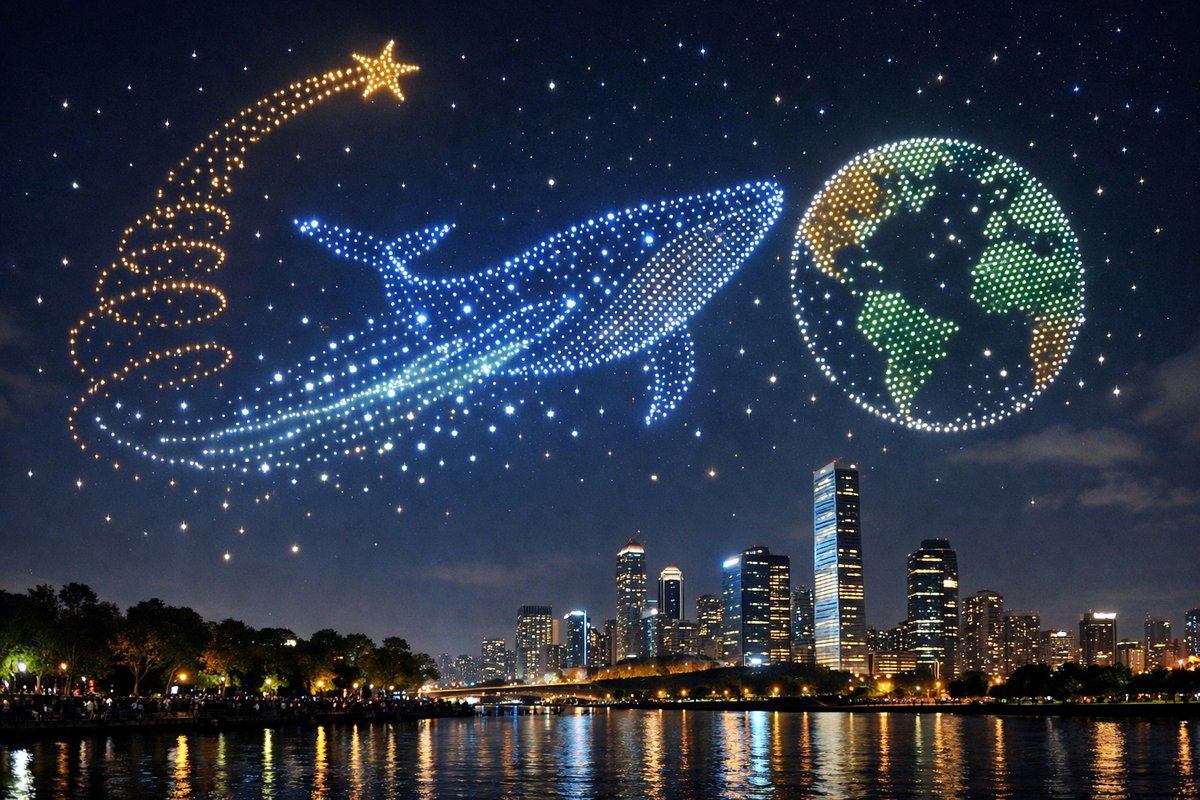

Just after dusk, the horizon above a central plaza pulses with color. Dozens of drones lift off in unison, their LED-tipped arms tracing geometric patterns that seem to hover in midair. Within seconds, a shifting constellation appears: an abstract phoenix in flight, followed by rippling waves of cobalt and amber. The crowd gasps as the formation dissolves into a cloud of tiny lights, only to reassemble into a soaring archipelago of islands. This is not a fireworks finale – it is the latest iteration of the drone light show, a rapidly emerging form of public art that marries engineering, environmental awareness and interactive storytelling.
In cities around the world, cultural festivals and municipal celebrations increasingly feature choreographed drone swarms instead of exploding shells. Recent programs have ranged from a 1,000-unit performance over a waterfront festival to a 500-drone display commemorating a historic city anniversary. Organizers cite several advantages: drones are reusable, produce far less noise and air pollution than pyrotechnics, and can be precisely controlled to respond to real-time data such as wind speed, air quality or audience input. Gone are the days when a single blast of color had to suffice; now art can evolve mid-flight, guided by sensors, smartphone apps and creative code.
At the heart of each show lies a design process that resembles 3D animation more than traditional sculpture. Artists sketch patterns in software, mapping out flight paths that avoid collisions while optimizing visual impact. Each drone’s LED cluster is assigned a color timeline, enabling complex gradients and transitions that flicker or fade with musical accompaniment. Some teams even build custom simulators that let the public preview formations in virtual reality, fostering community buy-in before the first takeoff. The result is a democratized approach to large-scale art, where spectators can influence the choreography by sending text messages or tapping options in a mobile interface.
“The sky becomes our canvas,” says one lead designer whose collective recently staged a performance in a European capital. “But unlike a painting, this canvas moves, breathes and can transform on demand. We can reflect the city’s energy, its air quality readings or the pulse of the crowd. It’s a living work that exists only in that moment.” This emphasis on ephemerality speaks to an emotional intelligence rarely explored in static installations. By making the art transient, designers encourage deeper appreciation for the here and now.
Sustainability advocates have welcomed drone shows as a greener alternative to fireworks. Traditional pyrotechnics emit smoke and particulate matter that can linger for days, affecting air quality and triggering respiratory issues. In contrast, modern lithium-ion batteries power LED arrays with minimal residue. Noise levels also drop dramatically; audience members report feeling more immersed in the visual narrative rather than startled by booming blasts. Planners often pair shows with local clean-energy initiatives, using solar-charged ground stations to refresh drone batteries or powering launch platforms with portable hydrogen cells.
Interactivity takes many forms. In one recent event, visitors scanned a QR code and entered a color choice on their phones. Within minutes, the entire fleet shifted to reflect the most popular hue, creating a collective work that celebrated communal decision-making. In another, real-time data from an air quality sensor network modulated the intensity of each drone’s glow: higher pollution levels triggered deeper reds, while clear skies resulted in pale greens and blues. This data-driven approach turns what might be a passive spectacle into a participatory dialogue about urban health and environmental stewardship.
Behind the scenes, the technical backbone relies on resilient communication protocols and failsafe systems. Each drone carries redundant positioning modules-GPS paired with local radio beacons-to maintain formation even if satellite signals waver. Self-diagnostic routines monitor battery voltage and motor temperature, guiding each unit back to its charging station before a risk arises. Organizers coordinate with aviation authorities to secure temporary flight corridors, ensuring no conflicts with commercial air traffic or emergency response zones. Weather forecasts are monitored down to the minute, since strong gusts can scatter formations and compromise safety.
Challenges remain. Regulatory hurdles vary by region, and obtaining airspace waivers can take months. Urban canyons-dense clusters of high-rise buildings-interfere with GPS precision and radio links, requiring careful site surveys. At low altitudes, drones must navigate tree lines, lamp posts and power cables. Even so, enthusiasts and municipal planners are forging ahead, driven by the allure of a sustainable, dynamic art form that can be tailored to any theme-from holiday celebrations and cultural festivals to climate-action campaigns and corporate branding.
Looking forward, artists envision deeper integration with augmented reality. Festival-goers equipped with AR glasses could see virtual extensions of the drone formations-sculptural details only visible through digital overlay. Remote audiences might tune into 360-degree livestreams, choosing angles and triggering special animations via web interfaces. Some designers are experimenting with tethered “jacobs ladder” drones that combine aerial illumination with ground-mounted projection mapping, creating hybrid installations that blur the line between screen-based video art and airborne sculpture.
Educators are taking note, too. After-school workshops teach teenagers how to code flight patterns, design LED effects and build miniature fleets out of recycled components. University labs study how swarm intelligence algorithms can optimize pattern transitions and energy use. The learning opportunities span computer science, environmental science, design and project management, making drone art a multidisciplinary gateway for the next generation of creators.
In a world where public spaces often feel over-saturated with billboards and static sculptures, drone light shows offer a fresh approach: art that can rise above the urban clutter, then dissolve without a trace. This ephemerality invites audiences to be fully present, to marvel and then let go. As the technology matures, these skyward canvases may become a nightly ritual, seamlessly woven into city life. For now, they stand as a testament to human ingenuity-and as a glowing emblem of how art and design can evolve in the age of connected devices and environmental awareness.
Ephemeral, data-driven and endlessly customizable, drone light shows are pushing the boundaries of public art. With every new flight pattern and interactive feature, they remind us that the sky above is not just empty space, but an open invitation to reimagine the very nature of shared experience.