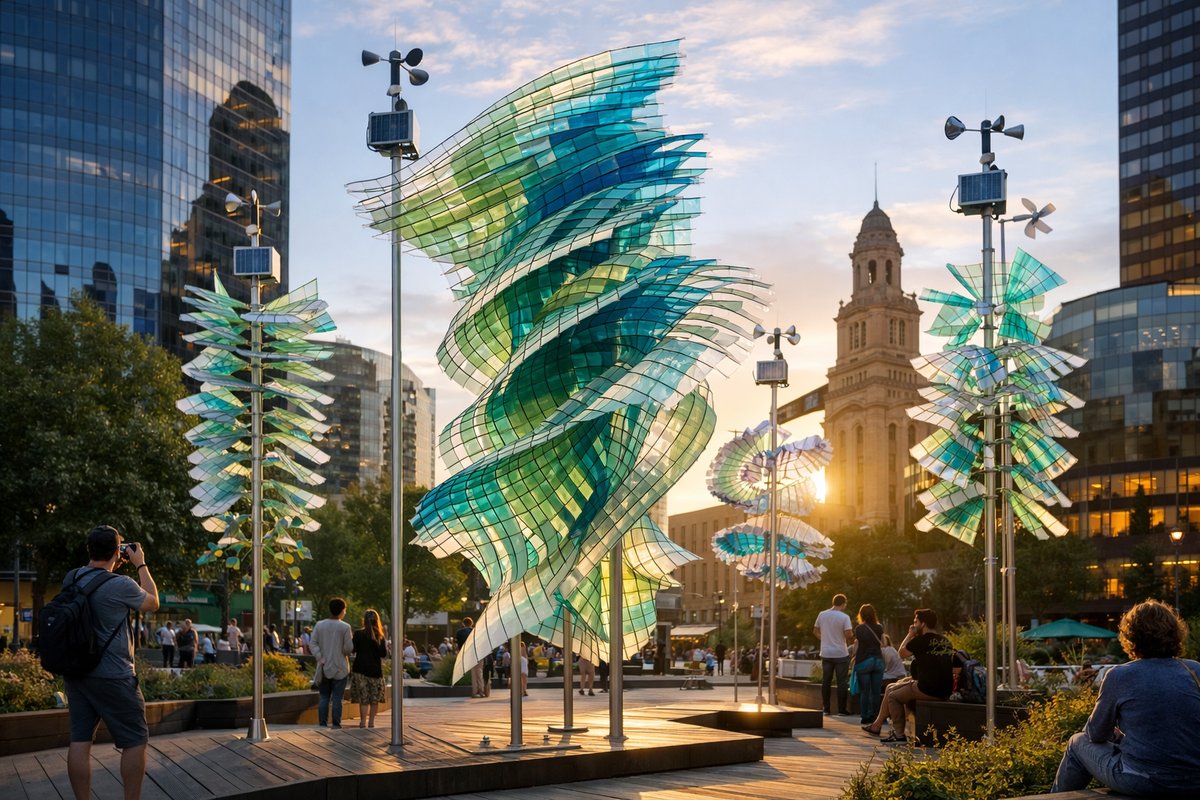

Across busy boulevards and quiet riverwalks, a wave of eco-responsive sculptures is quietly reshaping how people experience public space. These installations don’t rely on traditional stone or metal alone. Instead, they use recycled plastic granules, UV-curable resins, sensor-driven electronics, and modular construction to create forms that bend, sway, and glow in response to the slightest breeze. The result is an ever-changing dialogue between environment and design, where invisible forces become visible.
At the heart of each installation lies a philosophy of curiosity and sustainability. Designers source post-consumer PET pellets-collected from local waste streams-and blend them into custom filaments for on-site 3D printing. These recycled plastics form the skeletal ribs of a sculpture, extruded into organic curves that mimic leaves, waves, or abstract geometries. Once printed, each segment is assembled into a larger latticework capable of flexing in the wind.
But structure alone wouldn’t capture the spirit of change. Engineers embed anemometer modules and barometric sensors into discreet housings within the lattice. These environmental sensors feed real-time data to a microcontroller board tucked beneath the base. When wind speed crosses predefined thresholds, servo motors pivot hinged joints, causing panels to rotate or petals to unfold. On calm days, hidden springs return the form to its resting shape. The choreography is subtle yet mesmerizing, transforming gusts into living motion.
To add a nocturnal dimension, strands of addressable LED light strips snake along key edges. As daylight fades, the microcontroller triggers a light sequence that mirrors the day’s wind patterns-gentle breezes glow with soft ambers, while high gusts ignite vivid blues and greens. A layer of UV-curable epoxy over each light strip seals electronics against moisture, ensuring the installation weathers rain and dew.
One recent installment, dubbed “ZephyrWave,” stands on a riverbank promenade in a mid-sized city. Constructed as a series of overlapping fins, it reacts not only to the river’s thermal currents but also to passing boats and human footsteps. Local engineers linked the sculpture to municipal weather feeds, allowing it to anticipate approaching storms. The community has embraced ZephyrWave as both landmark and living weather vane: joggers time their runs by the sculpture’s motion, and photographers flock there at dusk for its luminous performance.
Residents describe an emotional connection that transcends typical public art. “I see a visual heartbeat,” says a student who passes the installation daily. “It reminds me that our city is alive, always shifting.” Children dart around its base, excitedly guessing which fin will flicker next. Seniors gather on nearby benches, noting how the sculpture’s patterns reflect the day’s weather-an informal forecast rendered in three dimensions.
Yet crafting such responsive art poses technical challenges. Early prototypes suffered from sensor drift and failed waterproof seals. Design teams had to iterate enclosure geometries, swap out off-the-shelf anemometers for marine-grade alternatives, and recalibrate microcontroller code to dampen false triggers. Modular brackets now allow quick replacement of faulty motors or sensor boards without dismantling the entire piece.
Scalability also proved critical. By standardizing the printed panel design and electronics housing, the studio behind ZephyrWave can replicate dozens of units for different parks or plazas. Each module snaps together with locking clamps, and power can be delivered via solar-charged battery packs or low-voltage lines hidden beneath paving stones. The plug-and-play approach cuts installation time and maintenance budgets, making eco-responsive sculpture feasible even for smaller municipalities.
Central to the ethos is a commitment to closed-loop materials. At the end of each installation’s lifecycle, every plastic component can be shredded, re-pelletized, and reused. The UV-curable resin overlay, formulated with biodegradable additives, breaks down under industrial composting. Even the electronics are housed in recycled aluminum shells that staff can reclaim and repurpose into future sensor mounts.
Beyond their technical prowess, these sculptures signal a deeper shift in public art’s role. No longer static monuments, they act as collaborators with their environment-listening, adapting, and reflecting ecological rhythms. They merge digital control with analog materials, inviting viewers to consider the interconnectedness of technology, nature, and community.
Curators and city planners are taking note. One urban art festival has commissioned a dozen wind-driven pieces for its next edition, encouraging artists to prototype new sensor configurations-humidity-sensitive membranes that rustle like leaves, pressure plates that detect footfalls, even sonic pickups that translate ambient noise into flickering pulses of light.
Looking ahead, designers envision multisensory expansions: integrating mist emitters to create transient vapor plumes, embedding small speakers to turn wind data into generative soundscapes, or adding thermal-responsive pigments that shift color under sunlight. Each layer aims to deepen emotional engagement and spark curiosity about the hidden forces shaping urban life.
For emerging creatives and makers, these projects offer a template for experimentation. With an affordable desktop 3D printer, a handful of recycled polymer pellets, an Arduino-compatible board, and a basic anemometer sensor, anyone can prototype a miniature wind-responsive model. From there, scaling up demands material know-how, weatherproofing strategies, and community collaboration-skills that enrich both art practice and environmental stewardship.
In an era grappling with climate uncertainty and rapid urbanization, eco-responsive public art offers more than aesthetic delight. It prompts passersby to notice the breeze on their skin, the shifting currents around buildings, and the dynamic interplay of human-made structures with natural forces. By making the invisible visible, these installations cultivate empathy for the elements that sustain life in our cities-and inspire us to design with nature, not against it.
Whether featured in bustling plazas or tucked into neighborhood greenways, these sculptures stand as testaments to human ingenuity and environmental curiosity. They remind us that art can be a living, breathing collaborator-one that bends in the wind, glows in the dark, and whispers the secrets of the air.
-
amomii Testudo Soldering Practice Kit, Build 3 Gadgets, Arduino ...
Amazon.com: amomii Testudo Soldering Practice Kit, Build 3 Gadgets, Arduino Compatible | Digital Piano, Game Console and Keypad Projects, Microcontroller ... -
0-60m/s Ultrasonic Wind Speed Wind Direction Sensor Module 360 ...
Less wear and long service life; No angle limit, can measure wind speed and direction data at the same time; Adopting the random error identification ...