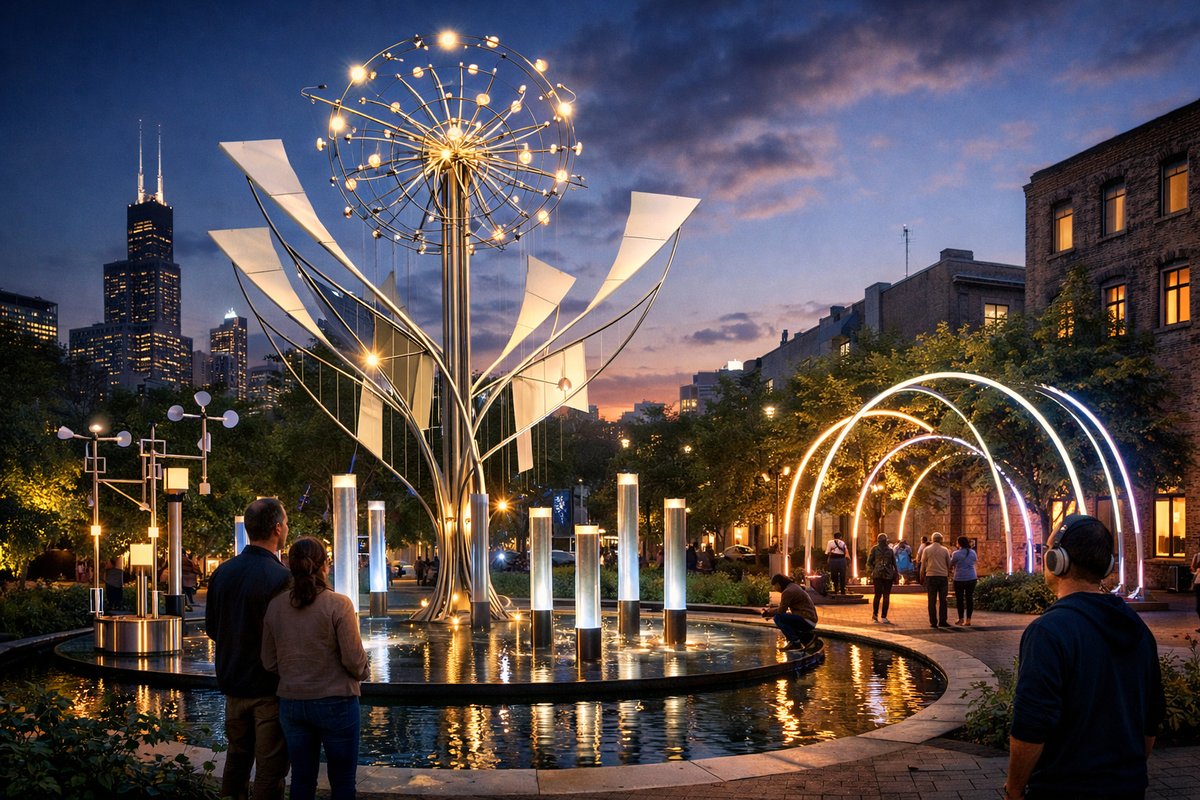

On a crisp morning in Millennium Park, a new visitor attraction greets joggers and strollers: a cluster of slender metallic arms punctured by glowing LEDs, gently swaying in time with distant traffic. At the heart of this sculpture, called “EchoPulse,” lies an array of sensors that read ambient noise levels and wind speed. Each gust or car horn prompts a subtle shift in the sculpture’s motion, while microphones pick up footsteps and chatter, translating them into pulsing lights and smooth robotic gestures. This is the latest in a growing movement of interactive, kinetic installations that blend art, engineering, and environmental awareness.
EchoPulse debuted this spring as a collaboration between a collective of sound artists and a team of robotics designers. The artists wanted to make urban noise perceptible in new ways, turning the cacophony of city life into an improvised symphony of movement and light. Engineers contributed custom microcontroller boards and servo motors optimized for outdoor use, while local fabricators cast the arms in recycled aluminum. The result is a sculpture that not only responds to its surroundings but does so with an elegant physical language-a choreography of metal and light that feels both organic and futuristic.
This trend isn’t limited to Chicago. In Berlin, a courtyard installation called “BreatheLines” uses temperature and humidity sensors to animate a web of fine cables and paper panels. As humidity rises, the cables tighten and the panels crease, creating shifting geometric patterns that echo the fluctuations of the air. Visitors are invited to step inside the web and feel how the sculpture adapts around them. The designers emphasize sustainability: the panels are made from biodegradable fiber composites, and the power system relies on rooftop solar panels. By making invisible atmospheric changes visible, BreatheLines invites a pause for reflection on how our bodies and built environment are enmeshed with the climate.
At a recent design conference in Tokyo, a prototype called “Pulse Weave” stole the show. This piece combines motion-capture cameras and robotic looms to translate live human movement into tapestry in real time. Dancers in a studio space are tracked by infrared cameras; their gestures are converted into weaving instructions for a row of industrial-grade textile robots. The resulting fabric scroll emerges layer by layer, embedding the memory of each performance in its warp and weft. Such experiments merge traditional craft techniques with state-of-the-art automation, prompting questions about authorship, collaboration, and the future of handmade production.
Across these diverse projects, several themes emerge. First is the idea of art as a living system: not static but in constant dialogue with environment and audience. Kinetic artworks like EchoPulse or BreatheLines become co-creators in the moment, improvising movements that reflect real-world conditions. This approach fosters curiosity, inviting passersby to engage physically and intellectually with phenomena they might otherwise overlook.
Second is the emphasis on modular, open-source hardware and software. Many teams now publish their microcontroller code and wiring diagrams online, enabling artists around the world to adapt and remix the concepts. This ethos of collaboration extends the lifespan of projects and builds a community of practice around interactive kinetic art. It also aligns with values of privacy and ethical tech: open platforms allow peer review of data handling protocols, ensuring that sensor data remains anonymous and is used strictly for artistic expression rather than tracking individuals.
Third is a deep regard for sustainability-not just in choice of materials but in lifecycle thinking. Recycled metals, biodegradable polymers, energy harvesting, and solar power are common strategies. Some installations are designed for seasonal assembly and disassembly, with components repurposed in new artworks. This circular approach reframes public art as a renewable resource rather than a one-off spectacle.
Curators and city planners are taking notice. A recent urban arts grant program in Vancouver prioritized proposals that integrate environmental data and renewable power. One winning project, “TideSongs,” will use tidal sensors to animate a floating platform with hydraulically actuated fins. As the water level changes, the fins will shift position, producing both visual patterns and low-frequency gurgling sounds. Organizers hope TideSongs will deepen residents’ connection to the waterfront and inspire stewardship of marine ecosystems.
The technological backbone of these works often includes microcontroller boards paired with expansion modules for sound, light, and motion. Wireless connectivity enables remote monitoring of performance and diagnostics, but many teams favor local data processing to reduce latency and keep data private. Advances in battery technology mean installations can run for weeks without maintenance, even in remote locations, opening up possibilities for eco-art in national parks or desert sites.
Art critics have begun to develop new vocabularies for these hybrid works. Rather than calling them merely “interactive,” some refer to “responsive kinetic systems,” highlighting the feedback loops between sensors, processors, and actuators. The tone of public engagement also shifts: viewers are less passive, more implicated in the creative process. This changes the emotional dynamic, encouraging empathy not only with the artwork but with the underlying environment-be it city noise, wind patterns, or tidal flows.
Yet there are challenges. Outdoor installations face weather extremes, vandalism, and the wear and tear of public access. Ensuring long-term durability requires rigorous testing of materials and electronics. Some artists worry that greater technical complexity could overshadow aesthetic concerns, leading to gimmicky installations rather than thoughtful experiences. To address this, many teams include material scientists, environmental engineers, and community stakeholders in the design process, aiming for balance between spectacle and substance.
Education is another frontier. Universities and maker spaces are launching workshops that teach both artistic design and embedded programming. Students learn to solder, write firmware, craft motion algorithms, and consider ethical implications of sensor deployment. By bridging disciplines early, these programs cultivate a new generation of artists who speak the language of code and metal alongside color theory and composition.
Looking ahead, we can expect more immersive environments that integrate virtual and physical layers. Imagine an installation where AR headsets overlay virtual brushstrokes on a kinetic sculpture, or where machine learning algorithms predict crowd movement to choreograph light shows. As computing power grows and hardware costs fall, the barrier to entry drops for experimental teams. What remains essential is curiosity-the desire to see the unseen and to give it form in a way that touches our senses and prompts reflection.
Responsive kinetic art represents a shift in how we think about public space and the role of technology in our daily experience. By treating environmental data as raw material for creative exploration, artists and engineers invite us to slow down, notice patterns, and recognize the hidden rhythms of our world. Whether it’s a network of swaying rods in Chicago or a living tapestry in Tokyo, these works remind us that art can be a dynamic partner in our conversation with the planet.
As communities around the globe invest in these interactive experiences, they also invest in the skills and infrastructure needed to support them. Open-source toolkits, sensor platforms, and sustainable materials are laying the groundwork for a future where public art is not a static monument but a living, evolving presence in our cities and landscapes. In that future, every gust of wind, murmur of conversation, or shifting tide becomes part of a grand ballet-a resonant reminder that art and life are deeply intertwined.