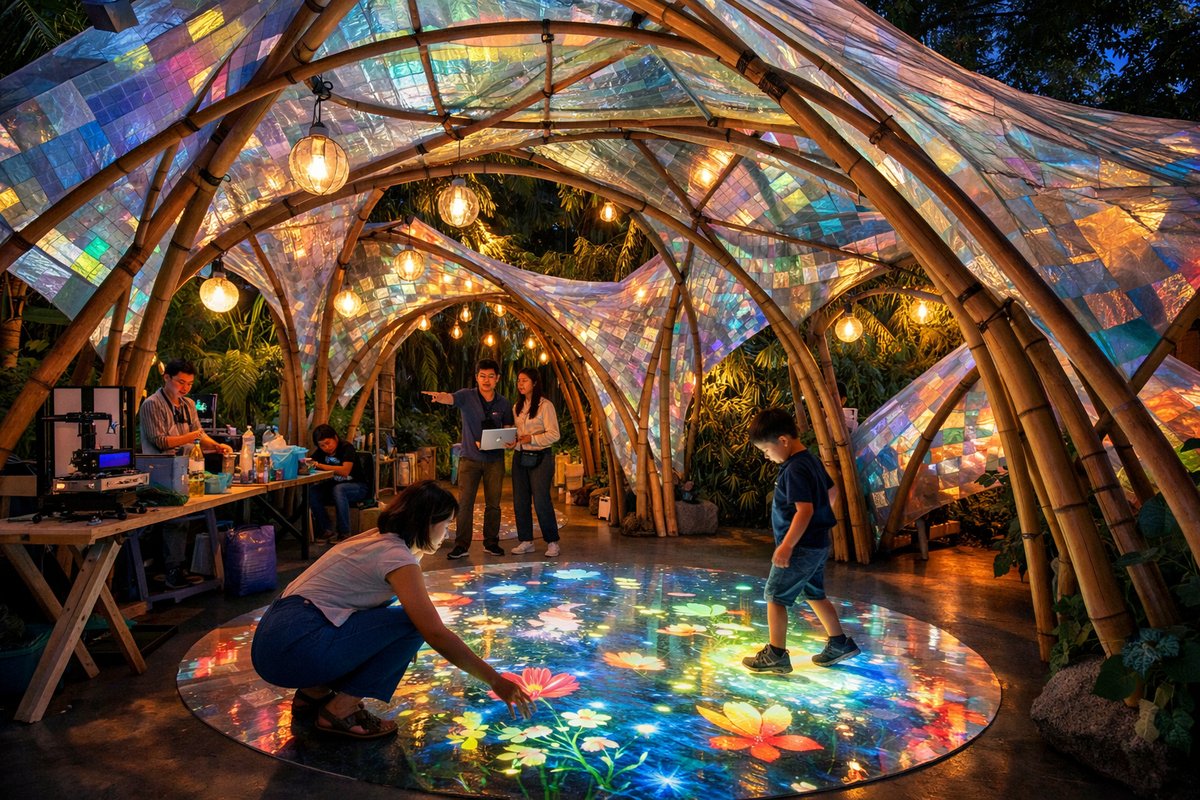

In the heart of the city’s riverfront park, visitors now encounter an undulating canopy of translucent panels harvested from post-consumer plastic bottles. Hovering above the walkway, this kinetic installation ripples in the breeze like a marine creature caught between sea and sky. Beneath the shifting surface, programmed LED spotlights trace patterns along repurposed bamboo columns. Nearby, an interactive projection invites passersby to reshape the digital rendering of the form simply by changing their posture.
The collective behind the installation describes it as a celebration of “material memory.” Every ingot of recycled resin carries a history-bottles once used for water, juice, or cleaning supplies now dance in the twilight on bamboo scaffolding. By casting plastic fragments into modular panels, the designers transformed what is often regarded as waste into something ethereal. The public encounter is intimate: visitors can tap a sensor on the base of a column to shift the overhead pattern from gentle ripples to wild, almost flame-like waves.
This project is part of a broader wave of eco-art that has gained momentum in recent months. As concerns about climate change and landfill overflow intensify, a growing number of artists and designers are exploring second-life materials, low-impact adhesives, and passive energy systems. Museums and city councils alike have begun commissioning works that foreground sustainability as both medium and message. The installation’s timing is significant: it opened alongside a major climate summit in a neighboring state, sparking conversations about how design practices can lead by example.
At the center of the design process lies a digital workflow rooted in parametric modeling software. Early concept sketches were scanned into a 3D environment where algorithms determined optimal joint placements, panel curvature, and light diffusion. Designers experimented with dozens of iterations, adjusting parameters like wind resistance and the weight distribution of each segment. The final form emerged when technical feasibility balanced with aesthetic fluidity, yielding a structure that seems both engineered and organic.
Before any code met a computer, the team sketched countless pages by hand. Their notebooks-filled with looping lines, shaded volumes, and annotated cross-sections-were the starting point for every digital mock-up. Graphite pencils of varying hardness captured quick gestures, while ink washes tested tonal contrasts. These analogue exercises provided an intuitive sense of scale and texture that guided later CAD refinements. Today, the same notebooks serve as tangible relics of the design journey, displayed alongside digital renderings in a small pop-up gallery inside the installation zone.
Material sourcing was equally deliberate. Every bamboo stalk came from certified sustainable groves, and each plastic panel was milled from flakes derived from household recycling centers. No single-use packaging or toxic solvent entered the process. Instead, the team developed a plant-based adhesive that bonds the panel edges and withstands rain or sun exposure. By sourcing local timber offcuts for the support beams, they reduced transportation emissions. This tight integration of form and function underlines the installation’s dual role as art object and ecological prototype.
Yet the tactile presence of bamboo and recycled resin is only half the story. Underneath the canopy, motion sensors feed data into a projection-mapping engine. Hidden projectors emit beams of colored light across a translucent screen of fibers woven into the plastic. When someone steps onto a pressure-sensitive pad, the digital pattern responds-dots coalesce into fan shapes, then dissolve back into static. The effect is at once playful and reflective, reminding viewers that every gesture has an impact, however ephemeral.
A curator from the municipal art council points out that this convergence of analog materiality and digital interactivity marks a shift in how public art engages communities. “We’re moving beyond static monuments and murals,” she says. “Now, design invites participation, turning observers into co-creators. At the same time, it fosters critical awareness of the resources we consume.” By emphasizing both process and product, the installation serves as a teaching tool as well as a visual spectacle.
Tracing back to the modernist era, large-scale public sculpture often relied on concrete, steel, and industrial paint. Those materials spoke to the permanence and authority of civic power. Today’s approach feels different-more vulnerable, more provisional. The choice of recycled resin and renewable bamboo suggests an artwork that can be dismantled, remixed, or scaled down. It acknowledges an uncertain future and offers adaptability rather than rigidity.
To extend this spirit of collaboration, the design team hosts a series of hands-on workshops in the adjacent pavilion. Participants learn to build miniature models using reclaimed cardboard, paper pulp, and small bamboo dowels. They follow a simplified version of the parametric workflow, adjusting paper panels into curved surfaces held together with non-toxic glue sticks. By the session’s end, each attendee takes home a scaled-down object that mimics the larger installation’s geometry.
These workshops also introduce visitors to basic digital-fabrication tools. A corner station features a laser-engraving module that etches pattern tests onto thin sheets of birch plywood. Nearby, a communal table offers eco-friendly acrylic paints and brushes for hand-coloring small prototypes. Instructors guide newcomers through the safe operation of equipment, emphasizing that design is accessible to anyone with curiosity and care for the environment.
Meanwhile, a row of touch-enabled drawing tablets lets visitors experiment with virtual sculpting. Using a pressure-sensitive stylus, they carve and extrude digital forms in real time. The software translates these gestures into wireframe meshes, which can be sent instantly to a small, on-site 3D printer. Within minutes, a miniature proof emerges, inviting further iteration. This loop of sketch, code, and object embodies a new kind of studio practice-one that blends the immediacy of hands-on craft with the precision of computational design.
Taken together, the installation, projections, workshops, and display stations illustrate a design ecosystem rather than a single object. They reflect a movement toward transparency in creative processes and an ethical stance toward materials. Rather than concealing labor and supply chains, this project illuminates them, inviting reflection on each step from raw resource to public spectacle.
As sunset melts into night, the LED spotlights shift from cool blues to warm ambers, and the plastic canopy seems to glow from within. Visitors linger beneath the undulating vault, taking photos and sharing whispers about the interplay of light and shadow. More than a fleeting backdrop, this installation feels like a living laboratory-one that tests our assumptions about permanence, waste, and the role of design in shaping sustainable futures.
Whether you arrive with professional aspirations or simply a weekend curiosity, you leave with a deeper sense that art and design are no longer separate realms. Here, philosophy and fabrication join hands, and every choice-from adhesive to projector-carries symbolic weight. What began as a wave of recycled flakes has become a ripple affecting how an entire city thinks about creativity, resourcefulness, and the footprints we leave on both earth and mind.
-
Amazon.com: Dyvicl Professional Drawing Sketching Pencil Set
This art pencil set contains 12 pcs sketching pencils in various degrees, harder degrees for outlining (2B - 6H) and softer degrees for blending and layering ( ... -
Recycled Sketchbook - Amazon.com
Strathmore 400 Series Sketch Pad, Recycled Paper, 9x12 inch, 100 Sheets - Artist Sketchbook for Drawing, Illustration, Art Class Students -
Eco Friendly Paint - Amazon.com
Results · DecoArt DecoEARTH Acrylic Paint Set “Farm to Table” Reclaimed Premium Paint Set of 8 (2 oz.) · Natural Earth Paint Pigment Sample Pack – 20 Non-Toxic, ... -
Drawing Tablet - Amazon.com
HUION Inspiroy H1060P Graphics Drawing Tablet with 8192 Pressure Sensitivity Battery-Free Stylus and 12 Customized Hot Keys, 10 x 6.25 inches Digital Art Tablet ... -
SUPERNIGHT LED Strip Lights, RGB Color Changing 16.4Ft ...
Amazon.com: SUPERNIGHT LED Strip Lights, RGB Color Changing 16.4Ft SMD5050 LEDs Flexible Light Strip Rope Lighting Kit with 44 Key Remote Controller and 12V ... -
Netzu Projection Alarm Clock for Bedroom Ceiling, Small Compact ...
Buy Netzu Projection Alarm Clock for Bedroom Ceiling, Small Compact Plug-in Digital Clocks with 180° Rotatable Projector, Temperature 4 Levels Birghtness, ...