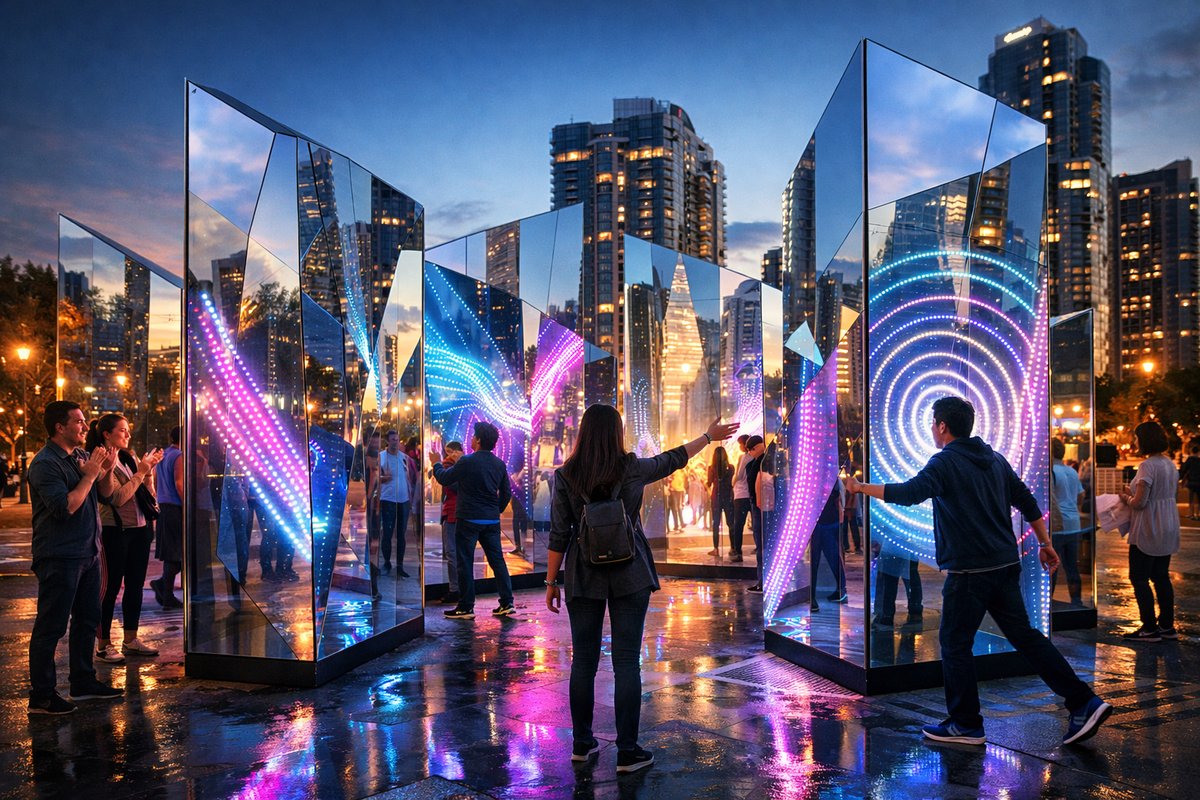

City centers around the globe are being reimagined through the transformative power of reflective art. This season, a series of large-scale installations-dubbed “Reflective Rhythms”-have begun springing up in plazas, building entrances, and pedestrian corridors. Far from static sculptures, these mirror-based works pulse and shift with the flow of traffic, ambient noise, and human interaction. By fusing precision-cut acrylic mirror panels, microcontroller networks, and sensor arrays, artists are exploring how the simplest element-reflection-can become a dynamic medium.
The flagship installation debuted in a repurposed industrial district where a row of 50 interactive mirror modules lines a former factory wall. Each module consists of a 60-centimeter square acrylic mirror mounted on a T-slotted aluminum frame. Beneath the surface, a microcontroller development board governs a cluster of proximity sensors and ambient noise detectors. When pedestrians approach or voices swell, embedded LED strips behind the mirrors shift through spectral colors, creating kaleidoscopic ripples that trace movement and sound.
Project lead Marisol Vega explains, “We wanted to take a material traditionally used for functional purposes-mirrors used in architecture-and reframe it as a living interface. As people walk by, they literally see themselves multiplied and refracted, but the real magic happens when the installation responds in color and intensity. It becomes a communal choreography.”
Technical precision was crucial. Engineers calibrated each proximity sensor to detect motion within a two-meter radius, while directional microphones isolate crowd noise from background traffic. Data streams into low-latency controllers that map input levels to color gradients on the LED array. The result is an ecosystem of mirrors that shimmer in purples, greens, and amber hues, echoing footsteps and laughter in fluid patterns.
While the visual spectacle draws crowds, the work is equally grounded in sustainability. All hardware was selected for low energy consumption: the mirror panels are optically pure acrylic sourced from local manufacturers, and LED strips run on efficient 12-volt circuits. Solar panels mounted on nearby rooftops feed a dedicated battery bank, ensuring the installation runs off-grid for up to twelve hours daily. “By powering the mirrors with on-site renewable energy, we shrink the carbon footprint typical of large-scale lighting projects,” says sustainability coordinator Wei Liu. “It’s important that public art not add to urban emissions.”
Privacy was another vital consideration. Although cameras are a common tool in interactive installations, Vega’s team avoided video recording in favor of anonymous sensor data. Proximity sensors register presence without capturing personal details, while directional microphones capture only decibel levels, not intelligible speech. This approach balances interactivity with respect for individual privacy-a guiding principle for public art in the age of surveillance.
Local communities have embraced Reflective Rhythms, citing unexpected benefits. One small business owner reported a 20 percent uptick in foot traffic since the installation went live. Nearby cafes now advertise “mirror viewings” as an evening attraction. Urban planners are taking note: a municipal task force is evaluating how similar responsive surfaces could be integrated into new transit hubs and pedestrian bridges.
Critics of digital public art often warn of novelty wearing off, but Vega believes the reflective medium offers deep longevity. “Mirrors have been part of human spaces for millennia,” she observes. “When we harness their inherent power to engage-rather than simply look at them-we tap into something fundamental. Audiences remain curious because their own reflection is at the heart of the experience.”
The success of the initial site has already inspired spin-offs. A downtown shopping arcade commissioned a variant that uses solar-charged kinetic motors behind each mirror, subtly tilting panels when sound thresholds are reached. Another project in a riverside park aims to build a floating mirror “labyrinth,” where visitors navigate shifting reflections on water-borne platforms.
Beyond the installations themselves, Reflective Rhythms is sparking dialogue about the future of public artistry. Urban designers are considering how responsive facades might improve wayfinding or create ad-hoc gathering spots. Educators are drafting school workshops around DIY mirror modules, teaching students basic electronics and interactive design. And architects are imagining entire buildings clad in tunable reflective surfaces that could adapt their brightness or hue based on environmental conditions.
Reflective Rhythms is more than an aesthetic experiment-it’s a case study in how art and technology can reframe our perception of the built environment. By leveraging simple materials, low-power electronics, and community input, the project offers a template for cities seeking to foster creativity without sacrificing sustainability or personal rights. As these mirrored canvases appear in more neighborhoods, they promise to transform not just walls and plazas, but the way people relate to the ever-evolving choreography of urban life.