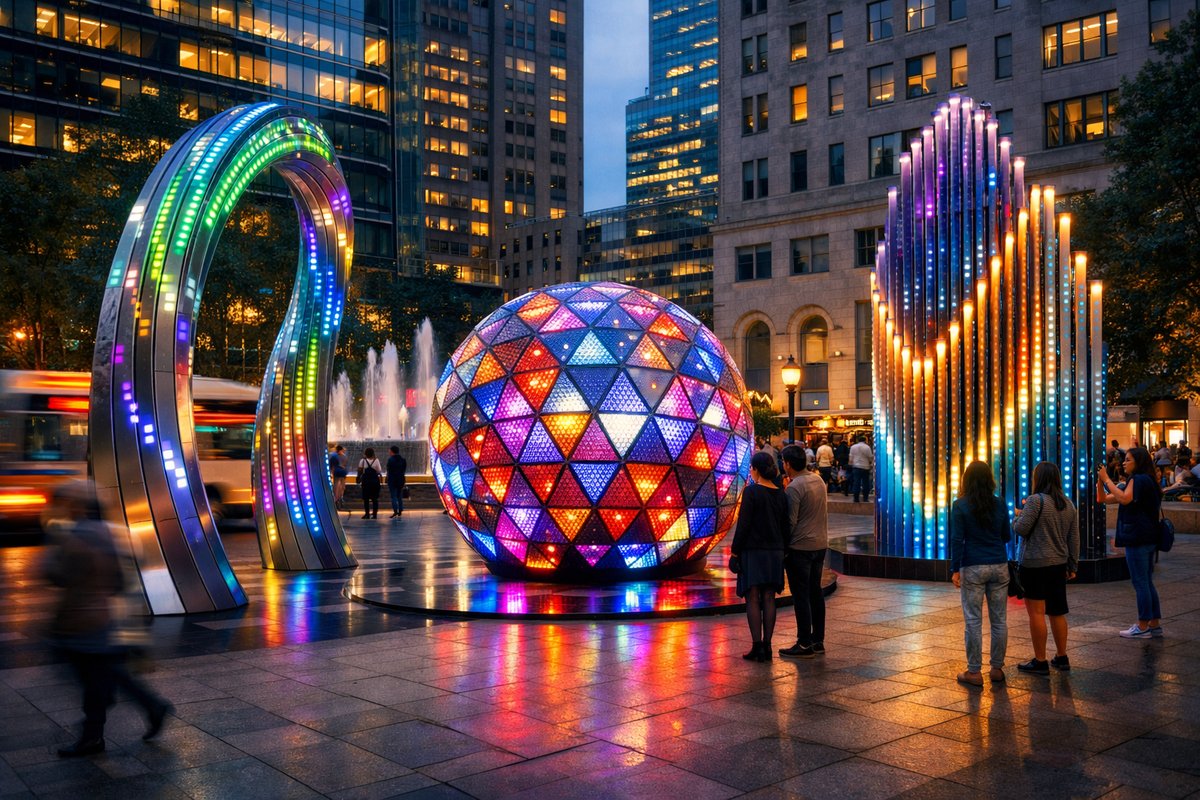

In the heart of downtown’s concrete jungle, a cluster of towering forms emerges after sunset: slender columns crowned with rings of pulsating LEDs and embedded microphones. As traffic noise builds to a crescendo, the columns ignite in rippling waves of color. When passerby voices murmur or laughter erupts, delicate oscillations cascade down their surfaces. This is PulsePoints, an ambitious new installation that converts urban soundscapes into living sculptures.
Conceived by a multidisciplinary team of digital artists, acoustic engineers, and sustainability experts, PulsePoints debuted at the annual City Sound Festival. Unlike static sculptures or preprogrammed light shows, these sensor-driven columns react in real time. Each unit houses an array of directional microphones, microcontroller boards, and weatherproof LED strips. Open-source algorithms analyze incoming sound frequencies and amplitudes, assigning each band a corresponding color palette and motion dynamic. Low-frequency traffic rumbles produce slow, deep-hued sweeps of indigo and emerald, while sharp human voices trigger bright yellows and rapid flickers.
The core innovation lies in marrying robust hardware with modular software. Lead engineer Maya Chen explains, “We used widely available microcontroller starter kits and audio sensor modules, then layered our own code to map sound signatures to LED patterns. This approach keeps costs manageable and allows future artists or city planners to reprogram the behavior without rebuilding the entire system.” The hardware sits inside custom 3D-printed enclosures, designed to withstand rain and urban dust. Solar-rechargeable battery packs on top of each column harvest daylight to power the lights through the night, reducing the environmental footprint.
Visitors are drawn not only by the shifting lights but by the playful invitation to participate. Standing close to a column, you can speak or clap and watch your voice trace its energy in glowing arcs. Groups of people generate complex interplays between columns as overlapping soundfields weave together. In quieter moments, the columns dim to a gentle ambient glow, offering a meditative counterpoint to the din of city life.
Beyond its visual allure, PulsePoints also sparks conversations about urban acoustics and the human relationship to noise. City planners have begun eyeing data logs from the installation to pinpoint peak noise levels at different times, potentially informing new sound-mitigation policies or pedestrian zone designs. Acoustic ecologist Dr. Gabriel Silva notes, “When people see noise visualized this way, they become more aware of its presence and potential health impacts. It’s art that doubles as an environmental sensor network.”
PulsePoints builds on a lineage of interactive public art that uses sensors to translate invisible phenomena into sensory experiences. Earlier projects have mapped wind speeds to kinetic mobiles or air quality measurements to colored smoke, but few have focused on the sonic dimension with such immediacy and accessibility. The team deliberately chose affordable electronics-directional microphone arrays, programmable LED strips, microcontroller boards, and open-source audio processing libraries-so that the design could be replicated or adapted in underprivileged neighborhoods as well as high-traffic plazas.
During its two-week run, PulsePoints attracted thousands of onlookers. Social media channels overflowed with night-time videos of the glowing columns morphing in sync with street performers’ drumbeats. Tech enthusiasts dissected the GitHub repository where Chen’s code lives, while local schools organized field trips to learn about sound sampling, coding, and sustainable design.
Looking ahead, the team plans to tour the installation to other cities, each time refining the software to account for different acoustic environments-from echo-prone subway stations to open waterfront promenades. There’s also talk of adding reactive kinetic elements: lightweight fins that tilt or rotate in response to low-frequency vibrations, introducing a tangible motion component to the light displays.
Above all, PulsePoints demonstrates how art and technology can converge to foster curiosity and community engagement. By making the hidden pulse of urban life visible and interactive, it invites passersby to reconsider the soundtrack of their daily routines. In the glow of these sensor sculptures, the city itself becomes both instrument and symphony.
Artists, engineers, and civic leaders alike are hailing PulsePoints as a blueprint for future public installations-ones that are open-source by design, energy-responsible, and rooted in real-time data. Whether it’s to beautify a neglected plaza or raise awareness about noise pollution, these sound-responsive columns show that the next wave of public art will not only decorate our spaces but listen to them, too.