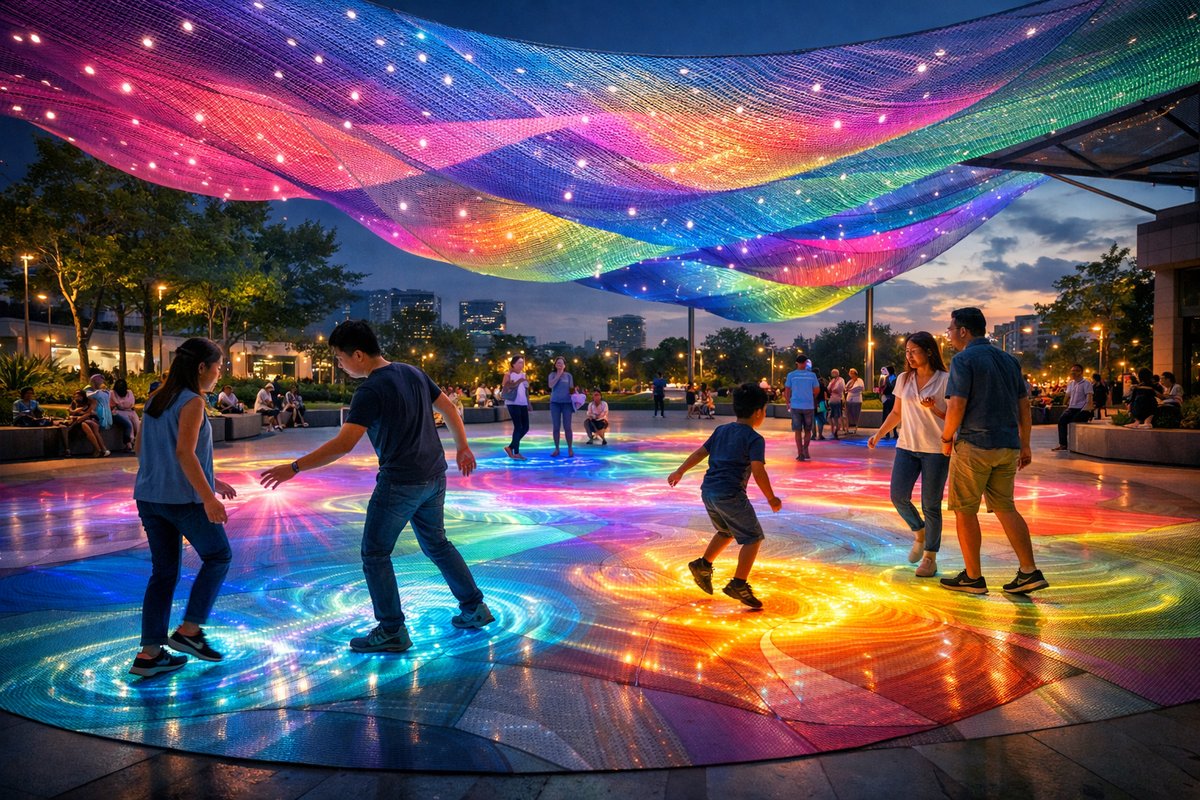

City squares and community centers around the world are coming alive underfoot as artist collectives unveil sprawling textile installations embedded with pressure sensors and microcontrollers. Dubbed “pressure points,” these interactive fabrics pulse and glow in response to human touch, converting everyday movement into a playful dialogue between people and place. Far from static murals or conventional sculptures, these works invite passersby to become co-creators, leaving ephemeral traces of collective rhythm and energy on a tapestry that evolves hour by hour.
This convergence of fiber art and electronics isn’t entirely new-pioneering experiments in the late 2010s saw isolated studios embed LED threads in garments-but recent breakthroughs in affordable sensor technology and open-source hardware have ushered in a renaissance of large-scale, responsive textiles. Today’s installations tap off-the-shelf pressure-sensitive pads, low-power microcontroller boards, and wireless communication protocols to build immersive experiences that can span dozens of square meters. Crucially, these projects favor sustainable materials-hemp, recycled polyester, or organic cotton-paired with biodegradable sensor films, aligning with a growing demand for eco-friendly public art.
At the heart of a typical pressure-responsive tapestry is a grid of thin fabric sensor pads spaced beneath a patterned textile surface. Each pad detects the intensity and position of pressure, reporting data to a central microcontroller that interprets footstep patterns in real time. Embedded LED strips or flexible panels weave beneath the fabric, illuminating segments where the sensors activate. As visitors step into different zones, waves of color trace their movement: emerald greens bloom under a child’s skipping feet, amber trails ripple with each adult stride, and overlapping patterns create kaleidoscopic mosaics when crowds gather.
One recent commission in a downtown park asked artists to “make the city breathe.” The resulting installation, titled “Pulse Weave,” stretches across a sunken amphitheater floor. Solar-charged battery packs, discreetly housed around the seating rim, power the microcontrollers and LED nodes from dawn to dusk. During test runs, engineers discovered that extreme midday heat triggered false positives in certain sensor pads. The team responded by adding a lightweight reflective coating and a vented backing layer to dissipate heat, ensuring consistent readings even under direct sunlight.
Visitors often arrive expecting a passive work of art but leave as participants in an evolving performance. Families line up to choose their “color channel” on a nearby tablet, then take turns leaving footprints in their hue. Elderly spectators watch the tapestry’s shifting patterns as if reading a living map of the day’s small dramas-two friends greeting each other, a skate boarder’s looping drift, a dog-owner’s erratic sprint. These installations foster a sense of play without instruction, guided only by simple rules coded into the software: gentle touches yield pastel shades, heavier pressure triggers bold primaries, and sustained contact paints complex gradients.
Curators emphasize that no one needs prior technical knowledge to engage. An open-source mobile app publishes a live feed of sensor data and offers a rudimentary interface to remix color palettes or control illumination speed. While this level of transparency invites curious hackers to examine or even modify the code, it also raises questions about digital privacy and data ownership. Installations deliberately avoid capturing any personal identifiers, focusing solely on anonymous pressure metrics. The code base is released under a permissive license that allows other cities to replicate or adapt the project, fueling a grassroots network of sensor-textile art across continents.
Behind the scenes, makers rely on a handful of core tools: conductive thread for seamless embroidery of sensor circuits, pressure sensor fabric kits for rapid prototyping, microcontroller starter boards to manage data flow, and portable LED projectors for fine-tuning patterns during testing. Many teams craft custom housings with digital textile printers and laser cutters, ensuring waterproofing without compromising flexibility. Industrial sewing machines outfitted with heavy-duty needles bind layers of sensor mat and decorative textile into a single composite panel that can be rolled, transported, and re-installed elsewhere. The fusion of traditional crafts with digital fabrication techniques reflects a broader trend in design: interdisciplinary collaboration between textile artists, hardware engineers, data scientists, and urban planners.
Challenges remain. Outdoor installations must endure rain, temperature swings, and heavy foot traffic. Designers have experimented with waterproof films, UV-resistant dyes, and shock-absorbent backing layers to prolong lifespan. Battery management is another critical concern: lithium-ion packs provide reliable power but require careful ventilation; solar panels extend run time but introduce variability on cloudy days. Some teams are piloting flexible solar cells woven directly into the fabric substrate, promising true off-grid operation for weeks at a time.
Experts say sensor-embedded textiles could expand beyond art into functional urban design. Imagine bus stop shelters that glow to signal approaching vehicles, crosswalk mats that alert drivers to pedestrian presence, or park benches that softly illuminate when occupied. Interactive playground surfaces could track movement patterns to support community health studies, while museum carpet systems might detect crowd flow and adjust lighting or audio guides accordingly. By integrating data collection into everyday materials, designers envision smarter, more responsive cities that bridge the gap between utility and wonder.
This creative wave aligns with a resurgence of digital crafting platforms: online repositories now host hundreds of open-source patterns for stitching sensor zones, customizing LED algorithms, and calibrating microcontroller inputs. Workshops and maker fairs offer crash courses in pressure sensor embroidery, attracting hobbyists eager to bring interactive textiles into their homes, studios, or local community centers. For emerging artists, these tools lower the barrier to entry, fostering a more democratic landscape where experiential public art is no longer confined to deep-pocketed institutions.
Looking ahead, research teams are exploring machine learning to enhance pattern recognition and predictive response. In one prototype, a tapestry learns to distinguish running footsteps from quiet strolling and adapts its animations accordingly-faster pulses for joggers, gentle ripples for wanderers. Future iterations may integrate haptic feedback, allowing visitors to feel subtle vibrations underfoot as part of the narrative. Others speculate about pairing sensor textiles with augmented reality overlays, visible through wearable glasses, to superimpose virtual layers of color and sound triggered by the same pressure grid.
As the line between craft and code continues to blur, sensor-infused textiles are rewriting the playbook for interactive art and urban engagement. By marrying sustainability with digital curiosity, these installations carve out new spaces for collective creativity, one footprint at a time. In the hands of diverse communities, they promise not only aesthetic delight but also fresh conversations about how we inhabit, shape, and share the cities of tomorrow.