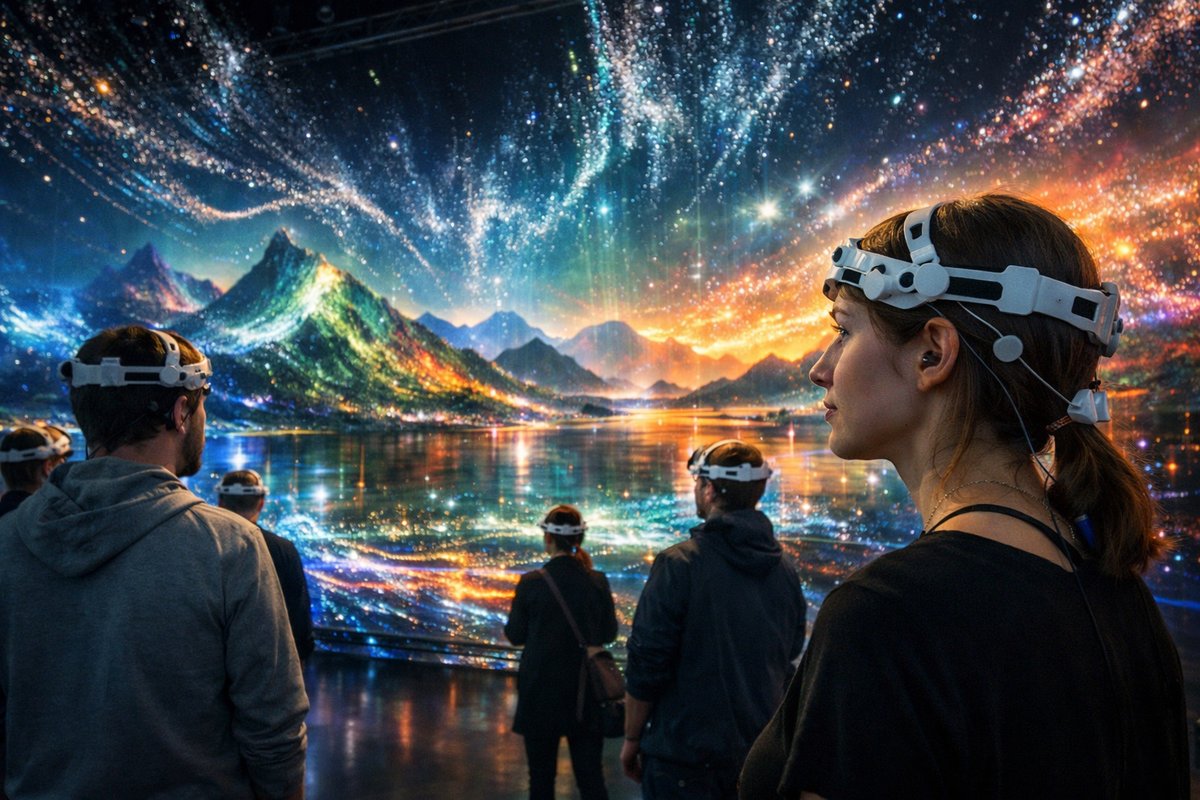

Berlin’s creative pulse quickened this month with the debut of “Neurographic Currents,” an immersive installation that transforms thought patterns into living imagery. Nestled in a converted factory near the Spree River, the exhibit fuses wearable EEG technology, generative software, and sustainable display materials to deliver an unprecedented encounter between mind and medium.
At its heart, “Neurographic Currents” invites attendees to clip on lightweight headsets that record electrical activity across the scalp. As participants wander the cavernous hall, algorithms translate fluctuating brainwave signals into rippling fields of color and form projected onto 360-degree screens. When the group moves in sync-breathing together, sharing moments of silence or excitement-the visuals coalesce into synchronized waves that ripple across the space.
Curated by a collective of neuroscientists, coders, and visual artists, the installation taps into advances in affordable consumer-grade EEG hardware. These sensors, once the domain of specialized labs, now retail for under $200 per unit. Real-time signal processing and cloud-based computation allow the artworks to respond instantaneously, highlighting subtle shifts in attention, calmness, or cognitive load.
Beyond its interactive appeal, the project champions eco-conscious design. Instead of traditional LED arrays or power-hungry projectors, “Neurographic Currents” relies on panels coated with e-ink derivatives and mineral pigments. These displays consume energy only when updates are required, reducing overall power draw by more than 70 percent compared to standard large-scale projections.
According to the lead organizer, the choice of low-energy substrates aligns with a broader mission to reconcile high-tech art with environmental responsibility. Reclaimed metal frames and modular mountings allow the entire setup to be disassembled and repurposed for future exhibitions. This circular approach extends from hardware sourcing to disposal plans, ensuring minimal waste at the end of the show’s run.
Throughout the day, clusters of visitors gather at designated “thought zones” marked on the floor with luminescent tape. Here, small groups are invited to follow guided breathwork or vocal exercises broadcast through hidden speakers. As shared mental states emerge, the projections shift-from undulating fractal blooms to cascading ribbons of pastel hues-creating a collective portrait of mood and intention.
Skeptics might question whether raw EEG data can faithfully mirror human emotion. Organizers acknowledge that the installation abstracts neural patterns rather than reading literal feelings. Instead of direct mind-reading, the system highlights rhythms in alpha, beta, and theta bands, offering a poetic rather than clinical interpretation of inner states.
“The goal isn’t precision,” explains the team’s lead neuroscientist. “We’re exploring a dialogue between biology and machine. Viewers see their own mental landscapes externalized and learn how subtle shifts in focus or relaxation can ripple through a shared environment.”
In early afternoon sessions, children accompany guardians and eagerly test the headsets. Their neural patterns yield playful bursts of color-vivid oranges and electric blues-that surprise even seasoned artists. Many parents report that the visual feedback encourages kids to slow down, prompting impromptu breathing exercises as they watch shapes settle into calm configurations.
As dusk falls, ambient light dims and the installation enters its “nocturne mode.” The e-ink panels transition into muted grays and deep indigos, and soundscapes composed of filtered field recordings from Berlin’s parks and waterways emerge. At this stage, brainwave inputs modulate low-frequency drones and subtle chimes rather than altering the visuals directly.
This sonic layer underscores the exhibition’s broader ambition: to cultivate mindfulness through technological wonder. By teasing apart the connections between cognition, atmosphere, and embodiment, “Neurographic Currents” offers an experiential philosophy rather than a static piece. It positions art as a living system shaped by participants in real time.
Critics have praised the installation’s balance of accessibility and depth. One reviewer from a leading design journal highlighted how the exhibit avoids the usual pitfalls of spectacle-driven tech art, instead encouraging reflection on how data flows shape our environments. The same critic noted that the sustainable hardware choices may become a template for future large-scale interactive works.
Though Berlin Art Week typically spotlights painting, sculpture, and performance, the success of this neural-driven installation suggests a fresh direction for the festival. Attendance data shared by organizers indicates that weekend showings of “Neurographic Currents” consistently sold out within hours, drawing a mix of tech enthusiasts, art lovers, and curious passersby.
In parallel to the public display, a series of workshops invites developers and designers to download open-source code underpinning the generative engine. These hands-on sessions cover neural data hygiene, ethical consent protocols, and methods for integrating similar techniques into theatrical lighting, health care environments, or therapeutic settings.
“This project is as much about community building as it is about art,” says the resident engineer. “By sharing code and materials lists, we hope to lower barriers for anyone interested in experimenting with brainwave-responsive design-while also sparking conversations about data privacy, informed consent, and emotional wellbeing.”
Privacy emerges as a central theme. Though the system processes only abstracted frequency bands, attendees can opt out of data retention entirely. Biometric streams are never stored long-term; they vanish seconds after rendering. The team collaborated with digital rights advocates to craft clear opt-in forms and signage that demystify how information flows from mind to machine.
Experts from the intersection of design ethics and neuroscience have lauded this transparent approach. In many interactive installations, data collection goes unnoticed or poorly documented. Here, the curators positioned consent and clarity at the forefront, turning privacy into a philosophical pillar of the artwork itself.
Beyond the exhibition halls, “Neurographic Currents” has sparked conversations across Berlin’s creative districts. Cafés and co-working spaces host informal gatherings where attendees swap stories about their favorite visual moments-whether it was the emergence of a coral-like lattice or a sudden burst of vermillion that synchronized an entire room.
Online forums dedicated to generative art now buzz with discussions about adapting the system for public spaces such as libraries, hospitals, and transit hubs. Proposals range from restful waiting-room installations that calm patients to data-driven street art that reflects the collective pulse of urban commuters in real time.
Economically, the project illustrates how relatively modest budgets can yield high-impact installations when guided by open-source principles and modular design. Backers included a local foundation focused on sustainable culture, a tech startup incubator, and a university research grant-all contributing hardware, code, or studio space.
Looking ahead, the core team plans to tour a scaled-down version of “Neurographic Currents” to festivals in Lisbon, Tokyo, and São Paulo. Each iteration will adapt to regional cultural contexts, inviting new collaborators and local research institutions to co-create data archetypes that reflect diverse cognitive rhythms.
As interactive art continues to evolve, this Berlin showcase stands out for weaving together neuroscience, generative algorithms, and ecological responsibility into a single narrative. Attendees leave not only with memories of shifting colors and shapes but also with questions about how technology can amplify our understanding of mind, body, and collective presence.
In an age where screens dominate our attention, “Neurographic Currents” reminds us that the most compelling displays emerge from the interplay of human thought and material agency. By turning electrical impulses into living art, the installation invites us to reimagine the boundaries between self and system-and to consider the creative possibilities hidden within our own neural landscapes.
Unexpectedly, some visitors report long after the show that they find themselves humming the ambient drones or recalling the ebbs and flows of color as a meditative practice. Perhaps this is the exhibit’s most profound legacy: a gentle nudge toward awareness, inviting each of us to recognize that our inner currents can ripple outward, shaping environments both virtual and real.