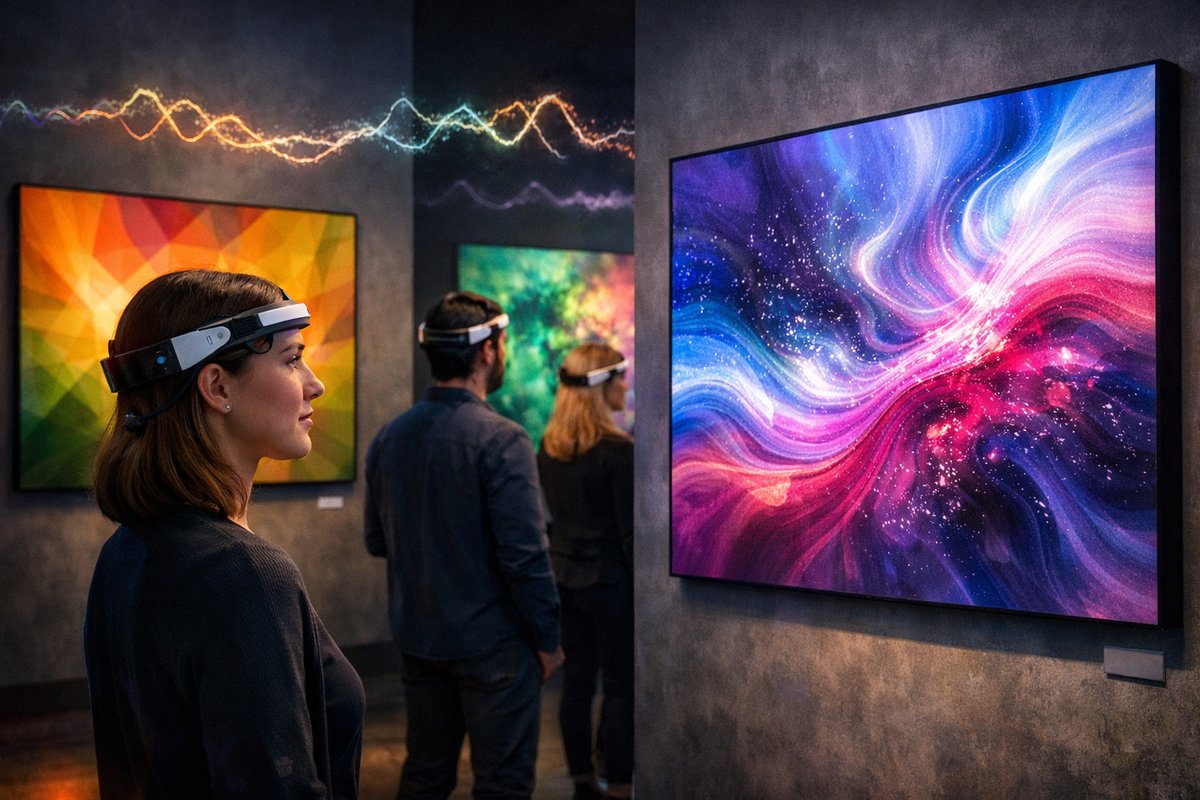

In a repurposed warehouse on the edge of the creative district, a hushed anticipation greets each visitor stepping into the NeuroCanvas exhibition. At first glance the paintings appear static: sweeping strokes of cobalt, copper, and pearl-white pigments arrange themselves into abstract forms. But once a viewer straps on a discreet neurofeedback headset, the surface ripples into shifting hues that mirror the wearer’s emotional landscape.
Developed by a collective of artists, materials scientists, and cognitive researchers, NeuroCanvas is the first public showcase of electrochromic artworks driven by real-time EEG signals. Rather than simply responding to touch or ambient sound, these canvases translate brainwave patterns into pulses of electrical current across microprinted circuits embedded in the paint layer. The result is an ever-evolving tableau guided by each participant’s state of mind.
“We wanted to explore empathy at the intersection of perception and technology,” says the lead curator, a former neuroscientist turned installation artist. “By visualizing internal processes like attention or calmness, we invite audiences to acknowledge emotions as textile, malleable, and shared.”
Behind the scenes, the process begins with the headset’s eight-channel dry electrodes, which detect frequency bands associated with focus, relaxation, and emotional valence. A miniature processing board filters noise, classifies incoming data, and transmits a binary control code to the painting’s embedded driver array. Within the canvas, transparent conductive tracks guide micro-amperage to electrochromic pigments that switch between complementary hues in under two seconds.
Each painting explores a different emotional palette. In one piece entitled “Refracted Reverie,” bright oranges dissolve into deep violet as alpha rhythms strengthen, then flicker back when beta spikes indicate renewed concentration. Another work, “Subtle Currents,” features a shifting gradient of teal and rose that ebbs gently, evoking calm even as visitors’ anxiety levels climb.
Importantly, the exhibition emphasizes data privacy and sustainability. All EEG data resides momentarily in onboard volatile memory before being discarded; no personal brainwave records are stored or transmitted to external servers. Electrochromic inks are formulated with water-based binders and non-toxic nanoparticle films, and the thin-film circuits are laminated onto recycled cotton canvas. When a piece reaches end-of-life, components can be separated for recycling or composting.
Attendees describe the experience as revelatory. One visitor recounted placing the headset on and feeling a gentle flush of guilt when recalling a stressful deadline. As she watched the painting’s pattern fracture into jagged scarlet streaks, she became aware of her own inner tension and consciously guided the piece back toward soothing aquamarine by focusing on rhythmic breathing.
“It’s like looking at your soul through a kaleidoscope,” says another participant. “You gain so much clarity about what’s happening in your mind and body.”
The exhibition also features communal installations that layer multiple visitors’ signals into a single composition. In “Collective Resonance,” up to five headsets feed separate channels into one expansive triptych. Colors merge unpredictably as individuals’ focus, relaxation, and emotional peaks weave together into a collective portrait of mood.
Despite its theatrical flair, NeuroCanvas rests on serious research. Collaborators spent two years optimizing electrode placement to minimize skin irritation and artifact interference. They worked with materials engineers to stabilize electrochromic polymers against humidity and UV exposure, extending each painting’s lifespan to over a thousand on-off cycles. Designers refined the headset’s ergonomics so it sits comfortably atop most head shapes, with adjustable straps and breathable mesh liners.
While the artworks themselves are confined to the gallery space, the team behind NeuroCanvas plans to release an open-source toolkit early next year. It will include circuit schematics, paint formulations, and sample code for translating EEG data into color maps. The vision is to empower educators, therapists, and hobbyists to adapt the concept in classrooms, meditation centers, and home studios.
Critics have praised NeuroCanvas for its innovative merger of art and empathy tech, while others caution about the novelty wearing off if the novelty of biophysical interactivity doesn’t deepen into genuine self-reflection. The curatorial team responds that the emotional intelligence sparked by the experience-however fleeting-plants a seed for longer-term inquiry into how we relate to our own minds.
As galleries worldwide seek ways to reengage audiences post-pandemic, NeuroCanvas offers a fresh narrative about the role of technology in fostering contemplation rather than distraction. By rendering feelings visible, it challenges traditional notions of portraiture and invites a new, participatory form of looking-one that constantly reminds us that the most intricate artwork resides within.
For now, visitors continue to cycle through the dimly lit hall, curious to see how their own waves of thought will paint the walls. With each headset snap and color shift, the line between artist and audience blurs a little more, hinting at a future where art doesn’t just reflect emotion-it becomes a living mirror of our inner world.
The NeuroCanvas exhibition runs through next spring, offering timed-entry tickets and guided workshops on EEG art techniques.
In a world saturated with screens demanding our attention, these brain-responsive paintings remind us that the most powerful interface is often the one between our own neurons and the world we co-create.