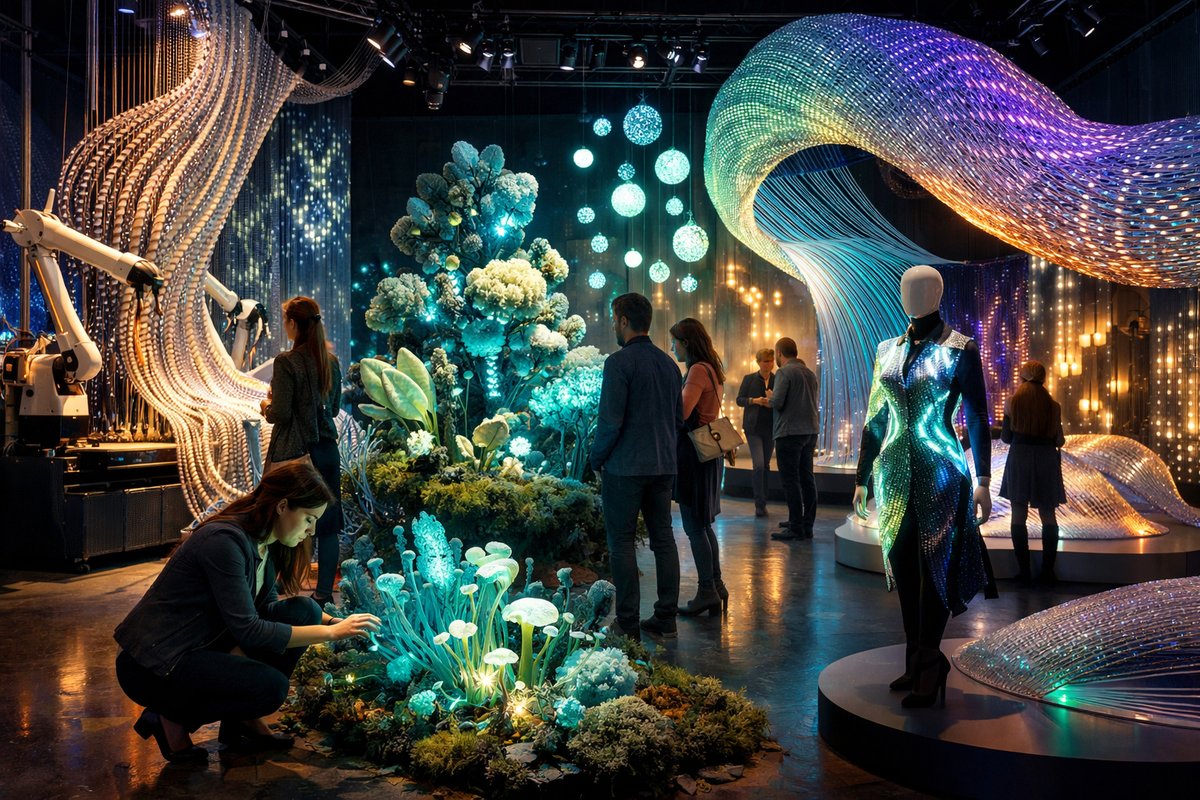

At one of Milan’s most anticipated design events this season, Lumina Flux invites visitors into a world where artificial intelligence, living organisms, and advanced textiles coalesce into dynamic installations. The exhibition occupies a restored industrial hall, its cavernous ceilings lined with strands of fiber optics and suspended living modules. Curators aimed to break down the barrier between viewer and artifact, treating each participant as an active node in a network of light, motion, and organic processes.
One of the first pieces encountered, titled Echosphere Weave, consists of responsive textile panels draped across steel frames. Cameras track the movements of passersby and feed data into a generative algorithm that shifts intricate patterns of LED filaments hidden within the fabric. As an individual approaches, the panels ripple with glowing lines that echo gestures, temporarily imprinting shapes before fading into new configurations. The designers credit a custom AI engine trained on centuries of weaving traditions, combining cultural memory with real-time computation.
Unlike static wall hangings or conventional projections, the Echosphere Weave invites a tactile form of visual interaction. Visitors often pause to trace the illuminated threads with their fingers, feeling the warmth of embedded micro-heaters that heighten the sense of presence. Each pass through the installation yields a fresh visual composition, prompting conversations about the tension between handcrafted heritage and machine-led innovation.
Adjacent to the reactive textiles, Biolume Cascade stands as a living sculpture built from tiered aquariums housing bioluminescent algae. Micro-pumps circulate nutrient solutions, while variable blue LEDs simulate the dusk conditions under which the microorganisms naturally glow. When a spectator’s smartphone camera triggers a proximity sensor, the display brightens for a brief surge of iridescent green light, revealing the hidden choreography of microscopic life.
This marriage of biology and design underscores sustainability as more than a buzzword. Rather than relying on single-use materials or energy-intensive effects, Biolume Cascade harnesses renewable processes. Exhibitors explain that the algae cultures can be harvested sustainably, offering potential for future applications in low-energy lighting. The living tanks are constructed from recycled glass and lined with biodegradable sealants, framing the work as a prototype for circular design systems.
A third standout piece, Neural Loom, takes AI integration further by weaving interactive tapestries in real time. A robotic arm equipped with multiple yarn feeders listens to ambient soundscapes and fragments of visitor input-snippets of speech, laughter, or even heart-rate data captured by wearable badges. The arm then selects colors and patterns from a palette rooted in natural dyes developed on-site, gradually generating an evolving textile that documents each day’s human-machine dialogue.
The Neural Loom project reflects a growing fascination with algorithmic aesthetics. Designers emphasize that while the system relies on machine learning to propose new motifs, human facilitators remain essential for material decisions and dye preparation. This hybrid workflow elevates the loom into a metaphor for collaboration between human intuition and digital suggestion, challenging traditional notions of authorship in craft and design.
Throughout the exhibition, these installations share a common goal: to evoke emotional resonance through multisensory engagement. Many visitors describe a sense of wonder akin to stepping inside a living organism, where light pulses like a heartbeat and fabric breathes with code. Designers have intentionally blurred boundaries between object and environment, rethinking display conventions in favor of networked and performative forms.
Lumina Flux also situates itself within broader trends in immersive art and bio-responsive design. From large-scale projection mapping to kinetic sculptures powered by plant neural networks, contemporary creators are increasingly seeking to embed liveliness into static forms. Milan’s showcase underscores the idea that design can become a dialogue partner rather than a one-way statement, encouraging future systems that adapt, learn, and even repair themselves.
Behind the scenes, the technical toolkit powering each installation blends off-the-shelf hardware with custom innovations. Wi-Fi-enabled microcontrollers coordinate LED matrices and pump controls, while low-power sensors capture environmental data for real-time adjustments. Smart fabrics incorporate conductive threads to transmit signals, and open-source software frameworks provide the scaffolding for generative visuals. Engineers and artists work side by side, iterating on prototypes at a rapid pace to meet the demands of the public showcase.
Visitors often find themselves suspended between observer and participant, instinctively mapping their own movements to rippling lights or subtle shifts in algal glow. Some report a mild synesthetic feeling, as if shapes and colors correspond to internal rhythms or latent emotions. This cross-sensory effect emerges from carefully tuned feedback loops, in which each system element influences the next in continuous cycles of cause and response.
Sustainability extends beyond material choices into energy and lifecycle considerations. Curators describe solar-powered arrays on the building’s rooftop that supply a portion of the installations’ energy, supplemented by low-voltage circuitry designed to run throughout the evening without spikes. Reclaimed scaffolding and recycled wood composites form supportive structures, ensuring minimal waste after the exhibition closes. These practices exemplify a shift toward eco-responsible event planning in art and design festivals worldwide.
Philosophers and critics have noted that this convergence of AI, living organisms, and responsive materials challenges historic divisions between nature and technology. By foregrounding non-human agencies-whether microbial, algorithmic, or material-Lumina Flux prompts deeper questions about autonomy, agency, and ecological interdependence. In one panel discussion, a poet described the collection as “a new form of symbiotic storytelling,” where each element contributes its own voice to an unfolding narrative.
The implications extend beyond the gallery walls. Architects experimenting with climate-adaptive facades point to Lumina Flux as inspiration for buildings that could self-regulate temperature or harvest ambient energy. Biomedical designers are exploring bioluminescent bacteria for medical diagnostics. Fashion houses are scouting AI-driven weaving processes for bespoke garments that respond to wearer data. In each case, the exhibition serves as a catalyst for cross-disciplinary innovation.
As the final days of the Milan Design Biennale approach, Lumina Flux remains a focal point for debate and discovery. Many attendees leave with a sense of having glimpsed a possible future-one in which design transcends static form to become a living conversation. Whether through glowing algae, reactive textiles, or generative looms, the exhibition offers a compelling vision of art and design as collaborative ecosystems in continuous flux.
For those seeking to engage with these emerging practices beyond the gallery, Lumina Flux provides extensive documentation, open-source code repositories, and material kits to download. The hope is that designers, researchers, and hobbyists worldwide can adapt these experiments to local contexts, spurring a wave of creative exploration rooted in sustainability and mutual exchange.
By merging curiosity with craft, technology with ecology, Lumina Flux marks a turning point in how we imagine the relationship between human creativity and non-human collaborators. As the lights dim on this edition of the Biennale, the glow of these pioneering ideas will continue to radiate far beyond Milan’s historic halls.