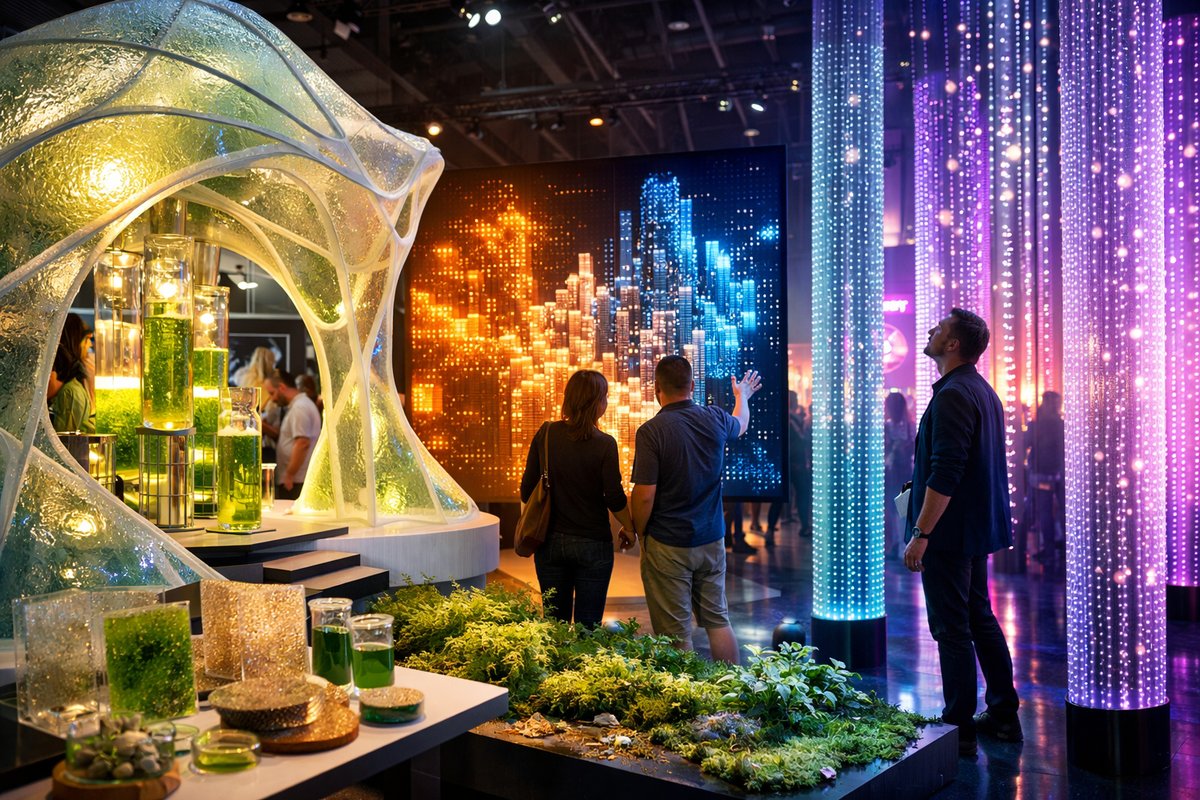

In a series of headline-making pavilions and public installations, recent design festivals across Europe and Asia have unveiled a radical vision for tomorrow’s cities. Rather than mere decoration, these immersive works deploy living and responsive elements to forge an intimate dialogue between viewer, environment, and material lifecycle. Against a backdrop of pressing climate concerns and advancing computational tools, designers are rethinking the role of art and craft in shaping sustainable urban experience.
At Milan Design Week, a centerpiece titled the Living Pixel Pavilion combined translucent panels of algae-derived bioplastic with a grid of generative light modules. By day, the semi-opaque walls filter sunlight through living microalgae, casting shifting green hues. After dusk, a network of embedded LEDs driven by a custom algorithm produces soft, organic patterns that mimic cellular growth. Motion sensors track foot traffic and trigger subtle ripples of color as visitors pass, animating the pavilion like a breathing organism.
Behind the scenes, the core innovation lies in the synthesis of open-source code and bio-based materials. The design team sourced commercially available biodegradable resin and worked with a local fabrication lab to adapt it for projection mapping and digital light processing. The pavilion’s control software is freely published on a creative commons license, inviting artists worldwide to remix the code for new spatial interventions. In doing so, the project aims to spark a decentralized community that values transparency in both material sourcing and algorithmic authorship.
Meanwhile, the London Design Festival featured Sonic Bloom, an interactive installation built from 3D-printed ceramic petals fused with miniature speakers. Visitors are encouraged to tap, stroke, or blow across the petal surfaces, producing delicate tones that evolve into cascading soundscapes. The ceramics themselves were printed using a clay composite and hand-glazed in earthen pigments sourced from urban waste streams. By integrating tactile interactivity with acoustic feedback, Sonic Bloom explores how humble craft disciplines can intersect with immersive media.
Across town, a pop-up studio at a historic gallery gallery in Hong Kong hosted an AI-assisted calligraphy installation. Large sheets of recycled rice paper were mounted on wooden frames fitted with robotic arms, each guided by machine learning models trained on thousands of traditional brushstrokes. Visitors could input a word or phrase via a touchscreen station; within seconds, the robotic arm would render a fluid character in ink, combining centuries-old aesthetics with real-time computation. The result is a living archive of collective expression that highlights both human intention and algorithmic interpretation.
These diverse installations share a commitment to lowering the barrier between maker and audience. Instead of viewing art as a static object, designers are inviting on-site participation, whether through physical gestures, voice, or code. By blurring distinctions between artist, visitor, and machine, the works foster a sense of co-creation. Many festival attendees reported that this hands-on approach deepened their appreciation for underlying processes-from the molecular shift in bioplastic color to the resonance pattern inside a ceramic speaker.
Another unifying thread is the emphasis on circularity. Algae-derived materials, clay composites from local waste, and recycled paper all minimize environmental footprints. During installation teardown, many projects were designed to be easily disassembled: bioplastic panels destined for composting, ceramic modules reground into new clay batches, and metal framing returned to community welding co-ops. This lifecycle thinking marks a departure from ephemeral art fairs of the past, where large-scale displays often ended up as landfill.
The integration of real-time data also plays a crucial role. Generative algorithms draw on local weather feeds, footfall statistics, or even ambient noise levels to modulate visual and sonic outputs. One London installation used open-source air-quality sensors to alter color intensity, turning murky gray hues into vibrant cyan only when particulate levels fell below a certain threshold. Such responsive design transforms installations into living barometers of urban health, heightening public awareness of environmental dynamics.
Beyond the festivals themselves, several designers have launched pop-up workshops to share fabrication methods. For instance, the team behind Living Pixel hosted evening sessions where participants learned to cast small panels of algae bioplastic, machine-etch QR-coded patterns, and program basic light-control scripts. These workshops often sell out within hours, signaling a growing thirst for hands-on training in sustainable fabrication and computational design.
Critics and attendees alike praise these installations for balancing technical rigor with poetic resonance. The tactile warmth of clay, for instance, tempers the precision of digital sound synthesis, while living bioplastic walls evoke a primally organic sensibility even as they respond to streaming data. This fusion of material authenticity with algorithmic choreography cultivates a new aesthetic vocabulary, one that acknowledges both the earth’s fragility and the transformative potential of technology.
As these design festivals circuit global design capitals, local municipalities are starting to take notice. City planners in Rotterdam and Tokyo have reached out to designers from the festivals to consider permanent commissions in public plazas, transit hubs, and corporate campuses. The goal is to embed living installations that improve air quality, stimulate social interaction, and convey environmental data in visually arresting ways. In this light, temporary festival projects serve as prototypes for a future where urban infrastructure seamlessly integrates art, science, and ecology.
However, challenges remain. Scaling up bioplastic fabrication requires more supply-chain coordination, and mass-produced sensor modules can suffer from calibration drift in harsh weather. Conservation experts also warn that long-term maintenance of living materials demands specialized knowledge-what thrives in a controlled exhibit may falter in an open-air setting. In response, design teams are experimenting with modular plug-and-play components, allowing local crews to swap out worn panels or update firmware without dismantling entire structures.
Despite these hurdles, the momentum behind interactive, sustainable installations shows no sign of slowing. As generative design tools become more accessible and biobased materials more affordable, smaller studios and community groups are beginning to mount their own site-specific experiments. Crowdfunded public art campaigns now commonly feature dynamic murals that shift according to social media sentiment, or pop-up pavilions that channel solar energy into ambient music performances.
Ultimately, this wave of living, data-driven art challenges traditional notions of permanence and authorship. Visitors no longer passively observe distant masterpieces; they engage as collaborators, influencing what the artwork is and does in real time. By situating creative expression within the ebb and flow of natural and digital ecosystems, these installations point toward a future where form and function, craft and code, converge in service of environmental resilience and shared wonder.
In the months ahead, many of these projects will travel to biennales, city tours, and maker fairs around the world. Each new locale will impose its own climate, culture, and infrastructural demands, prompting further adaptations in both design and material strategy. Yet the core ethos remains constant: to fuse living matter, open-source technology, and participatory ritual into experiences that renew our sense of connection-to each other, to the environment, and to the evolving possibilities of design itself.
As these pioneering installations spread into public spaces, they invite everyone to ponder a simple yet profound question: what happens when art not only reflects life but also grows, breathes, and transforms alongside us?