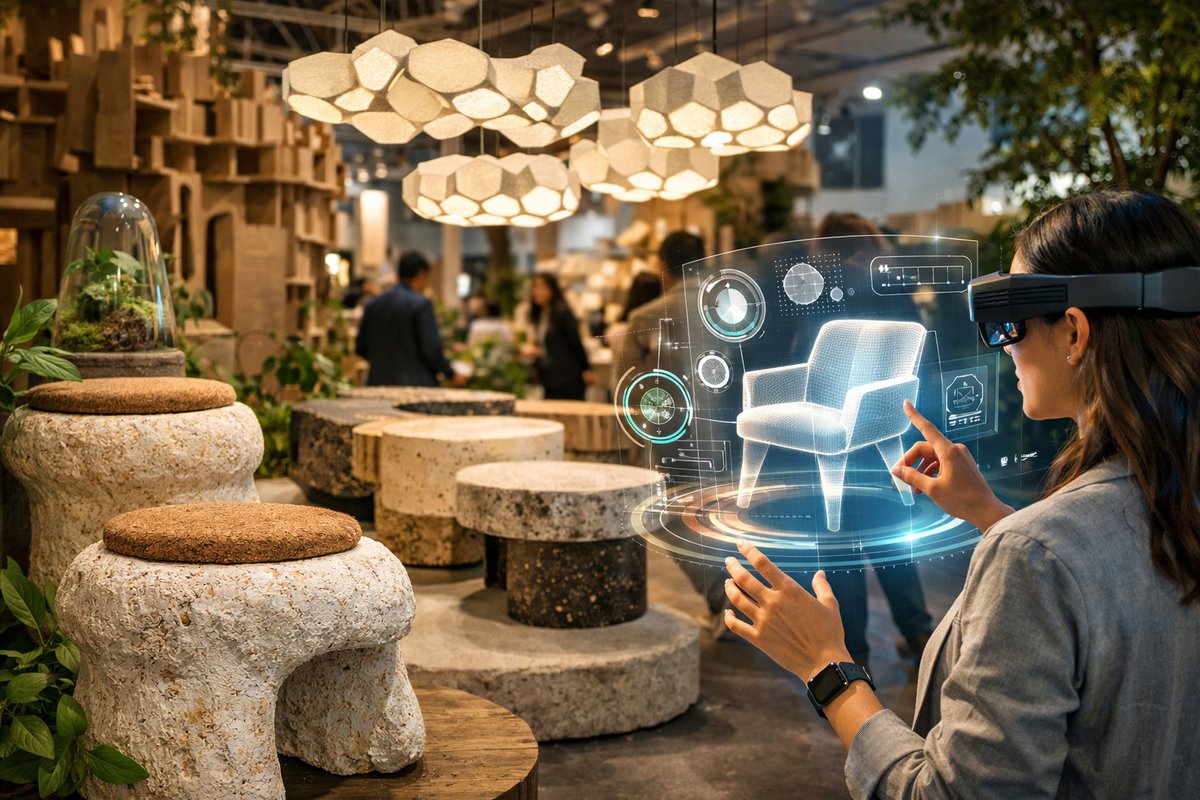

The crowds pouring into the sprawling pavilions and historic palazzos of Milan Design Week were met this season not just with fresh color palettes and sculptural forms, but with the very essence of life and data. As visitors navigated between installations, three dominant themes emerged: biodesign that turns living organisms into functional objects, circular processes that close the loop on waste, and immersive digital layers that shift static pieces into interactive experiences. Together, they suggested a design world tentatively stepping beyond pure aesthetics toward dynamic, sustainable systems that can evolve long after the fair closes.
In the heart of the Giardini area, the Biodesign Pavilion curated by a collective of bioartists occupied a light-filled gallery once reserved for traditional furniture showcases. Instead of lacquered wood and metal fittings, the space was anchored by seating blocks grown from mycelium-fungal networks that, when guided through molds, take on surprising strength and texture. Visitors were encouraged to touch the ochre-hued surfaces, feeling the faint softness of living threads under a protective clear sealant. Nearby, translucent partition panels made from algal bioplastic slowly shifted tint as ambient humidity rose and fell, a reminder that even inert-looking materials can retain a quiet pulse of change.
“I wanted to show that materials don’t have to be mined or molded in factories,” explained a designer involved with the exhibit. “Here, the substance grows itself. Our role is simply to guide its form and then let it be.” By using petri-dish prototypes alongside full-scale stools and low tables, the pavilion offered both technical specifications-tensile strength comparable to low-grade plastic-and poetic moments, like a glowing cluster of cellulose film that looked like bioluminescent jelly anchored on a pale wood stand.
Just a few blocks away, the Circular Futures install addressed the other end of the material lifecycle: post-consumer waste. In collaboration with an environmental organization, designers collected ocean-bound plastic debris and shredded it into raw pellets. These pellets were then 3D-printed into modular seating modules, each one distinct in color and texture. The modules interlocked like building blocks, so attendees could assemble benches, chaise longues or pop-up walls before dismantling them to return the plastic to the next project. One striking bench, mottled deep-sea blue and sandy white, bore the faint imprints of rope fibers-remnants of discarded fishing nets.
The organizers estimated that over one metric ton of plastic had been diverted from landfills and coastlines for the exhibit, illustrating how design fairs can be more than showrooms; they can become living demonstrations of a closed-loop economy. A digital screen looping behind the installation displayed real-time tracking data: every puncture of drone-mounted sensors over polluted beaches, every kilogram of plastic withdrawn, and every new filament batch extruded for display.
If the Biodesign Pavilion and Circular Futures shared a workshop ethos, the Experimental Lighting Showcase riffed on the opposite: products ready for immediate lifestyle adoption. Among the highlights was a series of 3D-printed lamps assembled from interlocking lattice segments. Varying the density of the pattern altered both the shape and the diffusion of LED glow inside. Some pieces resembled crystalline stalactites; others flared in geometries that suggested coral polyps frozen in mid-growth. A companion display offered visitors a hands-on station where they could manipulate design files on touchscreen terminals, adjust porosity levels, and then watch as miniaturized resin prints cured under rings of ultraviolet light.
Beyond physical form, a handful of exhibitors began augmenting design with digital layers. Using an open-source app, attendees could launch a smartphone camera at selected installations and uncover hidden content-sketches of the design process floating in space, animated diagrams of material compostability, even proposals for future iterations that existed only in code. Several furniture makers outfitted their chairs and tables with embedded chips that triggered guided audio tours through location-aware beacons. By donning lightweight smart glasses at a dedicated station, visitors could walk through a virtual showroom that overlaid alternative finishes onto real objects, testing metallic tint variations or sustainable veneer options before approaching production.
Several shops off-site took the AR concept further. In a cobbled piazza, a temporary “digital atelier” projected life-size furniture prototypes onto a blank scaffolding frame. Shoppers could reconfigure the model in midair by swiping controls projected onto the ground, then order the final version through an on-the-spot tablet interface. The instant-customization approach suggested a future in which design exhibitions morph into direct-to-consumer sandbox environments, collapsing the distance between showroom imagination and home installation.
Sustainability and digital integration weren’t mere talking points; they were woven into educational programming as well. Daily workshops introduced local students and emerging designers to low-energy bioreactors for growing cellulose fibers, or to algorithmic pattern-making for laser-cut jigs. A series of evening panels examined the social implications of living materials-regulating biofabrication, preserving biodiversity, and addressing intellectual property in open-source tissue-engineering protocols.
The collective optimism was tempered by debate. Some critics pointed out that the energy demands of UV resin curing and AR projection rigs could offset gains in material conservation. Others questioned whether widespread adoption of living furniture would create new environmental hazards if left untreated at end of life. But even dissent served to underscore a central revelation of this design week: that materials alone are no longer the full story. Systems of production, disposal, digital feedback and human interaction form an ecosystem in which each innovation ripples across technical, cultural and ecological dimensions.
Walking out of the Tortona district late one evening, visitors could glimpse projections spilling onto canal-side warehouses-digital tapestries of shifting patterns informed by city air-quality data. Nearby, a pop-up shop offered take-home sample kits: vials of fungal starter, spools of recycled filament, and mini LED modules for self-assembly. It was as if Milan had absorbed the greater questions of our time-climate urgency, resource limits, digital immersion-and translated them into tactile, sensory experiments.
As the fair closed its gates, one recurring thought echoed through the crowds: design is no longer an endpoint, but a threshold. The objects on display weren’t static markers of taste or luxury; they were living, breathing, networked invitations to rethink how we make, share and live with things. Milan Design Week 2024 may be in the books, but the real exhibition is already underway all around us, in workshops, studios and homes daring to integrate life and code into tomorrow’s everyday objects.
-
ANYCUBIC 3D Printer Resin, 405nm High Precision Fast Curing UV ...
Wide Applications. --ANYCUBIC resin is compatible with LCD 3D printers that use ultraviolet light sources to cure models. --Wide range of applications from ... -
CyberPowerPC Gamer Master Gaming Desktop, AMD Ryzen 5 ...
Typing experience : Can offer tactile feedback, but may have inconsistent keypresses. Generated by AI. View less. Customer photos. -
Amazon.com: Protopasta 3D Printer Filament | Black Recycled PLA
Recycled PLA filament - Since 2013, Protopasta has valued quality, reliability, and creativity. We seek to reduce waste in our production and build ... -
VELCRO Brand ONE-WRAP Ties 8in x 1/2in Ties Gray & Black 50 Ct
8 inches long and 1/2 inch wide. Convenient Pack Contents. 50 gray and black ties included. View all ... -
Mycelium Mushroom Growing Kit, King Oyster Gourmet I Alder & Soy ...
All-Inclusive Mushroom Cultivation Kit: This comprehensive kit includes 8LBS of our specially formulated alder & soy hull blend substrate with Mycelium Plus ... -
s Mane Mushroom Plug 100 Plugs ~ Crab Flavor - Walmart
Buy s Mane Mushroom Plug 100 Plugs ~ Crab Flavor ~ Mycelium Log Grow Kit at Walmart.com.