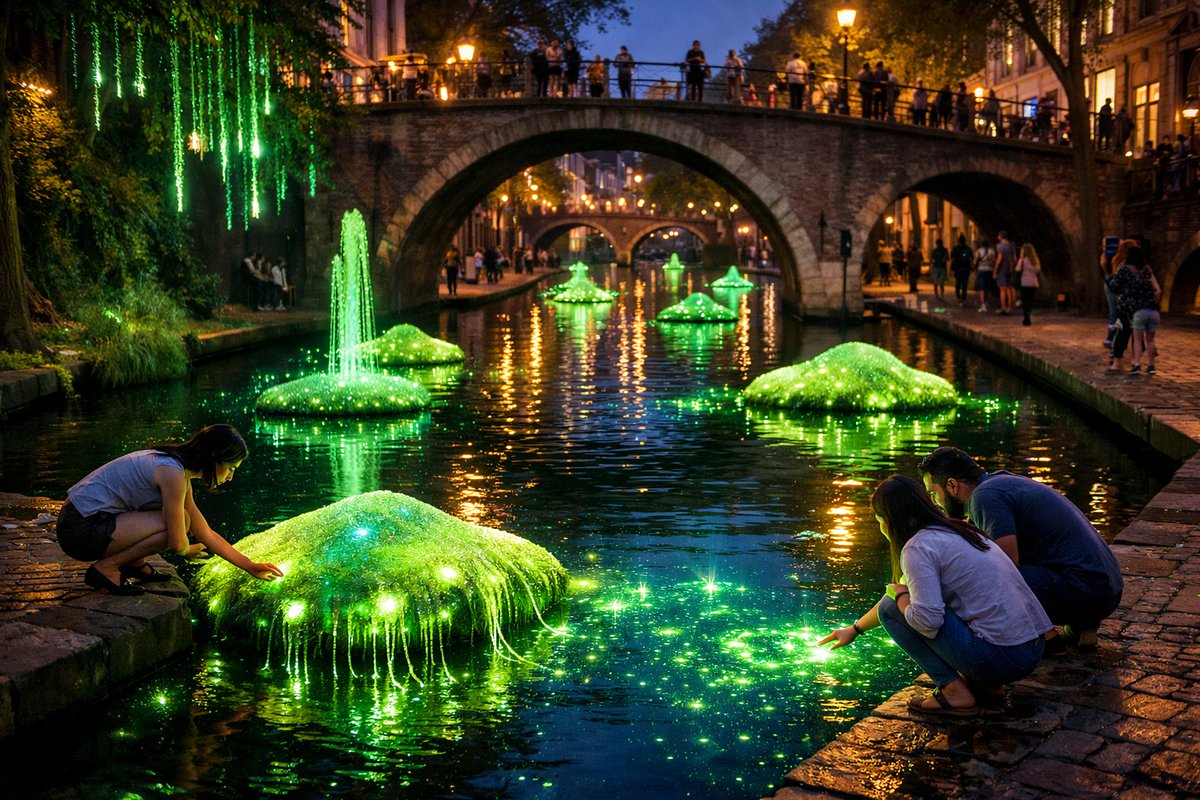

In a quiet harbor district renowned for its maritime heritage, the water has begun to glow. Earlier this spring, an art collective and a team of microbial ecologists unveiled a series of bioluminescent algae installations along the waterfront, revealing a luminous choreography of living organisms that pulse and shimmer in response to human presence. Dubbed “Luminous Currents,” the project positions itself at the intersection of art, science, and environmental stewardship, turning public canals into dynamic lightscapes.
By day, the installations resemble floating pods tethered to the dock-transparent spheres and slender buoyant tubes filled with seawater and carefully cultured bioluminescent algae. After dusk, tiny chemical reactions within each cell produce a soft blue-green glow, casting an otherworldly light across rippling surfaces. As passersby walk along the embankment, motion sensors and low-frequency hydrophones pick up footsteps and distant boat engines, triggering gentle flares of brilliance that expand and contract like living breaths.
This seamless integration of biotechnology and interactive design is the result of a yearlong collaboration between the art collective FluidEcho, a local marine research institute, and the city’s sustainability office. From the outset, the partners prioritized ecological safety: the algae species are contained in closed-cell vessels and sterilized at project’s end to prevent any unintended release. The water exchanged daily undergoes filtration and UV treatment, ensuring the surrounding ecosystem remains undisturbed.
Lead curator Jamie Serrano explains that combining living organisms with public infrastructure offers a radically different approach to urban lighting. “Traditional electric fixtures can feel static and impose on the environment,” Serrano says. “Here, the light source is alive and responsive. It invites curiosity about the natural world and reminds us of our connection to unseen biological processes.”
The underlying science taps into decades of research on marine bioluminescence. Certain dinoflagellate species emit light when stressed or agitated-a defense mechanism in the open ocean. By carefully tuning water flow, nutrient levels, and gentle agitation via micro-pumps, the design team creates predictable light pulses that avoid overstressing the organisms. Each sphere is equipped with slimline LED panels and miniature stirrers connected to solar-charged batteries, ensuring minimal power consumption.
Local residents have already embraced the installations as part of their evening strolls. “It’s like walking through a constellation on water,” says one visitor reclining on a dockside bench. Children gather at the railings, tapping the motion panels to coax bursts of luminescence. Even seasoned boat operators adjust their course slightly to glide alongside the glowing pods, marveling at the living light show.
Beyond its aesthetic appeal, “Luminous Currents” advances a broader dialogue about sustainable design. The project showcases how bio-based systems can complement-or even replace-energy-intensive infrastructure. City officials are monitoring the installations’ energy footprint and water use, evaluating them as prototypes for eco-friendly lighting in other waterfront zones and public parks.
Critics note that the approach still depends on mechanical and electronic components that require maintenance. Yet the modular design allows for quick replacement of malfunctioning units. The research team has documented algae growth metrics, ensuring blooms remain healthy over the course of the season. At the project’s conclusion, all biological materials will be safely composted or used as fertilizer, closing the loop on resource use.
Artists around the globe have taken notice. A parallel initiative in Southeast Asia is exploring a floating light garden made from programmable jellyfish-like orbs grown from cellulose scaffolds. In North America, architects are investigating bioluminescent facades for pedestrian bridges, while gallery curators discuss indoor micro-labs where visitors can watch living pigments glow under microscopes.
On the technical side, developers are experimenting with augmented reality overlays that allow smartphone users to visualize the cellular activity driving each flash of light. By scanning a QR code on a sphere, visitors access a simple interface showing real-time bioluminescence readings, water temperature, and nutrient cycles. This data adds a layer of transparency, inviting people to engage intellectually as well as visually.
Even city planners are intrigued by the possibilities. Public transportation stops, bike lanes, and pedestrian underpasses-spaces that often lack inspiring lighting-could be enlivened with similar bio-responsive installations. Imagine a canal-side bike path where each pedal revolution sends ripples of light through suspended algae tubes, or a pedestrian tunnel lined with slender columns that glow brighter as foot traffic increases.
The philosophical implications are equally compelling. By entrusting part of the urban lightscape to living organisms, designers encourage empathy with nonhuman life forms. The installations act as a subtle prompt: every surge of brightness represents a tiny organism’s response to external stimuli. It’s a reminder that cities cohabit with countless unseen species, and that technology need not alienate us from nature but can instead forge new bonds.
Of course, scaling up presents challenges. Maintaining optimal growth conditions in large open basins demands rigorous monitoring and backup filtration systems. Seasonal temperature shifts can slow down cellular metabolism, dimming the glow. And public safety concerns-particularly around slippery dock surfaces-require careful planning of viewing platforms and nonconductive railings.
Still, the success of the waterfront prototype has sparked conversations among municipal leaders and cultural institutions. Plans are already underway to install a smaller version along a canal in a neighboring city, this time incorporating red and green fluorescent proteins to expand the palette beyond blue-green hues. There’s even talk of pairing the algae modules with floating gardens of sea lettuce and kelp, creating mixed ecosystems that contribute to water filtration and habitat enrichment.
Back at the harbor, the twilight glow offers a fitting backdrop for impromptu gatherings. Musicians set up near the edge, performing ambient pieces that sync with the water’s pulses. Photographers station tripods, capturing long exposures that blend city lights with organic bioluminescence. Joggers pause for a moment, bathed in gentle radiance before continuing their route. In these moments, the living art installation transcends novelty-it becomes part of the neighborhood’s collective memory, a shared experience of wonder and reflection.
As the season progresses, researchers will track community engagement and ecological metrics. How do people perceive safety in a softly lit environment? Does the presence of living light increase foot traffic and support nearby businesses? What maintenance strategies prove most cost-effective? The answers will inform future iterations and help determine whether bio-responsive lighting can find a permanent place in urban planning
Ultimately, “Luminous Currents” poses a fundamental question: can our cities embrace forms of public art that are not only aesthetically compelling but alive-responsive to both human touch and natural rhythms? If early signs are any indication, the marriage of biotechnology and design may well herald a new era of sustainable illumination, where the boundary between organism and infrastructure dissolves into a shared glow.
This experiment in waterfront bioluminescence challenges us to imagine new relationships with our living planet, to see art and ecology not as separate domains but as partners in shaping the spaces where we gather, rest, and dream.