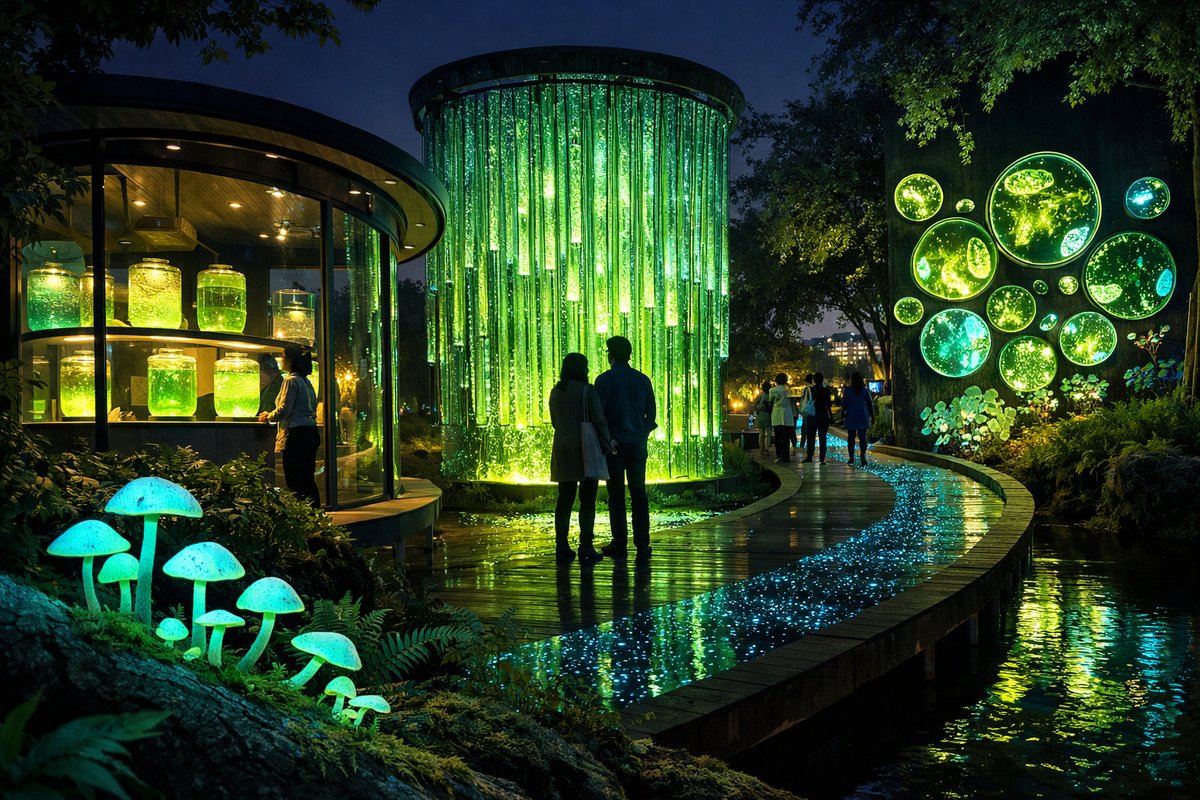

The interplay between life and light has found an unexpected canvas in contemporary art. Across cities from Tokyo to Bogotá, designers are turning to bioluminescent organisms-tiny algae, bacteria, and fungi that glow when triggered-to create living sculptures and luminous installations. These artworks not only captivate with their organic radiance but also prompt deeper questions about sustainability, systems thinking, and the boundaries between art and science. By inviting viewers into environments that pulse with a living glow, bioart practitioners are reshaping exhibition spaces into ecosystems that respond to environmental conditions and human interaction, forging a new chapter in the story of visual expression.
One of the most talked-about showcases of this trend took place at a recent design fair in northern Europe, where a pavilion built entirely around panels of bioluminescent algae drew record attendance. Visitors watched as gentle currents circulated through clear acrylic tubes, nourishing colonies of plankton whose luminescence swelled and dimmed in rhythm with ambient soundscapes. Curators describe the effect as “a living light orchestra,” and festival organizers note that the installation consumed a fraction of the energy typical of neon or LED displays. Its success points toward an appetite for artworks that marry aesthetic wonder with eco-friendly engineering.
At the heart of each exhibit is a delicate laboratory infrastructure adapted for the gallery setting. Sterile petri dishes and growth flasks evolve into transparent walls; programmable pumps maintain water quality and nutrient cycles; temperature and pH sensors feed data to control units that modulate flow and illumination. Artists partner with microbiologists to tailor culture media-often based on low-impact ingredients like agar from seaweed-to sustain bioluminescent species without toxic byproducts. The result is a closed or semi-closed system that can run for weeks or months without replacement, demonstrating how principles of aquaponics and closed-loop agriculture can translate into immersive art.
Bioluminescence itself is a marvel: a chemical reaction in which enzymes called luciferases oxidize light-emitting substrates called luciferins. Different species produce characteristic hues-ranging from ethereal blue of marine dinoflagellates to greenish glows of certain fungi. By layering cultures of multiple organisms or engineering conditions that favor one biochemistry over another, artists craft gradients and patterns of shifting color. Some use near-UV LEDs to trigger the reaction on demand, allowing scheduled light shows or interactive responses to sound and motion. Others experiment with genetically unmodified strains, ensuring that regulatory hurdles remain minimal while preserving complex natural behaviors.
Sustainability sits at the core of this aesthetic. Traditional light installations can rely on materials that are difficult to recycle, require high energy consumption, or contain hazardous metals. In contrast, living light structures often run on low-wattage pumps and minimal artificial illumination, sometimes supplemented by solar panels or human-powered generators in outdoor settings. When an exhibit concludes, cultures can be responsibly neutralized, and vessels repurposed for other displays. This lifecycle approach aligns with circular design philosophies-prioritizing durability, reuse, and minimal waste-and invites other creative industries to rethink how materials and organisms can form regenerative systems.
Interaction is another defining feature. Some installations respond to the proximity of onlookers: infrared sensors detect motion and modulate water flow, causing pulses of glow that ripple outward like bioluminescent waves. Others integrate biometric data, such as heart rate, captured by wearable devices to tailor the intensity or rhythm of the luminescence. By giving audiences a direct role in programming living art in real time, bioart fosters a participatory experience that blurs the line between observer and co-creator. This dynamic underscores a shift from passive viewing to embodied engagement, turning exhibitions into laboratories for collective exploration.
Public spaces are also embracing bioluminescent design. In one coastal park, a permanent walkway is lined with sealed glass columns containing renascent cultures of marine plankton, softly illuminating paths at dusk. Another city launched a pilot program to coat pedestrian bridges with phosphorescent panels seeded with fungal spores, effectively turning structural supports into living, glowing tapestries. City planners report positive feedback: residents feel a stronger connection to local ecosystems, and nighttime lighting bills have dropped significantly. These projects demonstrate that bio-responsive art can extend beyond galleries, providing functional lighting solutions that engage communities and foster ecological awareness.
Despite excitement, bioart raises ethical and regulatory questions. Containment protocols must prevent unintended release of non-native organisms, and health authorities often require strict sterilization measures after exhibits conclude. Moreover, sourcing cultures sustainably is crucial to avoid depleting wild populations or relying excessively on commercially propagated strains that may carry undisclosed genetic modifications. Many practitioners collaborate with universities and environmental agencies to secure permits and establish best practices-emphasizing transparency, open documentation, and peer review. This framework helps ensure that living art contributes positively rather than introducing ecological risks.
Economically, the lower energy footprint and reusable materials make bioluminescent installations cost-effective over time, despite initial investments in laboratory equipment. Local governments and corporations seeking green branding increasingly commission these artworks for plazas, atriums, and corporate gardens. Event organizers appreciate the novelty and shareability of living light, which often goes viral on social media, amplifying cultural impact. The field has also sparked startups that offer turnkey bio-lighting solutions, merging biotech R&D with design consultancy. As the technology matures, bulk-manufactured modules may become accessible to smaller galleries and educational institutions, democratizing the tools for bioart creation.
For artists, the collaboration across disciplines is both exhilarating and humbling. One designer describes the process as “learning to speak the language of microorganisms,” acquiring skills in sterile technique alongside compositional instincts. Workshops now teach bio-fabrication as part of art and design curricula, combining lab safety with creative prototyping. These programs often include modules on sustainability ethics, public engagement strategies, and even coding for sensor integration. The result is a generation of practitioners fluent in hybrid vocabularies-equally comfortable writing a shader for projection mapping and preparing culture media under a laminar-flow hood.
Looking ahead, the possibilities seem as boundless as nature’s ingenuity. Researchers are exploring self-healing surfaces that regenerate glow after damage, or wearable garments embroidered with cellulose matrices capable of hosting bioluminescent bacteria. Scientists envision emergency signage that glows without power in disaster zones, or interior design elements that shift ambience through natural cycles rather than electric timers. As materials science intersects ever more deeply with synthetic biology, bio-responsive pigments may become commonplace in paints, plastics, and textiles. If culture and city life become ever more intertwined with living systems, our definition of “public art” may expand to include entire breathing infrastructures.
Bioart’s rise represents more than a novel medium; it signals an ethos that values curiosity, stewardship, and co-creation with the living world. By harnessing organisms that glow, designers illuminate not just spaces but also the intricate relationships between humans and ecosystems. These installations invite a reconsideration of waste, energy, and the role of beauty in sustainability. Whether on a museum floor or a waterfront promenade, living light installations remind us that art can be as much about nurturing as it is about display, forging luminous connections that endure long after the glow fades.
-
LUMINESCENT SCIENCE LAB - Walmart.com
Chlorella, Living Green Algae Culture, Enough Materials For A Class Of 30 ... Specifications. Chemistry experiment kit type. Chemistry Experiment Kit. Edu ... -
Green Water Algae Culture Kit – Live Starter + Nutrient + Jar + Air ...
Algae fertlizer nutrient (enough to make 5 gallons). Green Water – Live Algae Culture Kit. Produces live green water — a nutrient-rich culture of ... -
Bioluminescent Algae Growing Kit With Light – Glow Like a Pro ...
Algae Growing Kit - Science Projects and more! Algae Growing Kit - Science Projects and more! $19.95 · Cute algae Dinoflagellates/ Bioluminescent plankton/ ... -
Nutrient Agar Kit, Includes 20 Sterile Petri Dishes with Lids ... - Walmart
Nutrient Agar Kit, Kit Includes Dry Ingredients Necessary to make 600ml of Nutrient Agar Solution, Kit Includes 20 100mm x 15mm Sterile Petri Dishes with ...