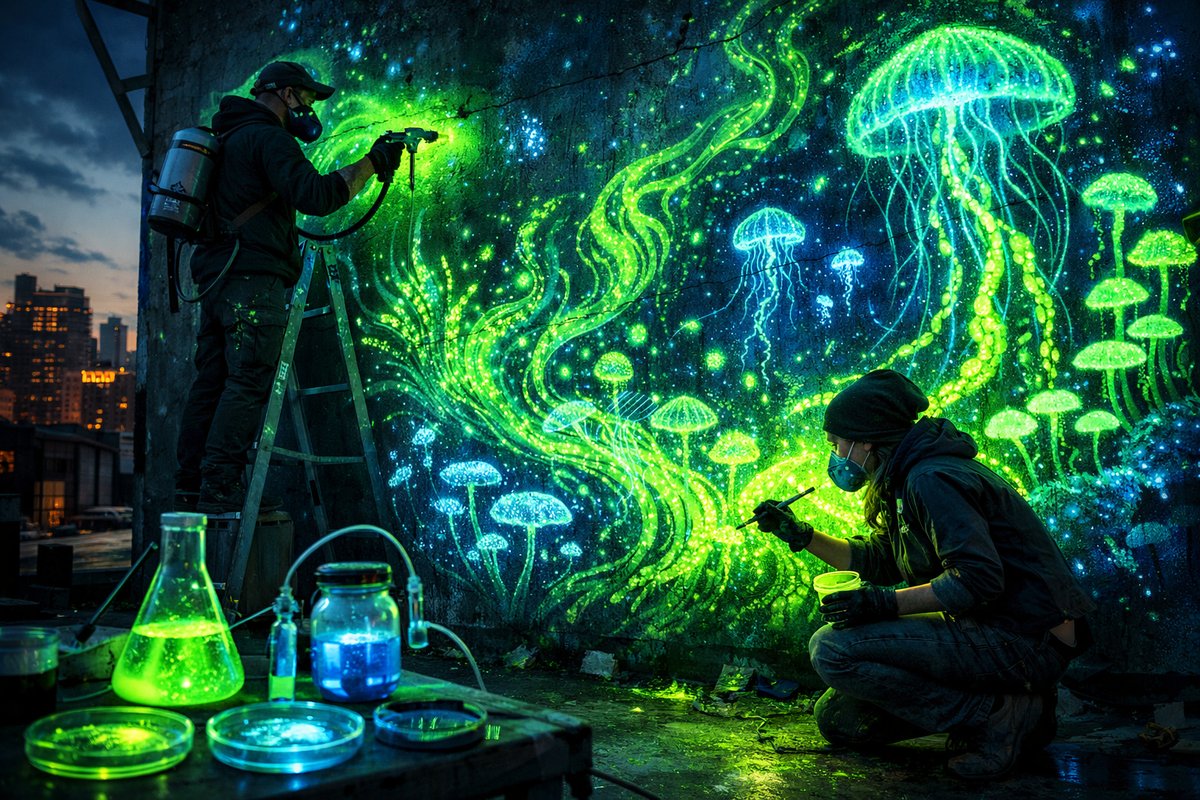

In alleys and plazas from Tokyo to São Paulo, a quiet revolution is unfolding on concrete walls. Instead of ordinary spray cans and acrylic brushes, a growing number of artists are applying bioluminescent paint-a living, glowing medium that pulses with life long after dark. This emerging practice sits at the intersection of synthetic biology, sustainable design and public art, inviting passersby to experience street murals as evolving ecosystems rather than static visuals.
The chemistry behind bioluminescent paint springs from decades of research into glowing marine organisms and genetically modified microbes. Early efforts focused on extracting luciferin from deep-sea plankton or engineering bacteria to emit light. Today, open-source communities and eco-design studios are refining these foundations into ready-to-use pigments that retain viability on urban surfaces. The result is a palette that emits soft green, blue or amber light without external electricity-ideal for lighting up underpasses, park walls or community centers after sunset.
Artists working with living luminescence face a radical departure from traditional mediums. Instead of thinking about pigments as inert substances, they must consider nutrients, oxygen supply and temperature stability to keep microbes active. Special binders made from cellulose or plant-based gelatin help anchor the organisms while allowing moisture exchange, creating a thin, self-healing matrix that sustains the glow. In colder or drier climates, artists may integrate microcapsules that slowly release hydration, ensuring the paint remains luminous through changing weather.
Beyond technical ingenuity, bioluminescent murals challenge notions of permanence and ownership in public art. A painted wall that glows tonight may dim in weeks or weeks if left untended-transforming public spaces into living canvases that require community engagement and stewardship. In Buenos Aires, a coalition of neighborhood residents collaborates with bioartists to maintain a series of glowing geometric patterns along a busy bus route. Volunteers water the murals with nutrient sprays and monitor light intensity, forging a collective guardianship over the art itself.
The storytelling potential of living light goes beyond aesthetics. By encoding simple patterns of on-off pulsations, some artists are embedding messages or interactive sequences into their work. In one installation at an urban agriculture fair, a mural of swirling vines emitted a steady glow that shifted into Morse code, spelling out conservation tips and seed-saving advice. Visitors who decoded the signals left with printed translations, turning a stroll past the artwork into an educational treasure hunt.
Public response to these glowing murals has been overwhelmingly positive. Night-time pedestrian traffic in treated areas often spikes, as residents gather to watch the gentle pulses of light. Social media feeds fill with time-lapse videos of walls that softly shift hue over minutes and algorithms that interpret the intensity variations. Municipal arts councils in Europe and North America are even piloting grants to support bioluminescent projects, viewing them as safe, energy-free solutions for beautifying underutilized spaces after dark.
Yet the movement is not without controversy. Critics point out that introducing non-native microbes into the environment carries ecological risks. To address these concerns, responsible practitioners work with contained, non-replicating strains that cannot survive outside their synthetic binders. Many of the latest pigment formulations employ “kill-switch” genes, ensuring that if the microbes escape their painted habitat, they self-deactivate. Ethical guidelines released by a coalition of biohackers emphasize transparent sourcing, community consent and thorough ecological impact studies before any large-scale deployment.
The rise of living light in street art complements other trends reshaping public spaces. In cities where green walls, solar-powered sculptures and responsive LED networks are already common, bioluminescent murals add a new dimension: a medium that literally breathes, metabolizes and fades. As energy costs rise and urban lighting regulations become more stringent, the appeal of an off-grid glowing solution grows. Local governments are taking notice, exploring pilot programs that overlay bioluminescent installations with motion sensors. After hours, walls glow softly; when pedestrians approach, the light brightens, guiding the way without harsh glare.
Behind the scenes, designers and architects are integrating bioluminescent systems into larger infrastructure projects. Imagine park benches with built-in microbe-coated panels that subtly glow at night, or bike lanes delineated by living luminescent strips. Even temporary pop-up festivals are experimenting with low-light maps that come alive only after dusk, using swabs of living paint to direct crowds and highlight key features.
Education and accessibility remain priorities for advocates. Workshops led by community makerspaces teach participants how to culture safe bioluminescent strains and mix their own paint. Open-source repositories host step-by-step protocols, complete with material safety data sheets and troubleshooting guides. By demystifying the science behind the glow, these initiatives aim to empower a generation of citizen bioartists who treat walls as both laboratory and gallery.
From a philosophical standpoint, glowing murals prompt us to reconsider our relationship with the built environment. Instead of flat, immutable facades, we can embrace surfaces as living collaborators-entities that respond to time, climate and human care. In this light, a city becomes a grand, participatory organism, where art and biology converge to illuminate the night.
Looking forward, the technology is poised for further democratization. Researchers are exploring pigment variations that shift color based on air quality or ambient sound levels. A future mural might flare from green to red if pollution spikes, or ripple in response to passing traffic noise. Such responsive installations could serve as both aesthetic marvels and real-time environmental monitors.
As living light art moves from niche exhibitions into city streets, it sparks questions about sustainability, public engagement and the evolving role of art in everyday life. Can a painted wall truly become a shared ecosystem? What happens when a mural’s glow fades unless the community steps in? And how might living art redefine our notion of permanence?
For now, passersby in dimly lit urban corridors can witness faint pulses of green or blue, a reminder that even the most concrete-bound cityscape can breathe. These glowing expressions merge cutting-edge science with creative curiosity, proving that public art still has the power to surprise-this time through the living flash of microscopic life.
Welcome to the era of bioluminescent murals, where walls come alive, glow without power and invite us all to become stewards of light.