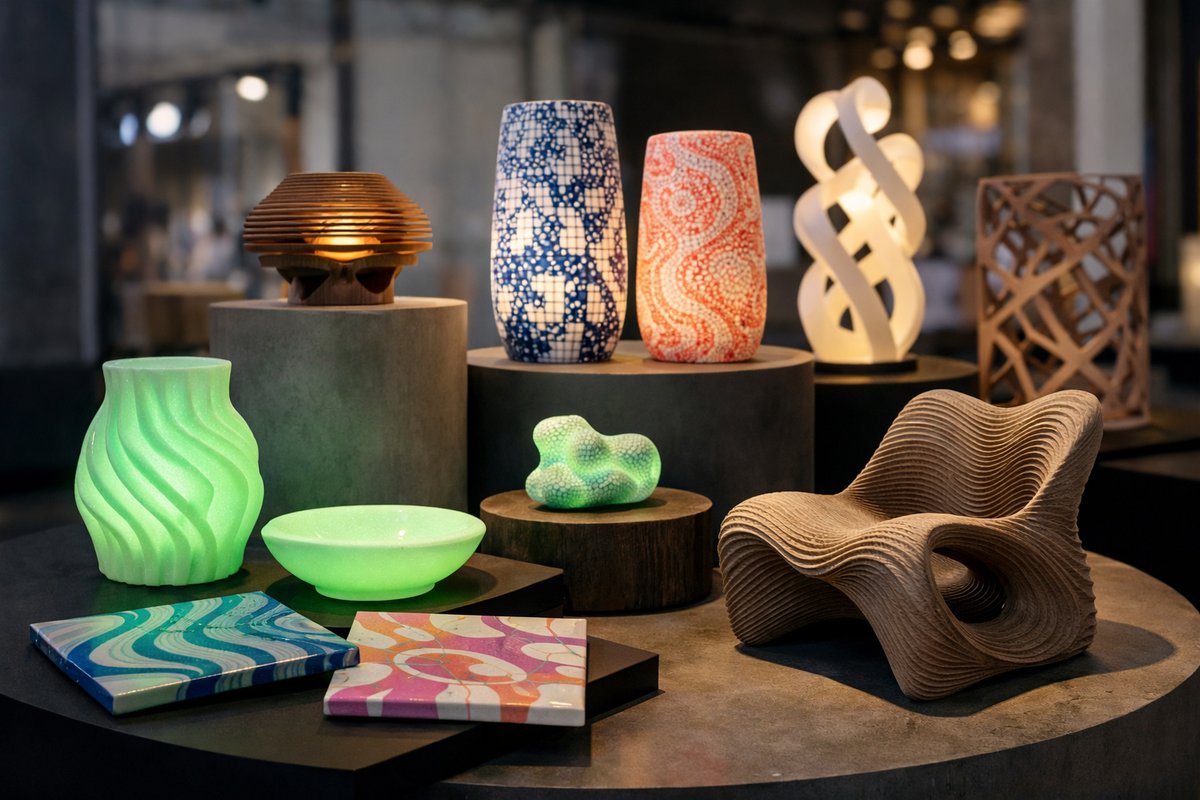

When you step into the vaulted halls of Barcelona Design Week, the familiar hum of conversation mingles with a soft, phosphorescent glow emanating from sculptural forms scattered around the space. These glowing vessels and interlocking tiles aren’t merely decorative experiments-they embody a vision of design as a dialogue between ancient craft and cutting-edge algorithmic tooling. Across several pavilions, the interplay of light-reactive ceramics, generative motifs, and wood-composite prints suggests a future in which sustainability and curiosity drive each other forward.
One of the festival’s most talked-about installations features a series of bowl-shaped vessels cast from a bespoke clay blend infused with photoluminescent powder. After charging under ambient LEDs, these pieces exude a soft emerald radiance in low light, tracing fingerprints and brush marks in the dark. The effect evokes prehistoric luminescent minerals, but the technique rests on a modern chemistry of strontium aluminate pigments-a durable and non-toxic alternative to the earlier radium-based glazes of the mid-20th century.
The artist behind these glowing ceramics describes the process as a bridge between material memory and emergent display technology. While handcrafted forms recall centuries-old wheel-throwing traditions, charging them under programmable light arrays introduces a variable, almost digital quality. Visitors can timing-shift the glow cycles by adjusting the color temperature and flicker of overhead luminaires, creating an interactive choreography of pottery and photon.
This exploration of light is echoed across the adjacent hall, where a company specializing in generative algorithms collaborated with a collective of clay workers to produce AI-drawn glaze motifs. Using an open-source software environment, the designers trained a neural network on thousands of traditional ceramic patterns from Mediterranean and East Asian archives. The result is a dynamic library of abstract arabesques and organic line-drawings that can be directed toward a variety of vessel shapes and sizes.
Projected onto each form before firing, these AI-generated patterns guide artisan painters who then meticulously trace and fill in the line work with colored slips. The process preserves a human rhythm-every brushstroke carries subtle variations-while accelerating the ideation phase. Artists can preview dozens of pattern permutations in minutes, selecting and refining the most compelling ones. This hybrid workflow reveals how machine intelligence serves not as a replacement for craftsmanship but as a source of new aesthetic possibilities.
Elsewhere in the fair, sustainability takes center stage through a series of large-scale wall panels 3D-printed from a custom wood composite filament. Developed by a Barcelona-based design studio, the material combines recycled sawdust with a biodegradable binder to achieve a warm, fibrous texture reminiscent of cross-cut timber. Layer by layer, the printer constructs intricate lattice structures and biomorphic reliefs that recall coral reefs and dendritic root systems.
These wood-based prints were conceived as acoustic panels for open-plan studios and galleries. Beyond their visual appeal, the undulating surfaces help diffuse sound and reduce reverberation-a functional nod to how organic form and environmental performance can merge in new architectural elements. Some installations incorporate planters nestled within the lattice, allowing moss and trailing vines to grow through gaps and further soften the geometry.
In a nearby corridor, a projection mapping experiment pushes the ceramic experiments into immersive territory. A grouping of white, unglazed tiles forms a seamless wall that serves as a canvas for animated digital motifs. As viewers move in front of the surface, motion-tracking cameras trigger shifting patterns of color and light that crawl across the earthen matrix. The digital imagery responds to footsteps, hand gestures, and even ambient sound levels, wrapping analog craftsmanship in a responsive, time-based performance.
This tension between the fixed and the ephemeral-the permanence of clay versus the fluidity of light-recurs as a theme throughout the event. One installation invites participants to press fresh finger-impressions into a slab of damp clay, which is then scanned and processed to generate a unique digital pattern. That motif is projected back onto a set of fired tiles, closing a loop between human touch, algorithmic abstraction, and material realization.
Philosophically, the fair embraces a belief that future design will require empathy for natural processes and humility before emerging systems. Workshops and panel discussions focus on circular material flows: how to recover glaze runoff, recycle failed prints, and design for disassembly. One talk examines how local clay deposits can be revitalized to reduce carbon-intensive shipping, while another investigates the lifecycle of hybrid biopolymers used in light-reactive coatings.
Beyond these technical and ecological concerns, the festival shines a light on curiosity itself as a driver for innovation. Many booths feature “lab corners,” micro-studios where practitioners tinker with pigment ratios, filament recipes, and code parameters in real time. Visitors can preview experimental batches of photoluminescent glazes or swipe through generations of AI sketches on interactive touch tables.
This spirit of open experimentation is by design. The organizers intentionally de-emphasize polished showroom finishes in favor of raw prototypes and live trials. The goal is to foster cross-pollination between ceramics, digital art, architecture, and material science. As one curator explains, “When you bring these different communities together under one roof, you start to see emergent hybrids-forms that none of us would have predicted on our own.”
The fair’s lingering impact lies in its invitation to reimagine the boundaries of craft. Rather than pitting high tech against handmade, the showcased works present a synthesis in which light-charged glazes, AI-driven patterns, and waste-derived composites become part of a cohesive design grammar. It suggests that the future of visual expression may hinge on practices that respect both the slow, tactile knowledge of traditional materials and the expansive reach of computational design.
For designers and makers inspired by these innovations, the fair offers a blueprint for ethical collaboration and material stewardship. The photoluminescent ceramics remind us that beauty can evolve over time, blossoming in response to illumination. The AI-generated motifs reveal a code-based aesthetic that still honours the human stroke. The wood composite prints point to a circular economy where industrial byproducts gain new life in architectural furnishings.
In the end, Barcelona Design Week’s glow-and-grain narrative emerges as a testament to what happens when curiosity, sustainability, and emotional intelligence intersect. It charts a path forward for a design ethos that values revelation as much as resolution, process as much as product. As the last visitors depart and the lights dim on the luminescent ceramics, the afterglow lingers as a metaphor for ideas yet to be fully realized-a softly pulsing invitation to continue exploring the evolving relationship between hand and machine.