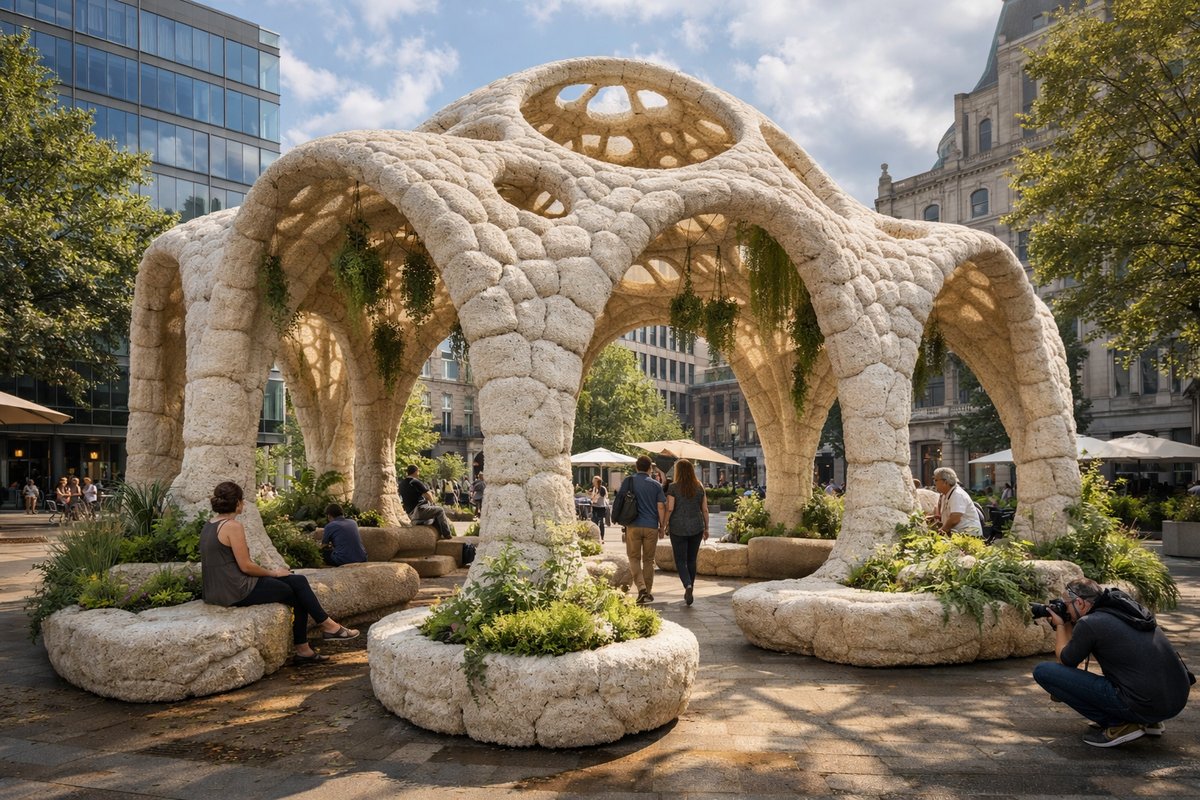

A new landmark has appeared in a bustling urban plaza: a pavilion that seems more organism than structure. Crafted from living fungal networks, its ribbed arches pulse with soft, organic textures, stretching ten feet high yet weighing mere hundreds of pounds. Visitors are invited to touch its spongy walls, step inside a vaulted canopy and witness tiny spores dispersing in clouds of microclimate humidity. This installation marks one of the first large-scale applications of mycelium-based art in a public space, signaling a shift toward living architecture and interactive design that views buildings as evolving ecosystems rather than static backdrops.
Behind the pavilion’s surreal presence lies a meticulous process that blends digital fabrication with biology. Designers first used desktop 3D printers to create a lattice of biodegradable polymer molds shaped like elongated ribs. Each mold was filled with a carefully calibrated mix of agricultural waste, recycled sawdust and nutrient-rich grain. Next came inoculation: the mixture was seeded with a strain of fungal mycelium cultured in sterile bioreactors. Over days in a climate-controlled chamber, white filaments spread through the substrate until the molds were fully colonized, bonding into rigid yet lightweight panels. Once the mycelium had consumed its feedstock, the team dried the forms to halt growth, producing durable sections that clicked together like puzzle pieces on site.
Maintaining the right balance of moisture, temperature and airflow proved one of the biggest challenges. In the growth phase, slight temperature fluctuations could slow colonization or lead to contamination by unwanted microbes. High humidity was critical for filament expansion, but excess moisture risked structural collapse. To manage this, the design team installed a network of smart sensors and low-power humidifiers inside the incubation chamber. Data streams tracked humidity levels to within one percent accuracy and triggered misting cycles when readings dipped. Growth rates accelerated as designers optimized these feedback loops, shaving days off production and improving panel integrity for public display.
Conversations with the collective reveal that the experiment was as much about material innovation as storytelling. One designer described the pavilion as a “conversation between humans and fungi,” emphasizing partnerships over domination. No paint was applied, no synthetic sealants used. The surface finish came purely from the density of the mycelial network, yielding a velvety texture with subtle variations of white and tan. Under spotlights at night, the installation glowed softly, its surface reflecting light like living bone. Daylight revealed delicate ridges where filaments had followed gravity’s pull, mapping out a fresco painted by nature itself.
Beyond its visual impact, the pavilion carries a deep sustainability message. Mycelium is fully biodegradable, can be cultivated on local waste streams and requires far less energy than concrete or steel. When the exhibit closes, sections can be composted or repurposed for smaller-scale installations. This cradle-to-cradle approach aligns with circular economy principles, challenging conventional architecture’s heavy carbon footprint. By demonstrating that large-scale structures can grow from agricultural byproducts, the installation offers a blueprint for future developments that minimize waste and harness biology’s regenerative power.
The implications extend into domestic and commercial design as well. Furniture prototypes have emerged that use the same mycelial process to form chairs, side tables and floor lamps. These objects are surprisingly strong under compression yet light enough to move with ease. In some explorations, mycelium blocks are embedded with natural pigments, producing furniture with muted earth tones and marbled patterns. Textiles dyed with fungal pigments offer another frontier: scarves and upholstery fabrics that change hue under varying pH levels, reacting to air quality or skin contact.
Across maker labs and community workshops, teaching kits have sprung up to let enthusiasts experiment with mycelium growth at home. Participants learn to sterilize grain jars, inoculate substrates and adjust environmental conditions for healthy filament expansion. These classes spark curiosity about biology and percolate through art schools, engineering departments and hobbyist circles alike. Online forums buzz with tips on ideal growth media ratios or DIY incubation box designs. By decentralizing biodesign education, the movement gains momentum and feeds a culture of open-source experimentation.
Technical hurdles remain, however. Scaling up to larger spans without internal supports pushes the limits of fungal tensile strength. Teams are testing hybrid builds that reinforce mycelial panels with hemp fiber, bamboo rods or biodegradable resins activated by ultraviolet light. Other efforts explore real-time biofeedback, embedding moisture sensors within panels to monitor structural health and trigger ventilation adjustments. Advances in low-cost digital microscopy could allow builders to inspect filament density at the layer level, ensuring consistency before drying.
Philosophically, living installations invite us to reconsider the boundaries between organism and artifact. When a pavilion responds to humidity by releasing spores, is it a sculpture, a building or a form of communication with unseen fungal networks? Such works provoke questions about agency in design, ethical stewardship of living materials and the rights of nonhuman life forms in creative practices. As urban environments adopt more bioactive elements-walls that break down pollutants, street furniture that nourishes soil-public perception of cities may shift from concrete jungles to collaborative ecosystems.
On the commercial side, startups backed by venture funds are racing to patent optimized fungal strains and proprietary growth protocols. Some design firms partner with material science labs to develop premium mycelium composites tailored for weather resistance or acoustic insulation. Regulatory bodies are beginning to draft guidelines for the safe use of living materials in public settings, addressing concerns around allergenic spores or invasive species. As standards emerge, the market for mycelium-based products could expand rapidly, disrupting established construction and furniture industries.
Whether sculptural pavilion or living lamp, each mycelium creation carries a story of symbiosis and creativity. The recent pavilion stands as an invitation to experience art that breathes, shifts and decays in tune with its surroundings. For designers, engineers and curious citizens alike, it opens a portal to a future where built environments are not imposed on nature but emerge in concert with it. As spores settle on the plaza’s paving stones, they leave behind more than a footprint-they plant seeds for a new dialogue between art, ecology and the living world beneath our feet.