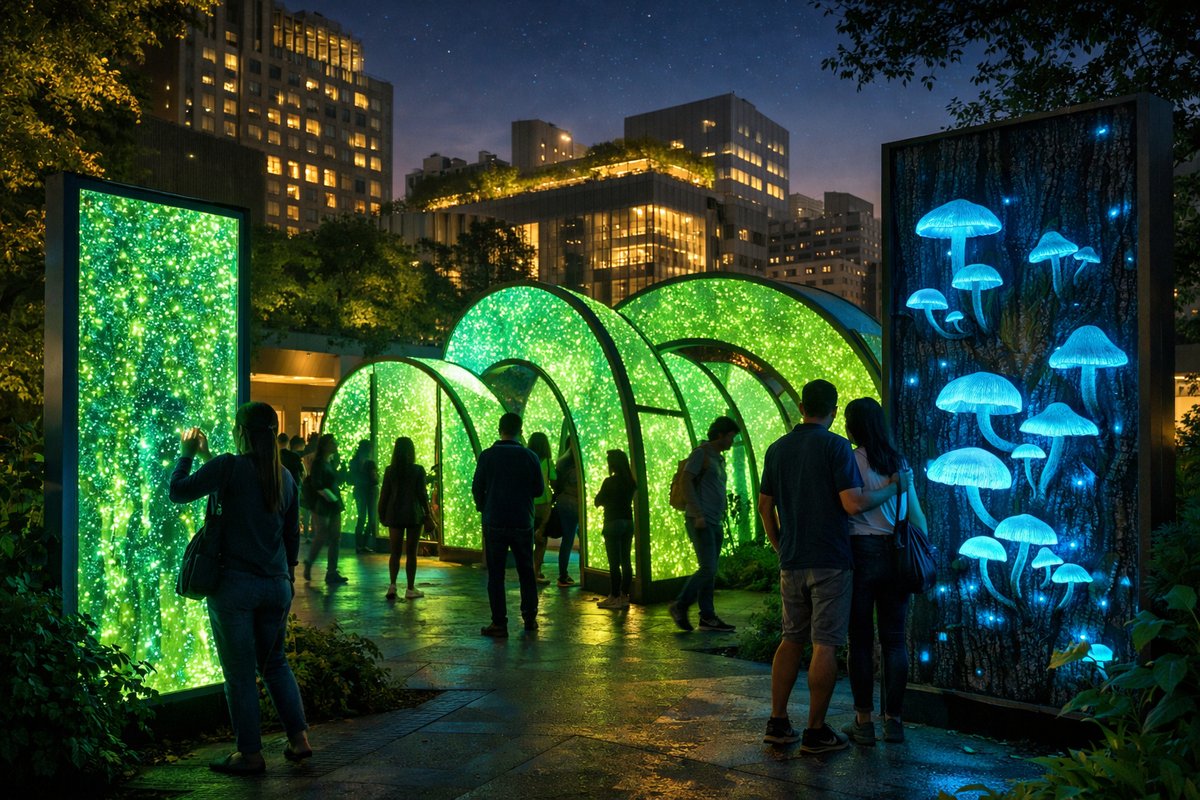

A dimly lit pedestrian thoroughfare pulses with cool green light as passersby pause in wonder. Rather than projection mapping or LED arrays, the glow emanates from living organisms embedded in transparent panels. This month, an interdisciplinary collective unveiled a series of bioluminescent installations across a renovated inner-city plaza, mixing microbiology, polymer design, and interactive electronics to reanimate public space. The result blends art, ecology, and technology into an urban light show that literally breathes.
The project began when a group of designers, scientists, and architects secured an unused glass canopy in a central square. Their goal was to demonstrate alternative approaches to urban illumination that reduce energy consumption and spark curiosity about living systems. They turned to certain strains of dinoflagellates-single-celled marine algae known for bioluminescent flashes-and to bioluminescent fungi derived from mushroom species. Both organisms emit light through chemical reactions, requiring only a nutrient medium and precisely controlled temperature.
Rather than flat aquaria or petri dishes, the collective engineered custom polymer panels infused with hydrogel microchambers. Each chamber holds a small colony of light-emitting cells suspended in a semi-solid agar matrix. When properly maintained, these colonies produce a soft glow for weeks at a time. Automated microfluidic pumps replenish nutrients and remove waste, all driven by low-voltage electronics. A backup LED array ensures continuous illumination during maintenance cycles, seamlessly fading into the living glow to avoid abrupt dark intervals.
Sensors embedded in the installation respond to human presence. Infrared motion detectors and ambient light meters feed a microcontroller that adjusts nutrient flow and temperature to coax brighter emissions as more people approach. Visitors can also activate short bursts of brighter luminescence via touch-sensitive panels. The effect is theatrical: a group walking side by side triggers a wave of light cascading along the row of panels, like a living waveform responding to crowd energy.
Behind the scenes, maintaining bioluminescent colonies in a public setting demands veterinary-level care for single-celled creatures. The collective partnered with microbiologists who monitor pH levels, salinity, and oxygen content daily. Nutrient formulas were adapted from marine science protocols, balancing cost and efficacy. Fungal strains required different conditions-cooler temperatures and periodic darkness. Custom software coordinates two parallel ecosystems within the same structure.
On opening night, a steady stream of curious onlookers gathered beneath the glowing canopy. Some tentatively placed fingers on sensor pads to trigger luminescent pulses; others formed small circles to see how group size influences brightness. Informational placards explained the organisms’ natural biologies and the installation’s sustainability goals: a net energy consumption that rivals a single smartphone charger. The collective hopes to spark conversations not only about public art, but about humanity’s relationship with living systems.
Artists have long sought eco-conscious materials, from reclaimed wood to moss walls. But living bioluminescence takes that impulse a step further: the material itself breathes, grows, and eventually fades, mirroring life cycles. The glow panels are modular, designed for easy removal and transport to new locations. After several months in the plaza, they will be decommissioned, the organisms returned to laboratory cultures, and the polymer housing refurbished for a festival later in the year.
This ephemeral quality resonates with current cultural currents around impermanence and regeneration. Visitors often remark on the contrast with static neon signs or battery-powered fixtures. Here, the glow ebbs and flows like a natural phenomenon, subject to microbial vitality and environmental variables. In daylight, the panels appear as simple clear frames; by dusk, they become living lanterns.
The technical team emphasizes that the project is a proof of concept, not a turnkey solution for all urban lighting needs. Challenges remain in scaling up for highway underpasses or large facades. The bioluminescent organisms are sensitive to pollutants and temperature swings, making outdoor applications tricky. Still, there is growing interest from city planners seeking low-impact public art that doubles as education. Workshops are already scheduled for local students in environmental science and design, giving them hands-on experience with sterile technique, sensor programming, and ecological ethics.
One workshop station invites participants to cultivate their own mini bioluminescent cultures in small test chambers. Kids and adults alike learn how to pour agar, inoculate cultures, and observe under microscopes. The process demystifies lab work and reveals the hidden world of microbial life. After a week of incubation in college greenhouse facilities, selected cultures join a community wall in a satellite location, adding to the living mosaic.
Critics have praised the initiative for its blend of sustainability, interactivity, and public engagement. Urbanists see potential to integrate living light with existing infrastructure: think bus shelters glowing from within or bicycle lanes outlined by bioluminescent strips. Designers imagine collaborative versions where community groups custom-print panels with patterns that only emerge when organisms glow, creating a dynamic public tapestry.
The broader implications extend into fields like biotechnology, education, and public health. Bioluminescent markers are already used in laboratories to track cellular processes; here they become a medium for creative expression. By bringing these techniques into the public realm, the installations invite lay audiences to consider the intersections of science, art, and urban life. In a time when many feel disconnected from natural systems, living light sculptures reconnect city dwellers to microscopic wonders.
As the installation’s first cycle draws to a close, the collective is planning a touring schedule to bring panels to smaller towns and community centers. They’re refining low-cost versions using recycled acrylic, open-source electronics, and locally sourced organism strains. Their dream is for DIY toolkits that enable neighborhood groups to set up micro-scale glowing walls, fostering local creativity and scientific literacy.
Living bioluminescent installations redefine public art by making the audience complicit in a living process. The glow depends on microbial health, which depends on thoughtful design and human interaction. Far from passive consumers, visitors become stewards of a tiny ecosystem. In transforming ordinary walkway canopies into living spectacles, the project offers a glimpse of urban futures where art, ecology, and technology coalesce into gentle, sustainable brilliance.
The city’s newly lit plaza has become a nightly pilgrimage site, a place where people linger, talk, and rethink the boundaries between artifice and life. By harnessing the gentle glow of bioluminescent organisms, the installation proves that sometimes the most powerful lights are the ones we grow.
-
Amazon.com: Official Arduino Starter Kit [K000007] - 12 DIY Projects ...
Complete DIY Electronics Kit – The Official Arduino Starter Kit includes everything you need to begin exploring the world of electronics and programming, ... -
Nutrient Agar Powder 250g for Science Projects | Yields 10.8 Liters ...
Nutrient Agar Powder 250g for Science Projects | Yields 10.8 Liters Culture Medium | High Gel Strength Microbiology Grade Agars | Professional Lab Grade for ...