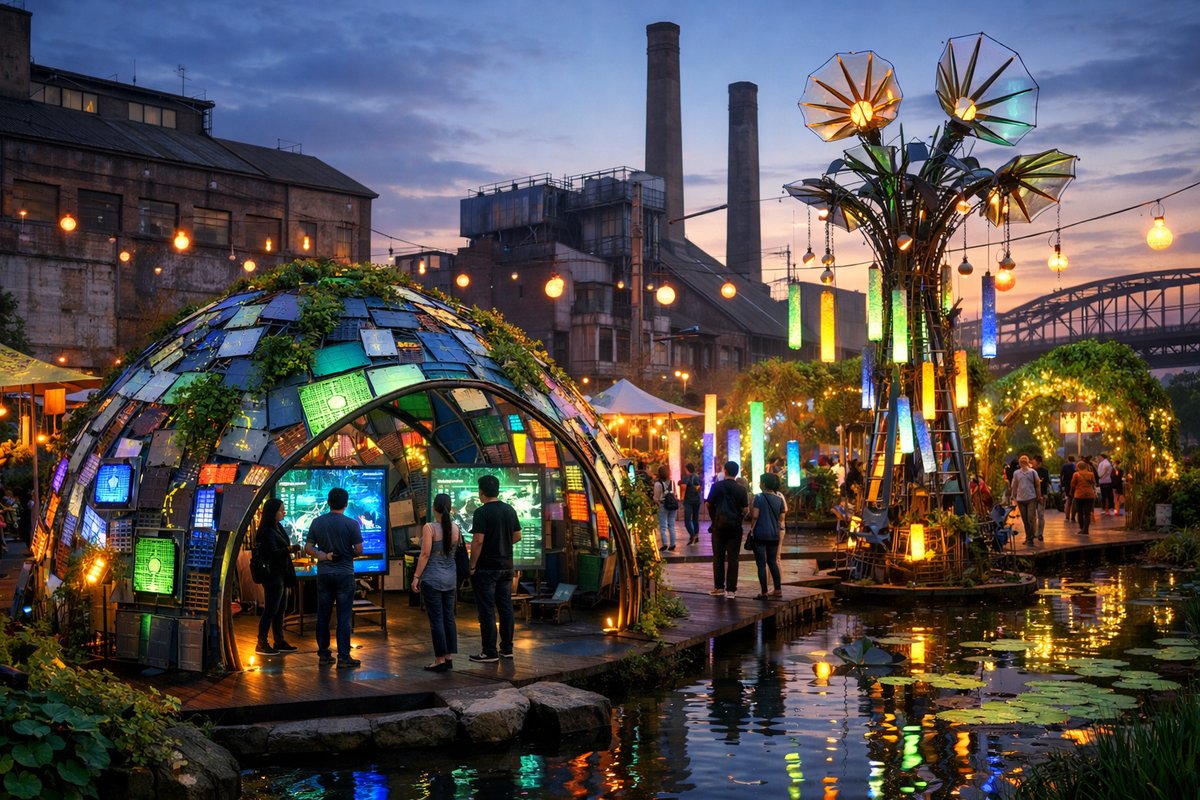

In a once-forgotten industrial park on the city’s east side, a vibrant fusion of recycled materials, artificial intelligence, and public participation has breathed new life into aging warehouses and concrete lots. Called EcoEcho, the weeklong festival invites artists, engineers, and curious passersby to witness interactive sculptures that evolve in real time-guided by environmental data streams and powered by upcycled scraps from local makerspaces.
What began as an experimental pop-up last year has grown into a fully curated event featuring ten large-scale works. From kinetic light displays fueled by wind patterns to generative soundscapes that sample urban air quality readings, each piece emphasizes the potential of sustainable design fused with advanced algorithms. Festival director Raina Morales emphasizes that the goal isn’t just spectacle, but a deeper conversation about waste, technology, and community agency.
“Our challenge was to reframe what people think of as waste,” Morales explains. “We’re showing how discarded plastics, electronic components, even scrap metal can serve as raw material for living artworks that breathe, shift, and adapt.” By feeding air quality indexes, weather forecasts, and foot traffic counts into AI models, the festival’s installations offer a poetic feedback loop: the city environment influences the art, which in turn inspires visitors to reflect on their urban footprint.
One marquee piece, “Breath of the Machine,” uses hundreds of translucent plastic bottles salvaged from nearby recycling centers. Arranged in an undulating spine, the sculpture is embedded with flexible LED strips and microcontrollers. As particulate matter levels rise, the LEDs pulse from cool blue to warning red, while low-frequency tones ripple through concealed speakers. The resulting effect feels like a living organism, its mood shifting according to the air we breathe.
Just steps away, “Corridor of Currents” converts discarded computer fans into a wind-responsive tunnel. Each fan’s blades capture subtle gusts, generating electricity to power an array of holographic projectors. These projectors cast floating geometric shapes onto the surrounding walls, creating a dreamlike portal that reacts to passerby movement. As visitors wave or step forward, the forms swirl and multiply, guided by AI vision systems that interpret body language and velocity.
In an adjacent gallery, “Fungal Frequencies” offers a quieter reflection on growth and decay. Here, mycelium blocks cultivated from spent coffee grounds are wired to moisture sensors and low-power processors. When humidity dips, tiny solenoid valves release micro-mists, coaxing the fungal network to expand. Slow ultraviolet pulses map the mycelium’s progress, capturing time-lapse imagery that loops on nearby screens. It’s a meditation on natural cycles rendered with digital precision.
Workshop areas peppered throughout the park allow visitors to test their own design chops. Under the guidance of resident technologists, participants can assemble basic sensor circuits, train simple machine-learning models on open-source datasets, or experiment with biodegradable 3D-printing filaments. These hands-on sessions emphasize modularity and repair, teaching strategies for extending product lifespans instead of discarding them.
One popular station invites visitors to code pixel art animations and project them onto reclaimed plywood panels. By connecting motion sensors to microcontrollers, attendees watch their creations shift in color and speed as crowds move around the block. The coded sketches are licensed under a public-domain pledge, ensuring that patterns and software can be reused in future community projects.
Local environmental groups have also joined forces with festival organizers to share real-time data on water turbidity and soil pH from nearby waterways. That information feeds into “Stream of Sentience,” a sculptural fountain of stacked glass vessels. Embedded electrodes detect conductivity changes, triggering UV-reactive dyes to swirl in dazzling patterns within each vessel. Onlookers can adjust flow rates via a simple touchscreen interface, learning how nutrient levels and pollutants shape aquatic ecosystems.
While EcoEcho’s technological ambitions are impressive, its backbone remains a commitment to social impact. Community liaisons guided the selection of recycled materials, partnering with scrap yards, electronics recyclers, and nonprofit repair cafes. The festival’s carbon footprint is offset by solar canopies installed at the park’s entrance, harvesting daylight to power off-grid lighting and charging stations.
Even the food vendors align with the sustainability ethos: compostable serviceware, surplus produce from local farmers’ co-ops, and herbal infusions sourced from urban rooftop gardens. Visitors can refill water bottles at filtered taps rather than purchase single-use plastics. This holistic approach turns every aspect of the event into an educational touchpoint, encouraging choices that respect both people and planet.
Public response has been enthusiastic. Social media posts brim with photos of illuminated sculpture trails winding through towering smokestacks, while impromptu dance performances erupt whenever a new projected motif appears. Families linger at interactive tables, tracing circuit diagrams with their children, and late-night DJs have set up stage corners where pulsating light patterns generated by audience applause feed directly into digital mixers.
Looking ahead, the EcoEcho team plans a touring program, bringing modular installations to neighborhoods across the region. Each pop-up will adapt to local resources and cultural contexts, integrating new data streams-like solar radiation in desert towns or tidal metrics in coastal communities. The festival’s open-source repositories will grow, guiding DIY makers worldwide who wish to replicate or remix featured works.
In an age when both environmental urgency and technological possibility have never been greater, EcoEcho demonstrates that art can serve as a bridge-melding the poetic with the empirical, the recycled with the high-tech. By inviting the public to become co-creators, this festival offers more than visual spectacle: it cultivates genuine stewardship for our shared urban ecosystems. And in that collaboration between human curiosity and machine ingenuity, we glimpse fresh pathways toward a more sustainable, imaginative future.
-
SUNLU PLA 3D Printer Filament, Black, 1KG | PLA Filament 1.75mm ...
SUNLU PLA 3D Printer Filament, Black, 1KG. PLA Filament 1.75mm, Smooth Printing, Neatly Wound, +/-0.02mm Accuracy, Compatible with Most FDM 3D Printers. -
VELCRO Brand ONE-WRAP Ties 8in x 1/2in Ties Gray & Black 50 Ct
Continue your search on Walmart. velcro cable ties · cord ... I use these to keep my 3D printer filament from becoming unspooled when I take it off the spool. -
Amazon.com: Official Arduino Starter Kit [K000007] - 12 DIY Projects ...
Complete DIY Electronics Kit – The Official Arduino Starter Kit includes everything you need to begin exploring the world of electronics and programming, ... -
Mini Projector, Meer Portable Pico Full Color LED LCD Video ...
SMALL & PORTABLE: This pocket size projector is only 11.9cmx8.6cmx4.8cm (0.29kg), not much bigger than your smart phone. Thanks for its mini portability,you can ... -
ARTSEA Mini Projector 4K 1080P Support Portable Smart ... - Walmart
ARTSEA mini projector supports 4K and 1080P, features WiFi 6, Bluetooth 5.2, auto keystone correction, 180° rotation, and projects up to 200 inches for ...