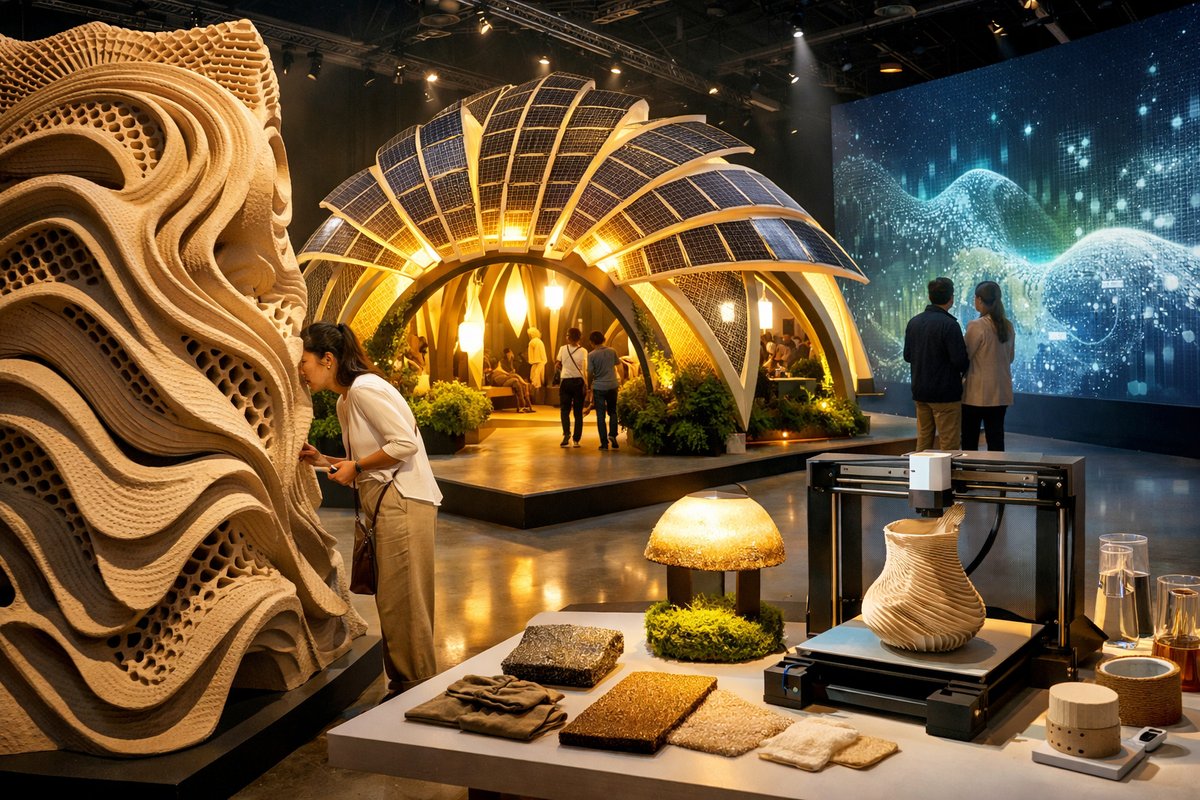

This spring, one of Europe’s premier design festivals opened its doors to a convergence of digital intelligence and ecological awareness. In a sprawling former warehouse repurposed into exhibition halls, designers and technologists presented works that probe the possibilities of combining generative algorithms with upcycled materials. Visitors find themselves surrounded by towering ceramic sculptures that evolve in real time, textile canopies that breathe with the movement of passersby, and light installations fueled by solar arrays. The festival offers both spectacle and substance, showcasing projects that could shape future cities and domestic spaces alike.
At the heart of the main gallery stands a series of AI-driven ceramic forms by the collective known as Synthetica Lab. Entitled “Morphogen Clay,” these sculptures begin as computer-generated topologies then are 3D-printed in biodegradable clay mixtures. Embedded sensors feed ambient temperature and humidity data back into the generative model, causing the surface patterns and protrusions to shift over days. Curators describe the work as an exploration of nonhuman aesthetics: a collaboration between machine logic and earthbound materials. Attendees watch cracks fill in, ridges swell, and hollows deepen as the installation responds to environmental shifts.
Not far away, the BioLoom Pavilion presents a textile environment woven from recycled fibers and living mycelium. Visitors step onto pressure-sensitive floor panels that trigger clusters of fungal cells to glow faintly beneath a translucent fabric canopy. As crowds move through, soft pulses of light ripple across the weave, illustrating how biological processes can interface with digital triggers. The designers sourced postindustrial textile offcuts and blended them with a proprietary mycelium mix that self-heals minor tears. According to the lead researcher, this hybrid material could soon be adapted for self-repairing upholstery or adaptive building membranes.
Outside in the courtyard, Photon Collective’s solar-powered light sculptures loop through dynamic choreography at dusk. Each modular lamp unit is coated in reflective sheeting made from upcycled beverage cartons; embedded photodiodes capture scattered daylight to recharge internal batteries. After sunset, microcontrollers orchestrate an animated dance of color-shifting from warm ambers to cool cyans-mapping local weather forecasts onto choreographic patterns. Passersby can use a simple smartphone interface to tweak speed, palette, and rhythm, blurring the line between spectator and collaborator.
One of the festival’s most talked-about pieces is “Echoes of Terra,” a monumental clay basin 10 feet in diameter. It collects rainwater in basins lined with conductive paint and funnels droplets onto capacitive touch pads. Each new drop generates a low-frequency hum that ripples through speaker arrays hidden beneath the structure. A neural network trained on field recordings of rivers, glaciers, and monsoon storms continuously remixes these hums, producing an ever-evolving soundscape. The artists behind the project hope to foster empathy for natural water cycles and highlight the fragility of freshwater ecosystems in an era of climate upheaval.
Parallel to these physical works, the festival hosts a VR painting studio open to the public. Armed with lightweight headsets and motion controllers, participants can paint in three-dimensional space using virtual brushes that simulate different viscosities-from thin ink washes to thick impasto. Every stroke can be recorded, replayed, and even exported as an NFT-should the user choose to mint it. Workshop leaders emphasize the platform’s potential for democratizing digital creativity, removing barriers to entry for those without traditional art training.
Behind the scenes, panel discussions examine how design education must evolve. Professors from art schools, technologists from research labs, and sustainability advocates debate curricula that integrate coding, materials science, and ecological literacy. One speaker argues that the next generation of designers will need fluency in algorithmic thinking as well as hands-on studio skills. Another warns that unchecked reliance on digital tools could distance practitioners from the tactile insights that arise through direct contact with clay, fibers, and other matter.
Local businesses and startups have taken note of the festival’s experimental atmosphere. A nearby ceramics studio now offers mixed-reality glazing previews, while an architectural firm is prototyping modular building panels inspired by the mycelium textiles. Even city officials attended a guided tour, exploring how sensor-driven installations might inform future smart-lighting projects and adaptive public art. The festival’s ripple effects extend beyond its walls, influencing commercial design and municipal planning in equal measure.
As the week draws to a close, festival-goers reflect on the striking hybridity of the works on display. Generative algorithms, once seen as cool curiosities, now navigate with equal weight alongside age-old craft traditions. Solar arrays and biodegradable composites challenge the notion that high-tech necessarily means resource-intensive. And interactivity invites everyone to become co-creators, blurring the line between artist and audience. In this dynamic landscape, the next frontier of visual expression seems boundless-anchored by the conviction that art and design must respond to both digital evolution and planetary limits.
Looking ahead, several emerging trends stand out. Biodesign practices will likely seed more self-healing materials for everyday products. Augmented reality experiences may layer digital narratives atop physical installations in public squares. And as AI models grow more sophisticated, we can expect generative art to extend into domains like fashion, furniture, and urban planning. For now, the festival leaves attendees with a sense of possibility: that creativity, curiosity, and conscience can converge to reshape how we inhabit the world.
Whether you’re a seasoned designer, a tech enthusiast, or simply curious about the future of form and function, this showcase offers a vivid preview of what lies ahead. Its message is clear: the fusion of code and clay, light and life, can yield artworks that not only dazzle the eye but also deepen our relationship with the planet.