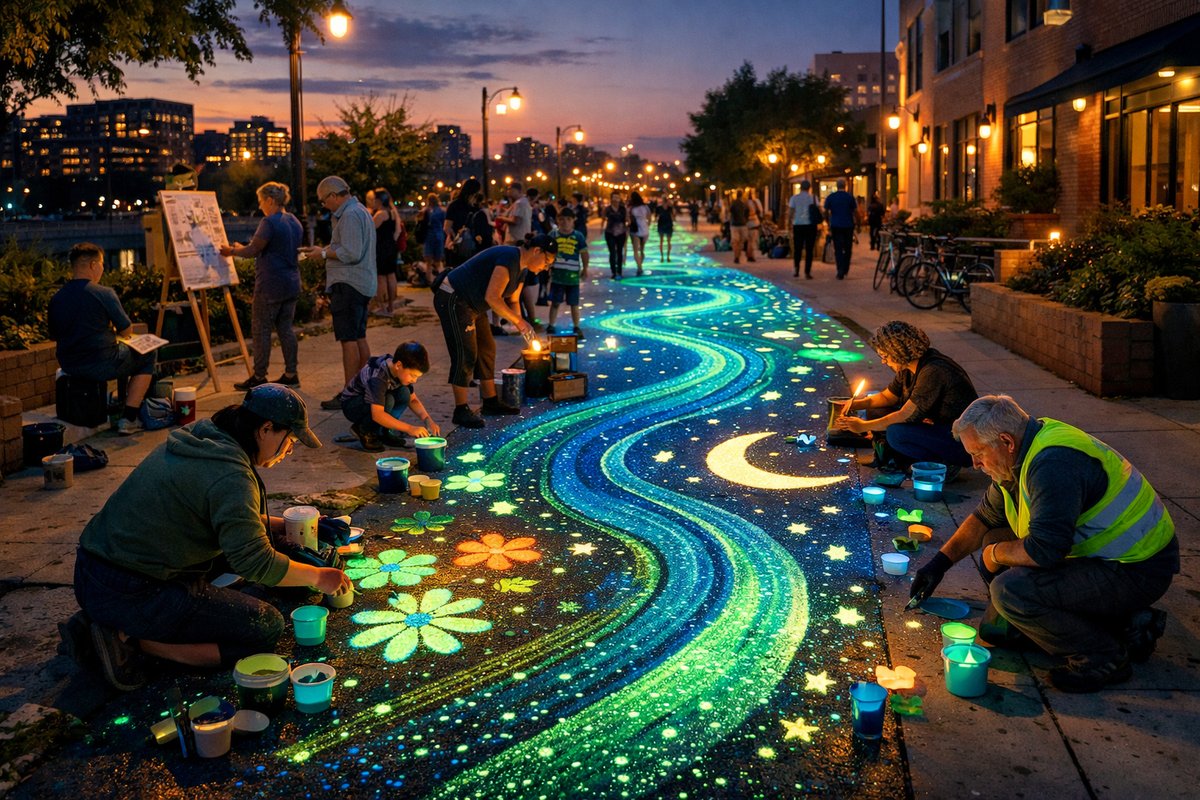

A new public art movement is sweeping across urban centers, replacing blank sidewalks with glowing murals that come alive when the sun sets. Using eco-friendly photoluminescent paints derived from non-toxic minerals, these pavement installations soak up daylight and release a soft, hypnotic glow once darkness falls. By blending art, technology, and sustainability, the project aims to reimagine cityscapes as dynamic, 24-hour galleries that invite residents to explore after dark.
What began as a pilot collaboration between a municipal design agency and a local art collective has quickly grown into a broader effort, with neighborhood associations and small businesses pitching in to fund materials and workshops. The glow-in-the-dark murals are not only decorative-they serve as pedestrian guides, crosswalk highlights, and meeting points that enhance public safety and foster community engagement. Rather than relying on electricity, the pigments in these murals harness solar energy, making them an energy-free solution to nighttime visibility.
The heart of the project lies in its innovative use of photoluminescent pigment. When exposed to sunlight, microscopic crystals within the paint absorb photons and store energy. As evening approaches, the stored energy dissipates as visible light, creating vivid patterns that can glow for several hours. Unlike traditional reflective strips or costly LED installations, these murals require no wiring, power source, or ongoing maintenance beyond an occasional clear coat to protect against foot traffic and weather.
Last month, the city’s historic arts district unveiled its first large-scale installation along a two-block stretch of boulevard. Abstract floral motifs, intertwined geometric shapes, and cascading waves appear muted by day, blending seamlessly with the concrete canvas. After dusk, each design softly illuminates in varying shades of teal, lavender, and mint green. The effect turns a once-forgotten walkway into an overnight attraction, drawing families, night-shift workers, and late-hour café patrons onto the street.
The project lead, a municipal urban designer, notes that community safety was a driving factor. “Our goal was to create art that doubles as functional lighting,” the designer explains. “We observed that many people avoid dimly lit sidewalks, and traditional streetlights can cast harsh pools of light that still leave dark spots. These glowing murals offer continuous, eye-friendly illumination and encourage foot traffic along quieter routes.”
Local artists are equally enthusiastic. A collective known as LightWeave spent weeks experimenting with color palettes and layering techniques to achieve consistent glow intensity. One member describes the process as a dance between opacity and translucence: “You need just the right thickness of pigment to store enough light without obscuring the underlying design. It’s like painting with starlight.”
Beyond aesthetics, the materials themselves reflect a commitment to sustainability. The photoluminescent powders are manufactured from recycled glass and naturally occurring minerals, avoiding heavy metals or toxic binders. The base paint is waterborne and low-VOC, ensuring minimal environmental impact during application. Once the murals reach the end of their lifespan-usually five to seven years-the pigments can be recovered and reused in new installations.
Technicians prepare the pavement by power-washing and applying a primer layer that enhances adhesion. Artists then paint the design in multiple passes, allowing each coat to dry fully before adding another. After a final sealant is sprayed on top, the surface is ready for public use. The entire process for a two-block section takes about two weeks, from initial prep to first nighttime reveal.
Community involvement has been vital. Prior to painting, neighborhood groups and local schools join hands-on workshops to learn about photoluminescent chemistry and mural planning. Participants sketch designs, mix small test batches of pigment with clear binders, and apply sample swatches on portable boards. This educational component demystifies the technology and builds local pride in the final result.
Early data suggest the glowing sidewalks are making a real difference. Pedestrian counts between 8 p.m. and midnight have risen by nearly 40 percent along the newly treated corridor. Local businesses report increased footfall for late-night cafés, galleries, and pop-up markets. Police officials have also noted a slight drop in minor incidents such as tripping accidents and petty vandalism, attributing improved visibility and passive surveillance.
Seeing the success, adjacent neighborhoods are now commissioning their own glow murals. Plans include community-driven themes, from stylized city landmarks to abstract cosmic vistas. City officials have allocated a budget for six additional pilot sites, focusing on areas with poor streetlighting or high foot traffic after-hours.
Some design critics caution against overuse, warning that constant glow could diminish the novelty over time. Others raise questions about long-term maintenance and potential color fading under harsh weather conditions. Project managers acknowledge these challenges, stressing the importance of regular inspections and reapplication schedules to keep the murals bright and functional.
From a sustainability standpoint, the glow murals present an appealing alternative to energy-intensive lighting. They exemplify how art can serve practical needs while reinforcing environmental values. By harnessing sunlight in a visually compelling way, these installations invite passersby to reflect on renewable energy’s potential and the creative possibilities hidden in everyday materials.
As cities nationwide grapple with energy conservation and public safety, photoluminescent pavement art offers a low-tech, high-impact solution. Its modular approach-each neighborhood can choose its own design, color scheme, and placement-allows for widespread adoption without a one-size-fits-all mandate. Already, urban planners in several mid-sized cities have reached out to share best practices and explore their own glow mural pilots.
What started as an experimental art project has now lit the way for a new form of civic expression. By turning sidewalks into luminous canvases, the initiative bridges creativity, community, and sustainability. As more glow-in-the-dark murals appear, city nights may never look the same again-radiant proof that art can brighten both our streets and our sense of possibility.