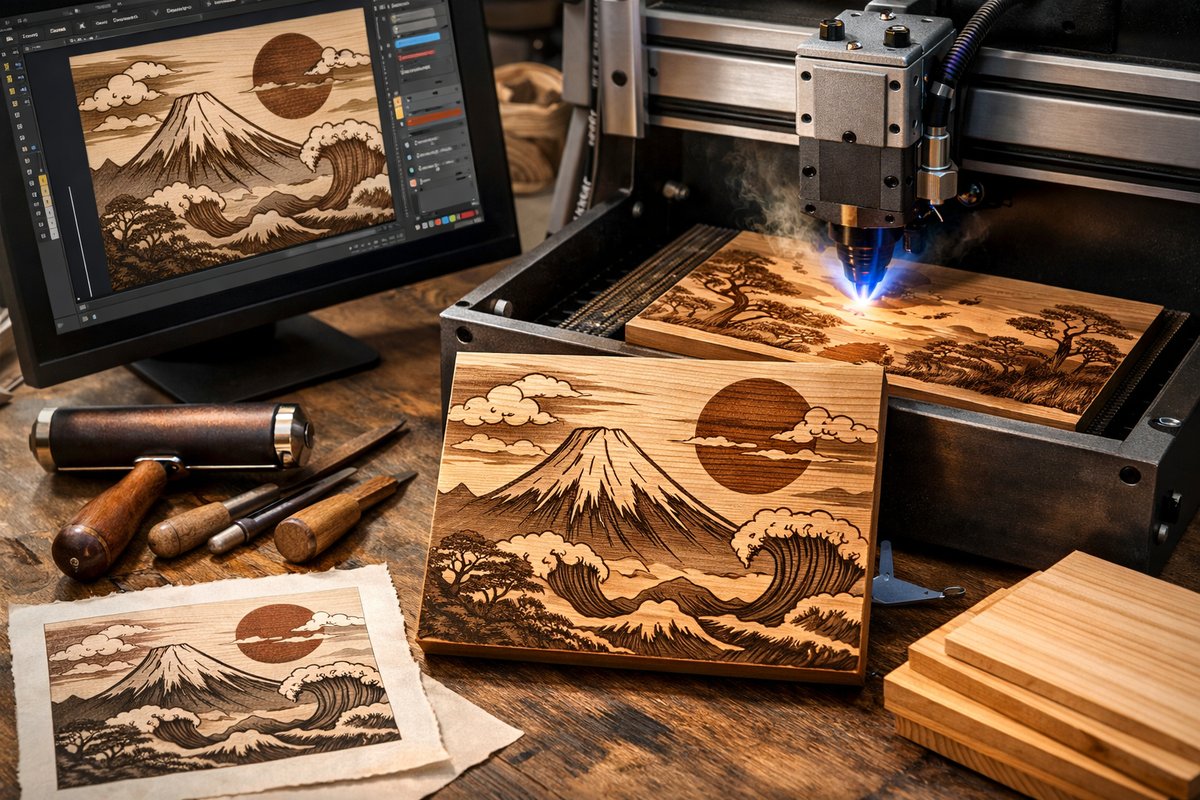

In studios around the world, a quiet revolution is unfolding: the age-old craft of woodblock printmaking is finding new vitality through laser etching. What once required painstaking gouges and hours of manual carving can now be rendered in minutes, thanks to precision cutting driven by digital design files. Artists and print studios are embracing desktop laser engravers to transform reclaimed wood, sustainable plywood, and even bamboo panels into intricately patterned blocks ready for inking and pressing. This hybrid approach is expanding the expressive range of printmakers, inviting newcomers to experiment without the traditional barrier of carving expertise.
At the heart of this renaissance lies a marriage of software and analogue process. Designers sketch motifs in vector illustration tools, then output their files to a laser cutter. By adjusting power settings, speed, and resolution, they control how deep the laser burns into the grain, sculpting lines and textures that vary from whisper-thin filigree to bold, sculptural relief. The resulting blocks carry both the warmth of wood and the crisp precision of digital control. After etching, the blocks enter a familiar ritual: rollers coated with water-soluble printing inks glide across their surfaces before the sheet or textile is placed atop and run through a press or hand-burnished with a baren.
Beyond individual prints, some artists are assembling tileable laser-etched panels into large-scale installations. In public spaces, façades clad with repeating patterns respond to changing light and shadow, while indoor galleries showcase sequential prints that reveal subtle shifts in line weight and texture. One recent installation in a converted warehouse used a dozen teak plywood panels etched with botanical silhouettes; as daylight streamed through skylights, overlapping shadows created a living curtain of foliage. Visitors could touch the wooden surfaces, feeling the etched channels where ink would pool and transfer.
The environmental benefits of this hybrid workflow are drawing attention as well. Many studios opt for sustainably sourced birch plywood or reclaimed cedar boards, reducing reliance on virgin hardwood blocks. Laser etching minimizes waste, since unetched areas remain intact and larger, reusable panels can yield dozens of smaller blocks. And water-based printing inks further align with eco-friendly priorities, avoiding the volatile solvents used in some traditional presses.
Adopting laser etching does come with a learning curve. Operators must master vector paths, engraving guidelines and the nuances of different wood species. Hardwoods like maple produce clean, sharp lines, while softer woods such as basswood yield a more textured, hand-carved look. Plywood blends bring stability but can introduce adhesive layers that char differently under the laser beam. Trial‐and‐error remains essential, guiding artists to fine-tune settings that balance speed with resolution.
Print studios are responding by offering workshops that pair digital tutorials with analogue print sessions. Participants learn to convert hand-drawn sketches into scalable vector art, set up job files for etching, and calibrate the laser modules. Once their blocks are etched, they join printmakers at the press tables, mixing inks by hand and experimenting with color blends. These hybrid classes attract both veterans of letterpress and newcomers curious about combining craft techniques with digital tools.
For many, the appeal lies in reclaiming the tactile dimension of printmaking while harnessing modern conveniences. The act of watching a laser head trace a complex floral design might feel effortless, but the muscular anticipation builds as the first inked impression emerges. When paper lifts, the fine details of tiny veins, stipple fields, and delicate cross-hatching testify to a collaboration between human creativity and machine precision. There’s a thrill in knowing that the digital file could generate dozens of identical blocks, yet each print carries the small irregularities that make it singular.
Commercial print shops are also taking note. Limited-edition apparel lines feature laser-etched wooden stamps that imprint sweatshirts and tote bags with intricate geometric patterns. Stationery brands use miniaturized etched blocks to emboss thick cotton cards with elegant textures. Even boutique packaging operations incorporate bespoke etchings to lend a handcrafted touch to product boxes. The tactile quality of woodblock prints resonates with consumers seeking authenticity in an age of digital mass production.
Artists have pushed the concept further by combining laser-etched elements with hand-carved relief work. In these mixed-tech prints, large areas of negative space are cut by hand, while highly detailed motifs-architectural facades or hand-lettered type-are etched to perfection. This layered approach blends the warmth of gouge-carved edges with the pinpoint accuracy of lasers, yielding prints that feel both organic and refined.
The philosophical implications are not lost on this community. Printmaking has a storied history of reproduction and democratization-Johannes Gutenberg’s movable type, for example, unleashed an information revolution. Today’s laser-etched blocks nod to that lineage, but with a twist. A single digital file can be shared globally, opening the door to collaborative print projects that span continents. Groups of artists can download shared archives of vector patterns, remix designs, and re-etch blocks locally. The result is a decentralized print network, where ideas circulate freely and blocks can be reinterpreted in any language or cultural context.
Looking ahead, some innovators are experimenting with hybrid materials. Bio-resins and composite timbers have been etched to produce flexible blocks that wrap around curved surfaces. Others are exploring laser etching on MDF panels coated with conductive inks, turning print blocks into functional touchscreens. As additive manufacturing and laser tech converge, the boundary between stamp and circuit may blur, giving rise to prints that respond to touch, light up under UV, or emit sound when pressed.
Of course, this technological infusion also raises questions about the essence of craft. Purists argue that the act of cutting by hand is central to the art form’s soul, and that outsourcing that labor to a machine risks losing an intuitive connection to material. Yet proponents of laser etching see it as an evolution-an expansion of the printmaker’s toolkit rather than a replacement. In their view, the true art lies in the creative concept, the design choices, and the final print’s emotional resonance. Whether carved by hand or etched by a laser, the block remains a vessel for artistic vision.
As desktop laser engravers become more affordable and user-friendly, the bridge between digital design and analogue printmaking grows stronger. The result is a thriving ecosystem where creativity flows in both directions: from the hand to the machine and back again. The next generation of printmakers will likely see these hybrid methods as second nature, blending code and craft to carve ever more daring expressions. In the meantime, the gentle hum of laser cutters in shared studios offers a promising soundtrack: a hint of history being rewritten one etched groove at a time.
In a world that often feels dominated by pixels and screens, laser-etched woodblocks remind us that the tactile, the hand-printed, and the digitally precise can coexist. They invite us to press our faces close to paper, to feel the grain beneath our fingertips, and to marvel at how centuries-old traditions can be reborn in the glow of a laser head. As this movement unfolds, it becomes clear that the future of printmaking is not a choice between analogue or digital, but a celebration of both.