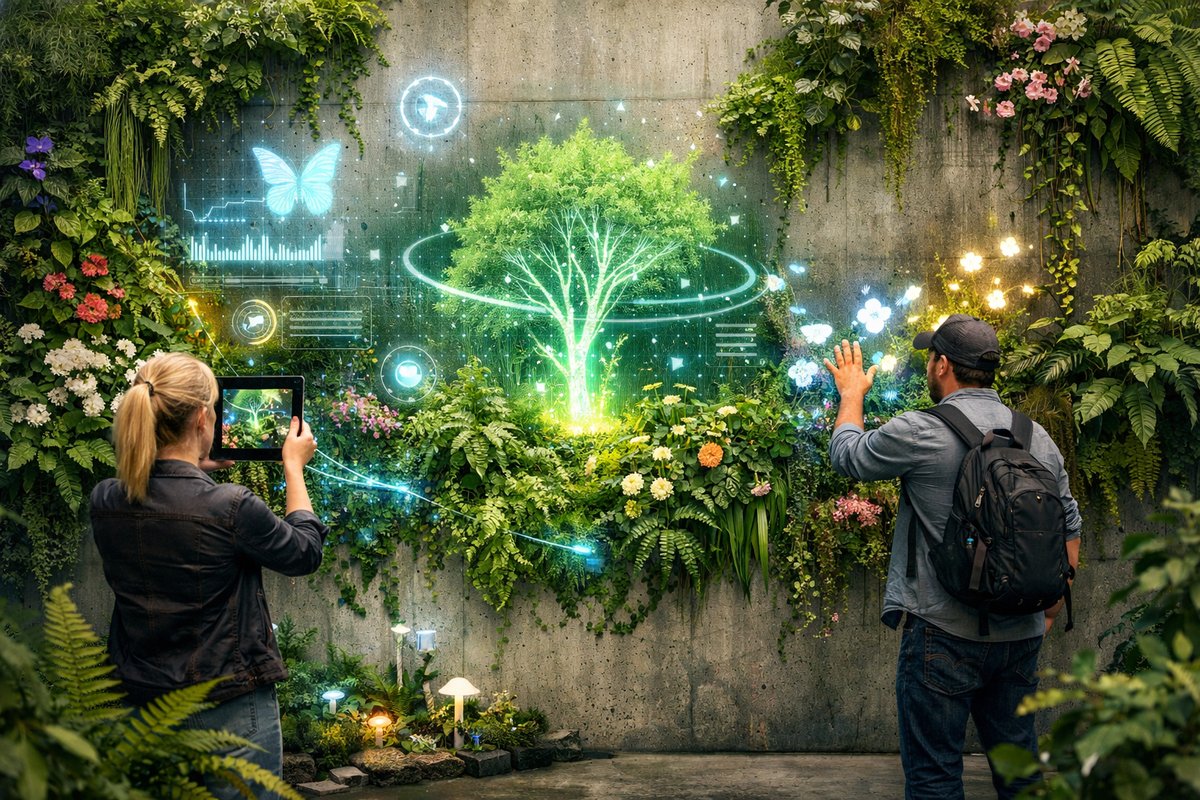

On a quiet evening in the heart of the city, a crowd gathered before a towering brick wall that looked like every other urban surface-until smartphones and AR headsets revealed a hidden ecosystem. Ferns unfurled in midair, neon pollen drifted across the brickwork, and virtual butterflies settled on real vines. This was the debut of the BioDigital Canvas, an ambitious public art series that merges living murals with augmented reality to spark a new conversation between nature, technology, and design.
The Verdant Code Expo, held in a repurposed industrial district, showcased nearly a dozen installations where artists cultivated lush plant walls and overlaid them with responsive digital layers. Visitors walked beneath a canopy of moss and ivy, raised their phones, and watched data-driven animations bloom like bioluminescent flowers. Each piece was coded to react to ambient noise, passing footsteps, or even local weather feeds, so the murals never looked the same twice.
At its core, the project challenges the traditional boundaries of canvas and sculpture. Rather than treating plants as static objects, artists collaborated with botanists and software engineers to treat the living wall as dynamic material. Hours of 3D scanning produced detailed maps of branch and leaf structures. Custom AR filters then transformed those scans into an ever-changing tapestry of color, motion, and sound.
One standout installation, titled “Symbiotic Frequencies,” married a wall of trailing pothos and philodendron with an audio-visual sequencer. Tiny microphones captured street sounds-conversations, distant traffic, even the rustle of leaves-and assigned each frequency band to a palette of virtual pigments. Low-frequency hums painted broad strokes of deep green, while high-pitched chirps splashed radiant yellows and electric blues. The result was a living painting that danced, shimmered, and breathed along with its surroundings.
Behind the scenes, a suite of affordable hardware made these experiments possible. Portable short-throw projectors cast base patterns of shapes onto plant surfaces, guiding viewers where to point their cameras. Microcontroller boards processed sensor inputs and relayed commands to projection software. Meanwhile, AR headsets supplied by a local design lab allowed hands-free exploration, overlaying digital structures without interrupting the visitor’s line of sight.
Materials played an equally important role in sustainability. Artists built custom mounting frames from bamboo and reclaimed wood to support vine growth. Biodegradable 3D printing filament was used to fabricate tiny hooks and clips that held plant sensors in place. UV-reactive paints were applied sparingly to highlight certain leaves or stems, ensuring that physical pigments would weather away over time while the digital elements remained fresh and vivid.
The creative process began with sketching sessions in a greenhouse, where artists made watercolor studies of leaves under different light conditions. These analog observations informed the palette choices for corresponding digital overlays. Collaborative coding workshops followed, with designers pairing up with data scientists to write algorithms that translated sensor streams into visual motifs. Many of the open-source scripts were later published online, inviting other creators to remix the concept in their home cities.
For visitors, the experience felt like stumbling into a secret garden that existed simultaneously in two realms. Some walked slowly, pointing out patterns as if whispering to the plants. Others experimented by speaking softly or clapping loudly to watch the mural pulse with newfound intensity. Children raced along the wall, their fingertip touches triggering bursts of virtual flowers that dissipated in a shower of pixelated petals.
Environmental awareness threaded through every installation. By celebrating the vitality of urban flora, the artists hoped to remind citizens of the importance of green spaces. QR codes placed near each piece linked to local conservation groups and tutorials on creating similar micro-gardens at home. One booth offered compact hydroponic panel kits for apartment dwellers to start their own living murals indoors.
Looking ahead, the BioDigital Canvas team plans to extend these ideas into other media. Collaborative pop-up exhibits are being planned in remote villages where solar-powered drones will map overgrown ruins, overlaying generative art atop weathered stones. Workshops for educators will introduce students to the basics of plant biology, coding, and 3D printing-bridging art, science, and sustainability in one modular curriculum.
The ripple effects are already visible in the design community. Local businesses are commissioning AR-enhanced logos that sprout digital vines and blossoms when scanned. Architecture firms are exploring integrated green facades with built-in projection grids and embedded sensors. Even fashion designers are experimenting with garments that carry tiny plant pockets and hidden circuits to animate leaf patterns in response to body movement.
In a world saturated with screens and concrete, the BioDigital Canvas offers a fresh perspective: art that grows, breathes, and transforms alongside its audience. By weaving together living organisms, biodegradable materials, and real-time digital overlays, these artists have opened a portal to a hybrid realm where nature and code coalesce in harmony. As the murals continue to evolve, one thing is clear: the future of public art will be as much about caretaking and code as it is about paint and canvas.
-
WEMAX Nova Pro 4K Ultra Short Throw Projector, Google TV, 2100 ...
【150'' Giant Screen, 3D Function & MEMC for Smooth Motion】 With a 0.23:1 ultra short throw ratio, this short throw projector 4K casts a massive 150-inch ... -
Magcubic HY450 4K Support Native 1080P Ultra Short Throw ...
Jan 25, 2026 ... Buy Magcubic HY450 4K Support Native 1080P Ultra Short Throw Projector, 900ANSI, Auto Focus & Correction with WiFi 6, BT5.4, Dual Speakers, ... -
Amazon.com: Lenovo Star Wars: Jedi Challenges, Smartphone ...
Feel your opponents' attacks with force feedback. - Lenovo Mirage AR Headset: The Lenovo Mirage AR headset is ergonomically designed for maximum game immersion. -
Augmented Reality Underwater Exploration Kit with Headset - Walmart
GJX Immersive VR Headset For iPhone & Android: Adjustable Lenses & Comfort! Add. $1535. current price $15.35. GJX Immersive VR Headset For iPhone & Android: ... -
Glow in the Dark Acrylic Paint - Set of 12 Colors Uv Reactive Paints
【VIBRANT & LUMINOUS COLORS】Experience the magic of Kebuye's 12-color acrylic glow dark paint set with 2 brushs, including bright color(Such as green, ... -
(12 pack) 6 Pack, Copper, Rust-Oleum Universal All Surface Interior ...
Buy (12 pack) 6 Pack, Copper, Rust-Oleum Universal All Surface Interior/Exterior Flat Metallic Spray Paint-365352, 11 oz at Walmart.com.