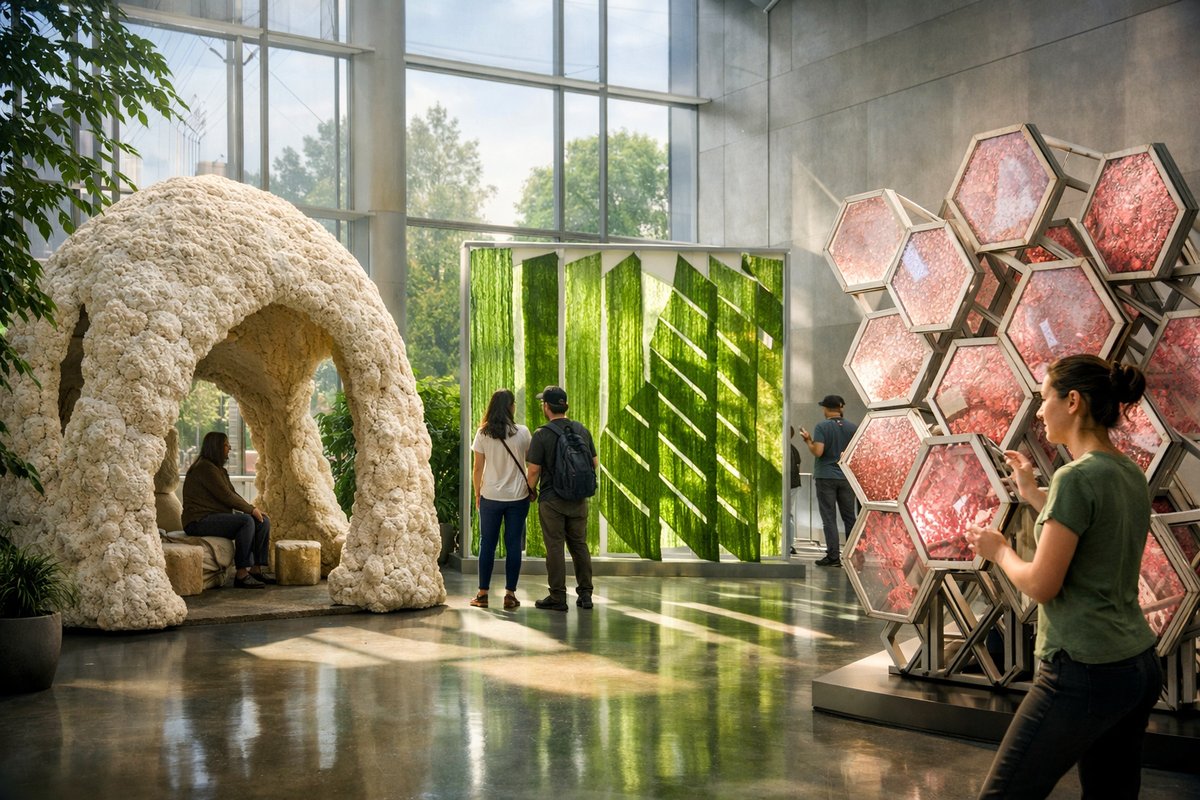

From seed to structure, a new wave of artists and engineers is turning biology into canvas. The Smithsonian Biodesign Challenge 2024, an annual competition that invites student teams to harness living systems for design innovation, concluded last week with three standout projects that blend art, sustainability and emerging biotech. Hosted virtually for the second year running, the event showcased work from more than twenty colleges and universities across North America and Europe, each tasking microbes, fungi and plant cells with holding form, generating color or responding to the environment.
The overall winner, a group from the University of Washington, presented “MycoMorph Pavilion,” an arched installation grown entirely from mycelium-a network of fungal threads-reinforced with plant-based resins. Built inside custom 3D-printed molds and cultivated in a humidity-controlled chamber, the pavilion’s organic ribs fan out like the gills of a mushroom. When illuminated at dusk, microscopic air pockets within the mycelium scatter light, giving the surface a soft, bioluminescent glow. By tweaking substrate composition-adding agricultural waste like rice husks-and regulating temperature, the team achieved both structural integrity and a striking, textured finish.
Just weeks after the pavilion was harvested, visitors at a pop-up exhibition in Seattle could walk beneath its umbrella-like canopy, touching its velvety underside and observing fine hyphal networks that branch like leaf veins. Beyond its aesthetic appeal, the installation points to a low-carbon alternative to conventional plastics and foams. When the pavilion reaches end of life, it can simply be composted, returning nutrients to the soil instead of accumulating in landfills.
A second prize went to a multi-disciplinary team from the Rhode Island School of Design whose project “BloomScape Shutter” used live microalgae trapped between transparent, modular shutter panels. Each shutter functions as both sunshade and living artwork: as sunlight filters through, the algae photosynthesize, shifting the panel’s hue from pale green at dawn to deep emerald by midday. Tiny sensors embedded in the frames monitor light intensity, pH and temperature, transmitting data to a smartphone dashboard that lets users adjust panel spacing or angle to regulate interior light and heat.
In a demonstration unit installed on a gallery façade in Providence, viewers noticed subtle color pulses as algae responded to passing clouds. At night, integrated LED arrays provide the algae with low-intensity “house light,” keeping the culture thriving around the clock. According to the team’s lead designer, harnessing microalgae for dynamic shading not only reduces energy demands but also fosters a daily ritual of observation-reminding city-dwellers that living organisms remain central to built environments.
Rounding out the top three was “Cellular Stream,” developed by students at CalArts and UCLA, who coaxed skin cells from plant-based biogel scaffolds into kinetic wall panels. Through programmed pulses of electric field stimulation, tiny clusters of cells contract and expand, creating rhythmic waves that ripple across the surface. The effect is reminiscent of water flowing downstream or grass waving in the wind. Though the panels don’t yet bear load, they demonstrate how living tissues might one day animate walls or furniture, offering built environments a subtle heartbeat.
Beyond the winners, dozens of other proposals explored bioresponsive pigments, microbial leather as upholstery and living concrete alternatives. Prizes for sustainability and social impact recognized teams working on biodegradable packaging printed with ink derived from bacterial cellulose, and a temporary pavilion in Ontario built from locally sourced hemp hurds bound by fungal networks.
The Biodesign Challenge doesn’t just award prizes-it connects participants with expert mentors from the fields of synthetic biology, architecture and art. In this year’s virtual pitch sessions, judges included material scientists from university labs, curators from design museums and entrepreneurs in the cultivated-meat space. Feedback ranged from design critiques to regulatory advice, ensuring that winning projects can evolve toward real-world applications rather than remain confined to academic showcases.
“There’s a profound shift happening,” said one mentor, who has guided student teams for five years. “Designers are no longer satisfied with inert materials. We want surfaces that heal, structures that sense, aesthetics that breathe. The line between organism and object is blurring.”
For many participants, the challenge serves as a stepping-stone into emerging career paths. Graduates armed with lab skills and design thinking are finding roles at startups developing sustainable textiles and at research institutes exploring living architecture. Meanwhile, some university labs have forged partnerships with local governments to test biofab installations in public parks and transit hubs.
Critics urge caution: permitting living materials in public settings raises questions about safety, containment and long-term viability. Pathogen screening protocols, waste management strategies and life-cycle analyses must keep pace with creative ambition. Several teams noted that scaling up from bench-scale prototypes to pedestrian-sized structures will require new standards and regulatory frameworks.
At the heart of the conversation is a larger question: can art and design lead society toward more symbiotic relationships with nature? History offers cautionary tales of technological hubris, but the Biodesign Challenge points to alternative narratives-ones where materials grow, adapt and even repair themselves.
As the competition wound down, a virtual gallery remained open for public viewing. Viewers praised a sense of wonder in seeing living sculptures and interactive facades, while educators noted the opportunity to inspire younger students toward science and sustainability. The Smithsonian’s director of design education announced plans to expand the challenge next year, adding tracks for urban agriculture installations and citizen-science collaboration.
In an era of climate urgency, living materials offer more than novelty. They promise reduced reliance on fossil-fuel plastics, potential carbon sequestration and a philosophy of circularity. Whether in a fungal-fiber pavilion that dissolves back into soil, an algae-dappled shutter shading a work studio or cell-powered walls that sigh with movement, the projects suggest a future built not only by people but also by microbes and cells.
If this year’s Biodesign winners point the way, tomorrow’s buildings and artworks will be growing, breathing and evolving alongside us-inviting viewers to interact with materials that are alive.
With biofabrication tools becoming more accessible, hobbyists and small-scale studios are already experimenting with DIY agar kits and 3D-printed molds for mycelium casting. Companies now offer off-the-shelf algae culture modules and open-source protocols for cell-based textiles. Even as academia refines the science, a grassroots movement is taking root in maker spaces and community labs, democratizing access to living sculpture.
In the months ahead, look for pop-up installations in urban plazas, workshops where visitors can design their own bioplastic samples and augmented-reality overlays that reveal microscopic life within public art. As living materials continue to mature, they will challenge our assumptions about permanence, aesthetics and the very definition of “object.” A painting may no longer be just pigment on canvas, but a photosynthesizing membrane that shifts color with sunlight. A bench might not be carved wood or welded steel, but a chitinous lattice grown in a bioreactor.
At a time when many designers pledge net-zero goals and cities pursue greener infrastructure, the Biodesign Challenge 2024 has offered a preview of how art, architecture and biology can converge-crafting designs that aren’t just sustainable but inherently alive. As fungi, algae and cells step into the design studio, our built environment promises to become more than a backdrop. It will become a living collaborator in the creative process.
-
Evviva Sciences Microbiology Science Project Kit, Pre-Poured Agar ...
What makes our products stand out? We make fresh agar petri dishes daily. These are used for our science kits, mold detection products, and mushroom growing ... -
MakerBot PLA Filament for Method 3D Printer - Walmart.com - Walmart
Buy MakerBot PLA Filament for Method 3D Printer - Biodegradable Corn-Based Plastic for Office-Friendly Prototyping (True Black, 0.75kg) at Walmart.com.