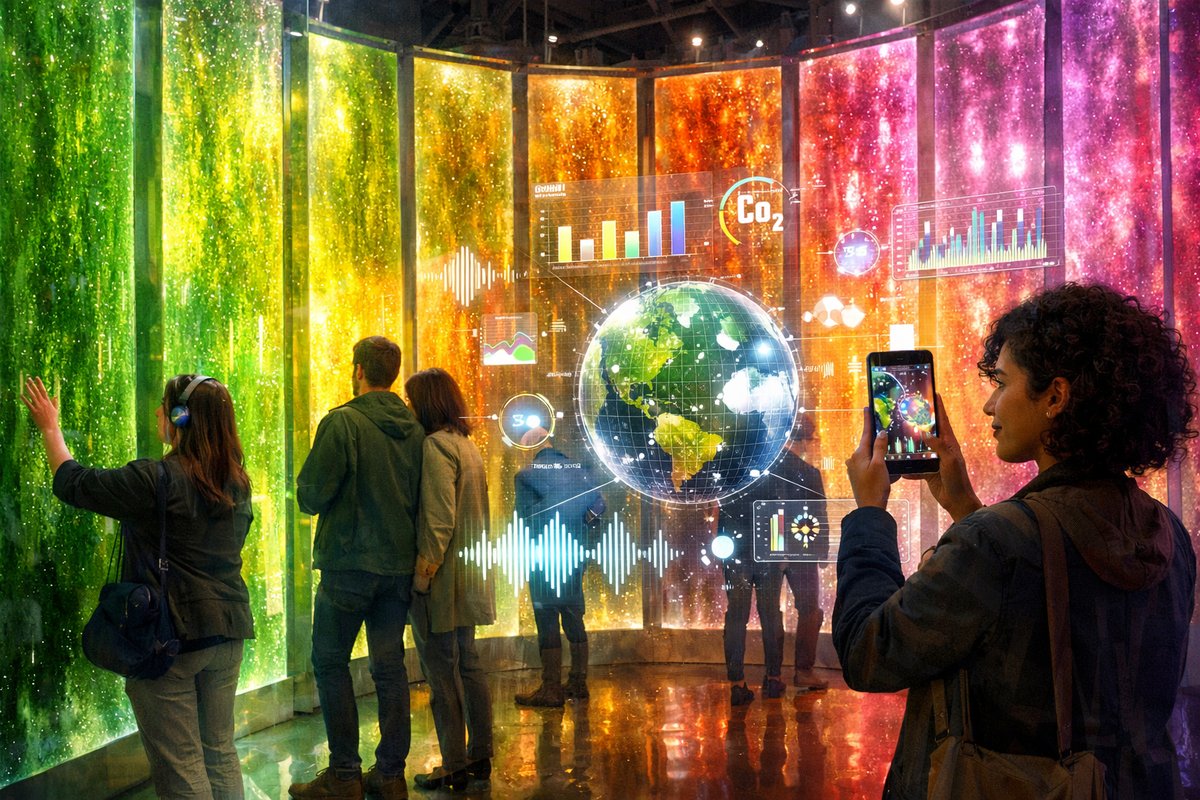

When the doors opened on the Biochrome Pavilion at London Design Festival, attendees found themselves immersed in an otherworldly world of undulating colors and softly humming panels. Far from a traditional gallery display, the pavilion’s walls were alive, seeded with living microalgae that shifted from emerald green to deep blue and even rust orange over the course of a single afternoon. By translating ambient noise levels and air quality readings into subtle adjustments of light and pigment intensity, the work showcased how biological systems and digital feedback loops can blend to create a responsive environment.
Conceived by design duo Eva Lind and Kaito Roe, Biochrome evolved from a yearlong collaboration between material scientists, environmental engineers, and interactive software developers. Lind, who trained as a ceramicist, was drawn to the idea of using living cells as a building material in much the same way clay or plaster is shaped. Roe brought expertise in immersive storytelling and real-time data visualization. Together, they envisioned an installation that would be equal parts art, living ecosystem, and intelligent architecture.
At the pavilion’s entrance, visitors scanned a QR code to launch the augmented reality companion app on their smartphones. Through the camera view, ethereal data ribbons arced across the microalgae walls, revealing metrics on particulate matter, carbon dioxide concentration, and decibel levels generated by foot traffic and nearby street sounds. Tiny animated icons drifted across the surface, indicating which environmental factor was driving the pigments’ transformation at any given moment. By weaving physical and digital layers, the duo encouraged viewers to consider the hidden systems that underlie every breath and footstep.
Inside, the panels were arranged in a sinuous sequence that guided visitors along a curving path emulating a river’s flow. The algae triodes-transparent modules measuring roughly 30 centimeters square-were embedded with microfluidic channels to deliver nutrients, and thin-film sensors to monitor light exposure, temperature, and pH levels. Every hour, a silent pump circulated fresh water enriched with minerals, nourishing the cells without mechanical noise. The only sounds were soft whirrs and occasional bubbling, underscoring the living nature of the material.
As dusk fell, the pavilion took on a new dimension. Beneath a vaulted ceiling of exposed steel beams, a network of programmable RGB LEDs gently backlit each panel, allowing the biological hues to deepened as natural daylight waned. The installation’s lighting choreography shifted throughout the evening, transitioning from cool, meditative waves to warmer, more vibrant pulses synchronized with recorded recordings of urban birdcalls. The effect was at once futuristic and primal, evoking both sci-fi habitats and primordial swamps.
Beyond its visual appeal, Biochrome raised pressing questions about sustainability and resource consumption. Microalgae are widely recognized for their carbon-capturing abilities and rapid growth rates. By harnessing these cells for color, Lind and Roe avoided synthetic dyes, heavy metals, and petroleum-based pigments typically used in large-scale installations. The team even piloted a closed-loop harvesting system: once a panel’s color palette shifted beyond a certain threshold, a portion of the biomass was collected, freeze-dried, and transformed into eco-friendly fertilizer for community gardens.
In conversation with festival curators, Lind emphasized the importance of material intelligence. “We wanted to demonstrate that living materials aren’t just novelty,” she explained, brushing a strand of hair from her face as she surveyed the glowing walls. “Algae can be teaching us about circular economies, drawing down carbon, and creating beautiful effects in real time. If we consider biological processes at every stage-from design to disposal-a new form of creative practice emerges.”
Roe added that integrating real-time data streams forged a deeper connection between visitors and their environment. “When you see the CO2 levels ticking up because more people are talking nearby, it’s a concrete reminder of our collective footprint. The AR layer turns invisible forces into visible ones, and that awareness can spark change in how we design our cities and products.”
The Pavilion attracted attention from architects exploring biophilic design, material scientists seeking scalable green pigments, and public policy experts interested in urban air-quality monitoring. A symposium held within the space featured presentations on microalgae bioreactors for building facades, community labs for DIY pigment extraction, and the ethics of living art. One panelist highlighted a pilot project in Copenhagen where algae-coated panels are already being tested on bus shelters to passively filter pollutants from street-level air.
Several universities expressed interest in licensing aspects of the technology for research, while local schools signed up for upcoming workshops on culturing microalgae at home. Attendees crowded around demonstration stations where volunteers showed how to prepare growth media and inoculate small glass vials. Children peered through digital microscopes to catch glimpses of motile algae cells gliding through their micro-environment, fueling a sense of wonder about unseen ecosystems.
By the festival’s final day, Biochrome had sparked dozens of emerging projects-from a pop-up café using algae-based microdots to color cocktails, to a community mural that integrates living moss carpets responsive to humidity. Though the Pavilion itself was deinstalled after a week, its ripple effects continue. A network of makers, designers, and researchers has formed an online forum to share protocols, source sustainable nutrients, and discuss ethical frameworks for living installations.
Biochrome Pavilion demonstrates how art and design are increasingly entangled with life sciences and data platforms. As climate concerns deepen and materials shortages grow, creative practitioners are turning to biology not just as a metaphor but as a tangible medium. The Pavilion’s success at London Design Festival points to an era where walls breathe, pigments regenerate, and our built environment acts as an active participant in planetary health. By staying curious and open to collaboration across disciplines, designers like Lind and Roe are charting a path toward more resilient, intelligent, and beautiful futures.
-
Freenove ESP32 Kit Dev CAM Board Ultimate Starter Kit, Dual-core ...
Amazon.com: Freenove ESP32 Kit Dev CAM Board Ultimate Starter Kit, Dual-core 32-bit 240 MHz Microcontroller, Onboard Camera WiFi+BT, 795-Page Tutorial, ... -
Super Starter Kit for R3 Projector Microcontroller Board Step Motor ...
Super Starter Kit not only contains UN- R3 control board, but also includes LED diodes, resistors, LCD1602-RFID module, Sound module,over 50 kinds of ... -
Circuit Scribe Conductive Ink Pen: Draw Circuits Instantly | Non-toxic ...
Circuit Scribe Conductive Ink is Non-Toxic & Dries Quickly. Draw on any Surface a Rollerball Pen will write on. Circuit Scribe. Circuit Scribe. Resistance is ... -
M Buder Conductive Ink Pen Electric Paint Pen Electronic Circuit ...
Buy M Buder Conductive Ink Pen Electric Paint Pen Electronic Circuit DIY Craft PCB Repair Tool Black, 5.5 inches / 14 cm[cite: 1] at business.walmart.com ... -
Algae Research Supply Algae Culture Kit Chlorella Vulgaris, Perfect ...
Buy Algae Research Supply Algae Culture Kit Chlorella Vulgaris, Perfect for School Science Fairs/Projects, Experiments & Classrooms: Chlorella - Amazon.com ... -
Nutrex Hawaii BioAstin Hawaiian Astaxanthin, 60 Gummies, 12mg ...
All Party SuppliesCake DecoratingDecorations & KitsParty Tableware ... Responsibly and sustainably cultivated microalgae in Kona, Hawaii for over 40 years.