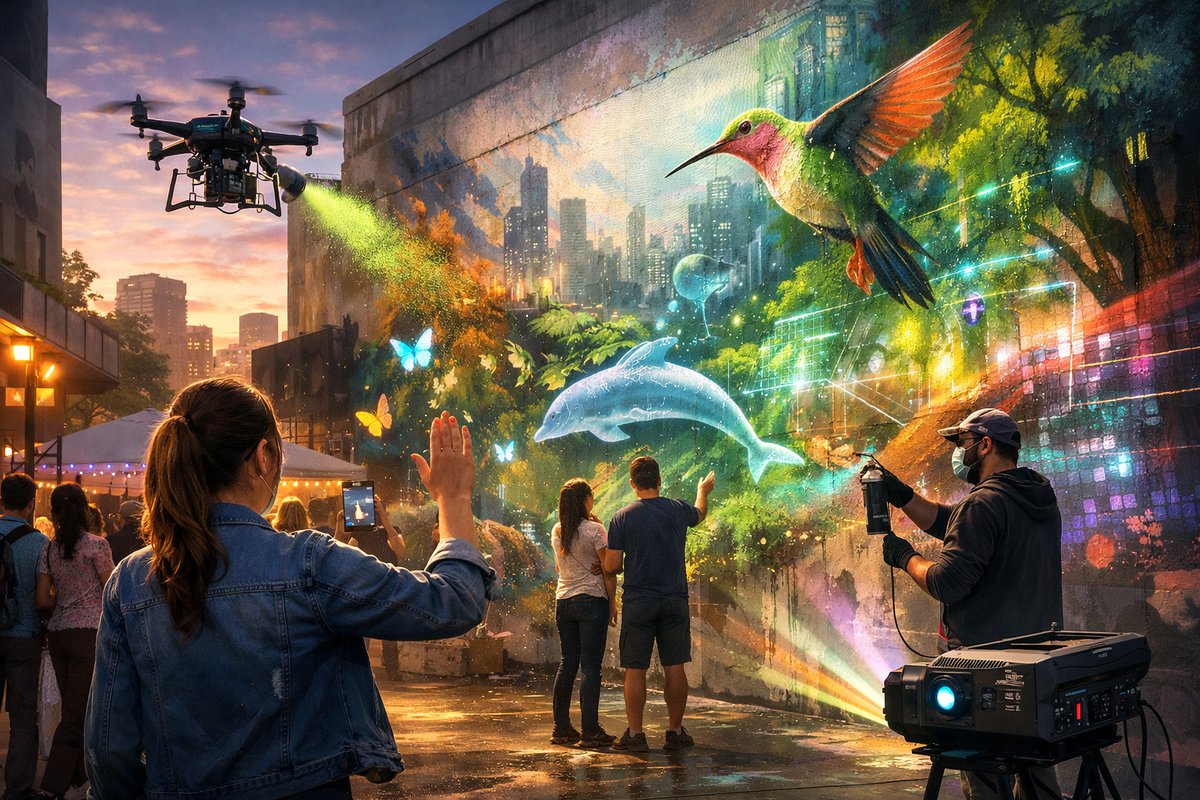

When a weathered brick façade in East London flickered to life with neon trails and floating geometric shapes, onlookers reached for their smartphones in surprise. That moment, captured at the City Canvas Festival, revealed a new frontier: mixed-reality murals that fuse traditional spray-and-brush techniques with digital overlays. Artists not only apply pigment to concrete but also program layers of augmented reality (AR) that users view through an app. As daylight fades, projections shift to reveal hidden animations-creatures that slither across the mortar joints, typewriters hammer out viewer comments above a doorway, and constellations pulse in time with ambient city noise.
This convergence of street art and technology has deep roots in both disciplines yet feels startlingly fresh in execution. Graffiti writers have long experimented with 3D illusion and stencils; video artists have turned entire buildings into screens. Now, open-source AR frameworks allow creators to pin digital elements precisely onto irregular surfaces. Meanwhile, sustainable pigment makers supply thermochromic powders and bio-luminous pigments that glow under ultraviolet light. The result is a layered experience: physical murals that persist through rain or wind, and digital animations that evolve in response to weather data, social media triggers, or even biometric sensors hidden in the wall.
Festival curator (name withheld) describes the vision as “a living canvas.” They note that passersby become collaborators when they point their devices at a mural and see a secret layer revealed. “Someone can draw a quick doodle on their phone, and it appears as shimmering graffiti in midair,” the curator explains. “The art never stops-each person’s gesture can alter the piece for the next viewer.” In one installation, a pulsating heart beats in time with the average citywide heart rate, recorded by volunteers wearing fitness monitors. A section of painted vines responds to real-time humidity, unfurling digital leaves when the air is damp.
Beyond the spectacle, this movement is guided by a philosophy of inclusivity and sustainability. Traditional spray paints rely on solvents that release volatile organic compounds (VOCs). A growing cohort of pigment manufacturers is developing water-based or bio-derived formulations that reduce environmental impact. Some startups extract thermochromic microcapsules from recycled plastics, while others cultivate glow-in-the-dark powders using algae-based biopolymers. These materials allow artists to build murals that shift color in direct sunlight or glow softly after dusk-without toxic byproducts.
Hardware innovations keep pace with materials. Portable projection units, small enough to fit in a messenger bag, use gesture recognition to let artists paint with light. Drone fleets equipped with spray nozzles can ink hard-to-reach walls according to GPS-guided paths. 3D mapping cameras scan uneven surfaces in minutes, generating point clouds that artists import into design software. Annotations added in the software translate into both spray nozzle coordinates and digital anchor points for AR content. The synergy between physical and virtual workflows streamlines what once took weeks of trial and error.
In Berlin, a team of designers recently animated a 60-meter mural using solar-powered projectors mounted on lampposts. Each evening, the mural morphed into a kaleidoscope of fractals, courtesy of an algorithm that pulled data from nearby environmental sensors. Temperature changes altered color palettes; pedestrian foot traffic influenced animation speed. Surveys showed that footfall increased by over 20 percent in that block after the installation went live, suggesting a boost in local commerce as well as communal pride.
Critics have questioned whether digital layers distract from the craftsmanship of traditional street art. Yet proponents argue the opposite: the digital component enhances appreciation for the physical work by revealing hidden complexities. A single QR-code spray-tag might unlock a 3-minute soundtrack or a short animation that explains the mural’s narrative. Viewers gain insight into the artist’s process, thematic intentions, and even ecological data related to the pigments used. This transparency aligns with a broader trend in creative work toward open documentation and audience education.
Community groups are exploring mixed-reality murals as tools for social engagement. In São Paulo, a neighborhood revitalization project invites local residents to propose themes via a public portal. Once approved, artists paint the wall while community members simultaneously sketch digital motifs that appear on smartphones. Children frequently outpace adults, contributing whimsical creatures or dreamscapes that linger as playful AR graffiti. Local schools now integrate the platform into art classes, teaching students both painting techniques and basic coding principles.
The economic ripple effects are also notable. Tours specializing in AR-enhanced street art have popped up in major cities. App developers sell in-app tokens that unlock exclusive digital layers, providing artists a new revenue stream. Architects and urban planners consult with mixed-reality collectives to enliven pedestrian zones and transform corporate facades into interactive installations. As the technology matures, rental services for projection hardware and 3D scanners are emerging, making advanced tools accessible to emerging artists and grassroots collectives.
Looking ahead, creators envision murals that evolve autonomously. Machine-learning algorithms could curate color shifts based on traffic patterns or ambient music. Biometric sensors embedded in handrails might trigger animations in response to touch or pulse. Advances in responsive materials-like thermochromic paints that react to human proximity-could allow walls to breathe or ripple under a spectator’s gaze. In one speculative prototype, a mural of urban forest scenery would sprout digital leaves when someone draws near and gently shed them when they walk away, leaving a delicate trail of luminous particles.
The boundary between canvas and code continues to blur. For artists, mastering this hybrid medium demands a blend of traditional skills and new literacies: coding, data analysis, hardware calibration. Workshops at design schools now teach mapping shaders alongside stencil cutting. Local maker spaces offer drop-in sessions on AR authoring tools and pigment chemistry. As these capabilities spread, mixed-reality murals may soon become as common as wheatpaste posters or chalk tags.
Back at the East London wall, a final flourish: viewers can subscribe to an online feed that sends a snapshot each time the mural’s AR layer changes. Some enthusiasts update their social feeds, turning the mural into a living, collaborative chronicle. Hovering above the painted bricks, digital butterflies flit across the user’s screen-and in that bright moment, public art feels more communal and unpredictable than ever before.
The latest wave of mixed-reality street art reminds us that creativity thrives at intersections: between physical and digital, between artist and audience, between tradition and technology. By embracing innovative pigments, gesture-driven tools, and community-powered platforms, these murals rewrite the rules of visual expression. And as walls across the globe awaken to reveal hidden dimensions, the city itself becomes a playground for boundless imagination.
-
Art 'N Glow Thermochromic Pigment - 20 Grams - Walmart
Thermochromic Multipurpose Pigment Set of 11 various color pigments. Add. $14 ... Related pages. Reactive Metal Paint · Golden Supply · Chromakey Paint · Aero ... -
Universal Color Changing Paint Activated by Body Heat ...
Amazon.com: Universal Color Changing Paint Activated by Body Heat Thermochromic Fabric Paint Temperature Reactive Secret Message Magic Paint Red to Yellow ...