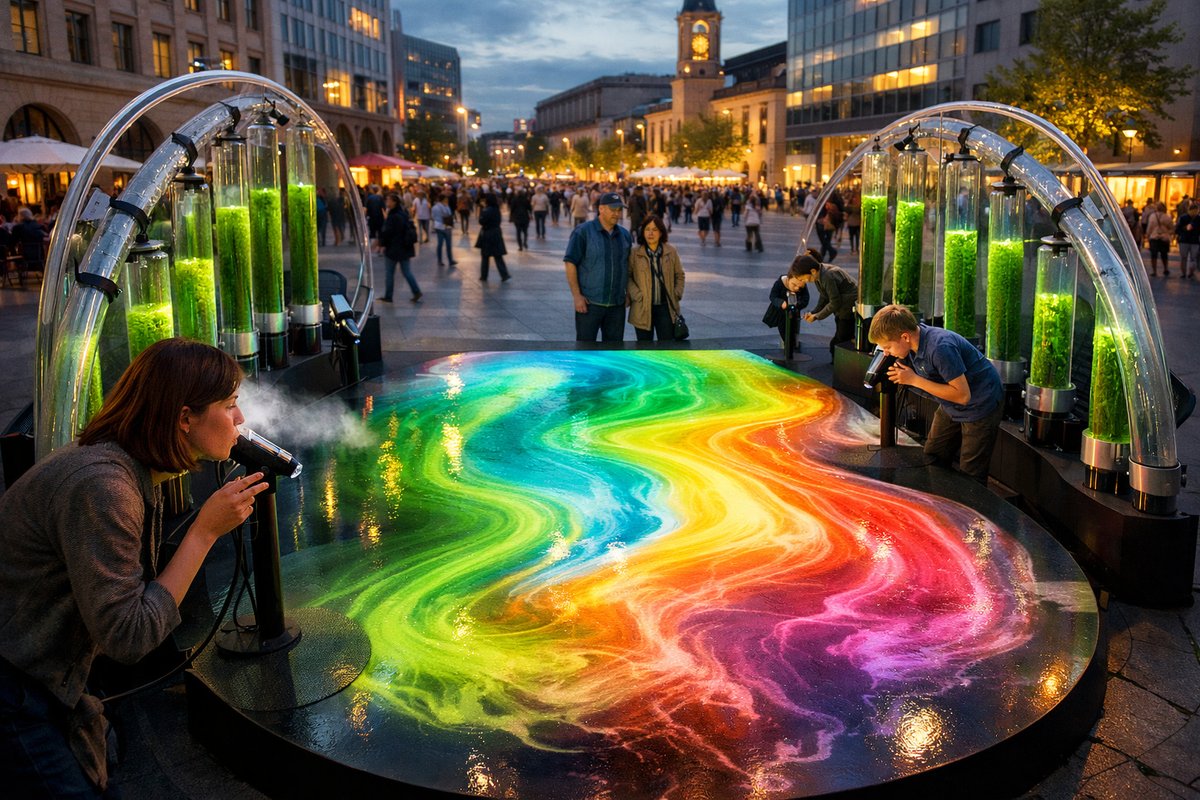

Walking through the plaza at dusk, visitors are met with a softly pulsating glow that seems to inhale and exhale alongside the crowd. Dubbed “Aurora Breath,” this installation merges environmental data with dynamic projection to create a living artwork guided by human presence and physiology. Rather than a static sculpture or a simple light display, Aurora Breath responds in real time to the collective breaths of passersby, transforming exhaled carbon dioxide into vibrant patterns that ripple across reclaimed wood benches and nearby paving stones.
Conceived by a trio of designers who specialize in the intersection of technology and ecology, the artwork is part of a new wave of public interventions that prioritize dialogue over decoration. Here, every visitor becomes both observer and participant. As individuals approach one of the seven sensor-equipped seating modules, a discreet carbon dioxide sensor picks up slight changes in breath concentration. That data is fed to a microcontroller network, which in turn adjusts projection mapping parameters-intensity, hue, and movement-across a canvas of biodegradable ink panels embedded in the benches and plinths.
The visual language of Aurora Breath is constantly shifting. A solitary visitor might see soft gradients of violet give way to cool blues as they sit and breathe. When a group gathers, the colors accelerate and merge, producing a prismatic chorus of warm oranges and greens. The installation deliberately eschews predetermined sequences; instead, it harnesses the unpredictability of human interaction to compose ephemeral color symphonies. In this way, the artwork invites contemplation of collective responsibility for the air we share.
On a technical level, the project relies on a network of low-power microcontroller boards linked via a mesh network. Each board is connected to a CO₂ sensor module with sensitivity down to 50 parts per million. Those readings are transmitted to a central processing unit running custom projection mapping software. High-lumen projectors mounted on nearby lamp columns cast images onto retrofitted benches coated in algae-based pigment prints. This choice of sustainable ink-cultivated from local microalgae farms-reduces reliance on petrochemical dyes and underscores the project’s ecological ethos.
Powering the installation is an array of discreet solar panels integrated into modular street furniture. By day, these panels harvest sunlight to charge a bank of lithium iron phosphate batteries. At night, the stored energy drives both the sensor network and the projection system, ensuring the installation operates entirely off-grid. “We wanted every component to reflect our commitment to sustainability,” explains one of the lead designers. “From the materials we source to the way we power the system, every decision reinforces the central theme of shared stewardship.”
Beyond its technical ingenuity, Aurora Breath taps into a deeper resonance. The color shifts invite passersby to tune into their own breathing patterns, an exercise in mindfulness amid urban bustle. Pedestrians pause to test the responsiveness of the installation, capturing video clips as living hues swirl around them. Social media posts have turned the plaza into a viral sensation-yet the true aim isn’t self-promotion but collective awareness. By making the invisible exchange of gases visible, the installation sparks conversations about air quality, public health, and our impact on the atmosphere.
In its first week on display, Aurora Breath measured nearly a thousand unique interactions per evening. Local schools have organized field trips to observe real-time data visualizations and discuss the science behind the sensors. Nearby cafes report an uptick in visitors lingering longer after sunset, drawn by the ever-changing spectacle. City health officials have even noted that the installation has become an unexpected public health educator, prompting questions about outdoor air safety and prompting some to consult local monitoring apps.
The choice to incorporate algae-derived inks was more than symbolic. Algae cultivation can sequester carbon dioxide at scale, and the pigments retain vibrant color under projection while remaining fully compostable. Instead of repainting benches, the installation team plans to remove and compost panels at the end of the exhibition, returning nutrients to local gardens. Likewise, all mounting hardware and electronic components are designed for easy disassembly and reuse, reflecting a cradle-to-cradle mindset.
Aurora Breath stands at the crossroads of art, science, and civic engagement. It builds on a growing trend of installations that prioritize interactivity over passive viewing, echoing earlier works that used motion sensors or mobile apps. Yet this project goes further by linking our most basic physiological process-breathing-to a living palette of light. In doing so, it transforms a public plaza into an open-air laboratory, where art and data converge to invite reflection on our shared environment.
Critics have lauded the piece for its elegance and its call to collective action. One reviewer noted that the installation “makes atmospheric chemistry feel as intimate as a conversation.” Another praised its “quiet power,” pointing out that the soft rhythms of color can evoke both calm and camaraderie. For the artists, these responses confirm that the intersection of tactile materials and responsive technology can open new pathways for storytelling in the public realm.
Looking ahead, the team plans to expand Aurora Breath to other neighborhoods, adapting the concept to different urban contexts. Future iterations may incorporate particulate matter sensors or ambient noise levels, layering additional data streams into the visual choreography. Workshops are also in the works, inviting local makers and students to build their own micro-art installations using open-source schematics.
As cities evolve, artworks like Aurora Breath offer more than fleeting spectacle. They reveal hidden systems, foster community dialogue, and embody sustainable design principles in every detail. Here, light becomes a living collaborator, drawing attention to the rhythms of life we often take for granted. And in the interplay of breath and color, we glimpse what’s possible when creativity and curiosity come together in public space.
-
Projection Mapping 101: Creating Immersive Visual Experiences ...
Buy Projection Mapping 101: Creating Immersive Visual Experiences: Your Essential Guide to Techniques, Software, & Applications: Read Books Reviews ... -
Amazon.com: VM Basic Colors Miniature Paint Set,Eco-Friendly ...
Amazon.com: VM Basic Colors Miniature Paint Set,Eco-Friendly Water-based Pigments Acrylic Paint Set, Modeling Acrylic Paints For Resin,Metal and Plastic ...