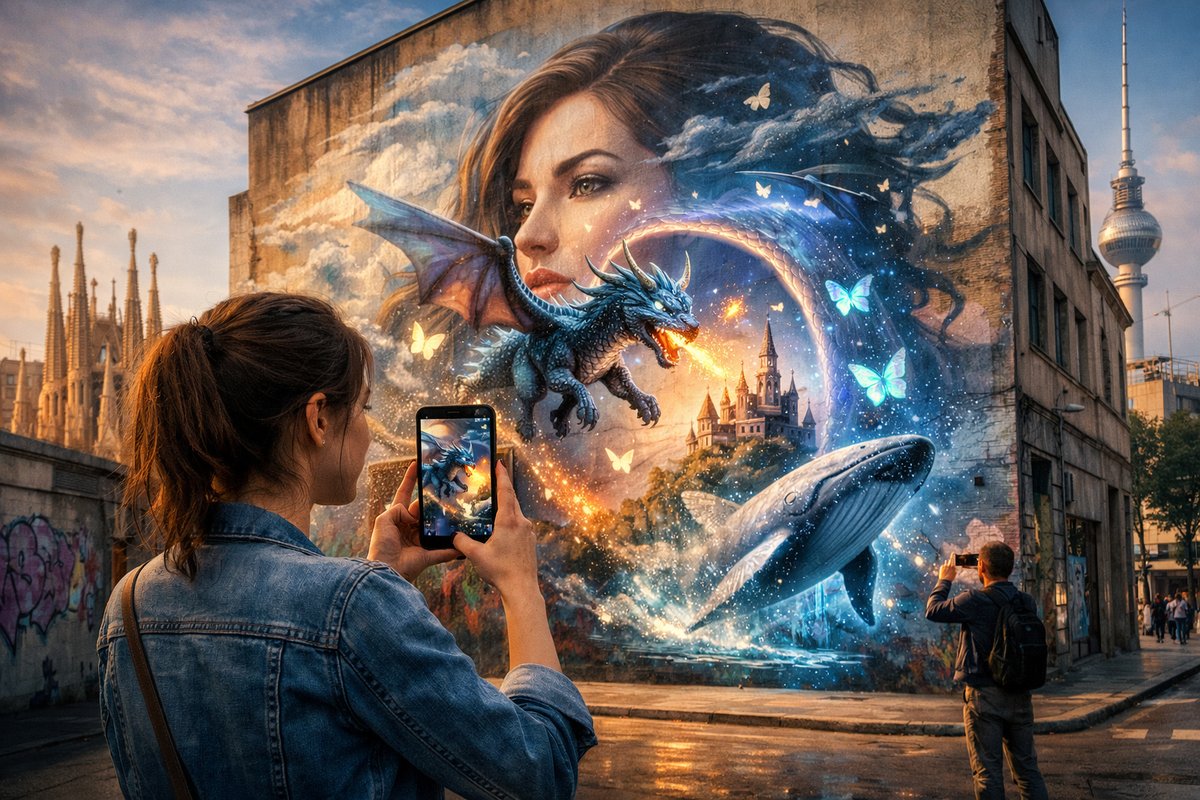

In neighborhoods from Barcelona’s narrow alleys to Berlin’s grand boulevards, a new form of street art is capturing the public imagination: augmented reality murals that reveal animated layers, soundscapes, and interactive elements when viewed through a mobile device. Rather than simply admiring painted motifs, audiences can scan a specially coded section of a wall with an AR app to see characters come to life, data visualizations emerge from graffiti shapes, or historical figures step out of classical frescoes in three-dimensional form. This hybrid medium is redefining how public art is conceived, accessed, and experienced in urban environments.
At last summer’s CityRama Festival in Barcelona, renowned visual artist Elena Arteche debuted a sprawling wall on Carrer Blai that appears as a tranquil coastal scene by day. When viewers hold up their phones and open a free AR viewer, a swirling shoal of fish darts through the painted waves, accompanied by an ambient soundscape of seagulls and chimes. According to festival organizers, more than 35,000 unique scans were recorded over two weeks, generating nearly 150,000 minutes of interaction time. Such engagement figures mark a 23 percent rise in audience participation compared with the previous year, reflecting a broader trend toward immersive public art highlighted in a recent Art Basel report.
Technical wizardry underpins these installations. Artists collaborate with software developers who use platforms like Unity and Vuforia to anchor 3D models and animations to precise mural coordinates. Specialized markers or invisible image patterns painted into corners of the artwork act as AR triggers. Once the app recognizes those markers through a smartphone’s camera feed, digital overlays blend seamlessly with the physical wall. For preparatory outlines, many teams use mini portable projectors to trace complex shapes before applying weather-resistant paints. After the analog work is complete, coders embed the digital assets, calibrating alignment and lighting so virtual elements cast shadows consistent with ambient sun or streetlamp illumination.
Curator Jasmine Ortiz, who coordinates a traveling exhibition of AR murals across three European capitals, explains that the movement is driven by a desire to merge tactile craft traditions with emergent technology. Ortiz describes it as both a reaction against the flatness of pure digital screens and an evolution of classical fresco techniques. ‘We’re embracing the physicality of paint and texture while harnessing interactivity that transforms passive viewership into active discovery,’ she says. ‘Audiences become explorers, scanning for clues and piecing together narratives that play out only through their engagement.’ This philosophy underscores a shift from static spectacle toward participatory storytelling in public spaces.
Yet artists face logistical challenges. Stable power sources are scarce on open sidewalks, so many teams rely on lightweight lithium-ion battery packs to power projection tests and development rigs during installation. Network connectivity can also be inconsistent, which is why most AR viewers are designed to download digital assets beforehand and operate offline. Ensuring compatibility across dozens of smartphone models requires rigorous testing to confirm that both iOS and Android devices render 3D animations smoothly without overheating or draining the device battery too quickly.
For passersby, the surprise of stumbling upon an AR mural is part of the magic. In Berlin’s Kreuzberg district, a monochrome portrait of a tree transforms into a kaleidoscopic ecosystem of birds, beetles, and blossoms when scanned, eliciting audible gasps from curious onlookers. One visitor described the experience as ‘peeling back the skin of the city’ to uncover hidden layers of life. Local shopkeepers report that foot traffic in the area has increased by roughly 15 percent since the mural’s debut, suggesting that these installations can have tangible economic impact as well as cultural resonance.
Sustainability is also a guiding principle. Many artists now select eco-friendly pigments and low-VOC spray paints for the physical murals, while coders optimize file sizes of digital assets to minimize data usage and storage waste. Portable solar chargers are being tested as an alternative to conventional batteries, allowing teams to top up equipment with renewable energy during daylight hours. By integrating green practices into every stage-from concept sketches to final deploy-they aim to reduce the carbon footprint of large-scale public artworks.
Accessibility lies at the heart of the AR mural ethos. Unlike gallery exhibitions that require timed tickets and travel budgets, street art is free and available to anyone with a compatible device. Developers collaborate with accessibility specialists to include audio narration, haptic feedback options, and high-contrast settings, ensuring that the experience can be enjoyed by people with visual or auditory impairments. Some murals even feature multiple language overlays so residents and tourists alike can access context and stories in their native tongues.
While AR murals share some DNA with earlier digital street art movements-such as projection mapping and video graffiti-the current wave places greater emphasis on narrative depth and audience agency. Where projection mapping typically projects ephemeral visuals onto landmark facades at scheduled showtimes, AR murals offer on-demand interactivity that can be experienced at any hour. This shift reflects an urban design ethos that prioritizes decentralization, empowering viewers to choose when and how to engage with public art.
Data analytics play an increasingly prominent role in measuring impact. Event organizers track total scan counts, dwell times per animation, and repeat interactions to evaluate audience engagement. These insights help artists refine their storytelling pacing and optimize asset distribution. However, they also raise questions about data privacy. To address concerns, many AR projects anonymize user interactions, store no personal identifiers, and allow viewers to opt out entirely if they prefer to remain offline.
Looking ahead, artists are exploring integration with wearable AR glasses and 5G networks to create persistent world anchors that can be revisited over months or even years. There’s talk of cross-city trails where murals in one neighborhood trigger clues to digital secrets hidden in another. Machine learning could enable murals to adapt animations in real time based on weather data or crowd density. As the technology becomes more accessible, the boundary between painted walls and interactive canvases will dissolve further, ushering in an era where every street corner holds potential for surprise, dialogue, and wonder.
Augmented reality murals stand at the intersection of paint, pixels, and public imagination. By blending analog craftsmanship, digital innovation, and sustainable practice, this pioneering art form invites city dwellers to become participants rather than mere spectators. As more communities embrace interactive murals, urban landscapes will evolve into open-air galleries that expand and transform with each scan, reminding us that the stories etched on city walls can live far beyond pigment alone.