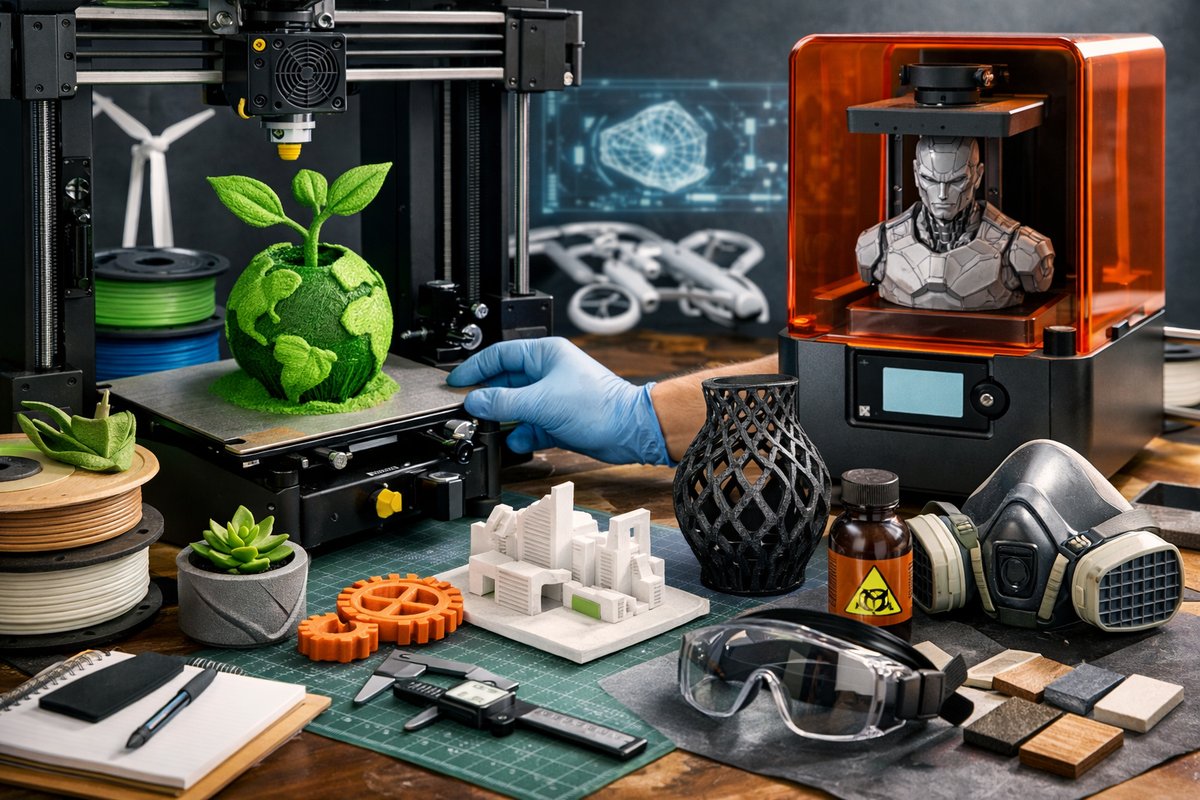

The world of 3D printing has evolved far beyond its roots in rapid prototyping. Once relegated to industrial research labs and specialized workshops, additive manufacturing now thrives in classrooms, maker spaces, and home studios. Whether you’re a curious newcomer or a seasoned hobbyist, understanding the interplay of materials, machines, and methods is key to creating functional, beautiful, and reliable prints. This article unpacks the core elements of 3D printing in a modular way, so you can focus on the areas that matter most to your next project.
From Filaments to Resins: Material Matters
Choosing the ideal printing material is the first step on any 3D printing journey. Thermoplastics like PLA (polylactic acid) and ABS (acrylonitrile butadiene styrene) remain popular for FDM (fused deposition modeling) machines due to their affordability and ease of use. PLA, derived from renewable resources like cornstarch, offers low-warp prints and is biodegradable-making it perfect for educational settings. ABS, on the other hand, delivers higher temperature resistance and impact strength but requires a heated build plate and proper ventilation to manage fumes.
Beyond these basics, advanced filaments combine plastic with additives to achieve unique properties. Carbon-fiber-infused PLA offers rigidity and a matte, industrial finish. Flexible TPU (thermoplastic polyurethane) mimics rubber, enabling wearable prototypes or shock-absorbing parts. Specialty blends like wood-fill or metal-fill embed microscopic particles for realistic textures, though they often require hardened nozzles to avoid abrasion.
For users of resin-based SLA (stereolithography) or DLP (digital light processing) printers, the palette expands further. Standard UV-curing resins deliver fine detail and smooth surfaces but can be brittle. Tough or engineering-grade resins bridge the gap, offering impact resistance and temperature tolerance. Dental or castable resins cater to specialized industries, turning prints directly into molds or biocompatible models. When handling liquid resins, always wear nitrile gloves and work in a well-ventilated area to minimize skin contact and inhalation risks.
Machine Toolbox: Exploring Printer Types
Not all 3D printers are created equal. FDM machines remain the most accessible, printing by extruding filament through a heated nozzle layer by layer. Entry-level models can cost under a few hundred dollars, while industrial-grade units with multi-extrusion capabilities and large build volumes climb into the tens of thousands. Key considerations include build volume, nozzle diameter, bed leveling system, enclosure, and upgradeability.
SLA and DLP printers, which cure photopolymer resins with lasers or projectors, excel at capturing intricate geometries. They’re beloved by jewelers and dental technicians for their precision but typically require post-curing in a UV chamber to reach full strength. The trade-off is slower print times for larger objects and additional cleanup steps involving isopropyl alcohol baths and protective gear.
Emerging formats like SLS (selective laser sintering) and MJF (multi-jet fusion) use powdered materials-nylon, for instance-sintered by lasers or fuses deposited agents. While these machines are often too costly for personal use, desktop SLS units are starting to reach prosumer budgets. The result is durable, isotropic parts without the need for support structures, making them ideal for functional prototypes and small-batch production.
Fine-Tuning the Print: Techniques for Quality
Once you’ve selected your material and hardware, dial in the settings to coax the best performance from your setup. Layer height, print speed, extrusion temperature, and cooling fan strength all interact. A lower layer height (0.1-0.2 mm) yields smooth surfaces but increases print time, whereas a thicker layer (0.3 mm or more) speeds up production at the expense of visible layer lines.
Bed adhesion can make or break a print. Traditional methods include blue painter’s tape, glue sticks, and hairspray on glass beds. Modern printers often come with PEI or BuildTak-like surfaces that offer reliable grip without extra adhesives. Auto bed leveling sensors-such as inductive probes or capacitive arrays-further ensure the nozzle maintains a consistent distance, reducing first-layer issues.
For filament printers, nozzle size has a pronounced impact on resolution and throughput. A 0.4 mm nozzle is standard, but swapping to 0.2 mm doubles detail at the cost of slower extrusion. Conversely, a 0.8 mm nozzle can crank out structural parts rapidly. Don’t forget to calibrate extrusion flow, also known as E-steps, to avoid under- or over-extrusion. Using a digital caliper to measure test cubes helps you tune the exact amount of plastic delivered per millimeter of filament.
Sustainable and Safe: Ethics and Environment
As 3D printing spreads, so does its environmental footprint. Many makers are embracing recycled filaments, made by shredding existing prints and blending them with virgin plastic. Several companies now offer carbon-neutral or biodegradable alternatives to standard ABS. Recycling bins dedicated to PLA waste and spent support structures can be reprocessed into new filament through desktop filament extruders.
Workplace safety must remain a priority. Filtration systems with HEPA and activated carbon filters capture ultrafine particles and VOCs emitted during printing. Enclosing machines reduces noise and thermal fluctuations while containing odors. Always read safety data sheets (SDS) for your materials, wear appropriate PPE-especially when handling solvents for resin cleanup-and keep a first-aid kit nearby for any mishaps.
Scaling Up: Post-Processing and Finishing
The journey doesn’t end when the build stops. Post-processing can transform a raw print into a polished prototype or final product. Sanding and priming FDM parts smooth out layer lines; solvent vapors like acetone can fuse ABS layers for a glossy finish. Chemical polishing works wonders but demands careful ventilation and flame suppression measures.
Resin prints benefit from rinsing stations to remove uncured liquid, followed by dedicated UV-curing chambers. Some enthusiasts spray protective coatings or paints to enhance durability and aesthetics. Functional parts-gears, brackets, or jigs-may require press-fitting metal inserts, tapping threads, or applying specialized adhesives. Think of post-processing as a creative extension: it’s where craftsmanship and additive manufacturing truly converge.
Future Threads: Trends on the Horizon
Additive manufacturing continues to innovate at a blistering pace. Hybrid machines that combine subtractive and additive processes can mill metal reinforcements into polymer parts. Pellet extrusion systems promise lower material costs by allowing direct feeding of plastic pellets. Bioprinting organs and construction-scale 3D printers that print concrete structures hint at entirely new applications-from healthcare to architecture.
Software is also catching up. AI-driven slicers can auto-optimize support structures, reduce material waste, and suggest print parameter tweaks based on cloud data from thousands of printers worldwide. Open-source communities drive rapid iterations on hardware designs, empowering users to modify firmware and share improvements across platforms.
Whether you’re crafting cosplay armor, prototyping medical devices, or producing replacement parts for vintage machinery, 3D printing offers a blend of creativity and engineering rigor. By mastering materials, machines, techniques, and sustainable practices, you can push the boundaries of what’s possible-layer by precise layer. The future of making is here, and it’s additive.