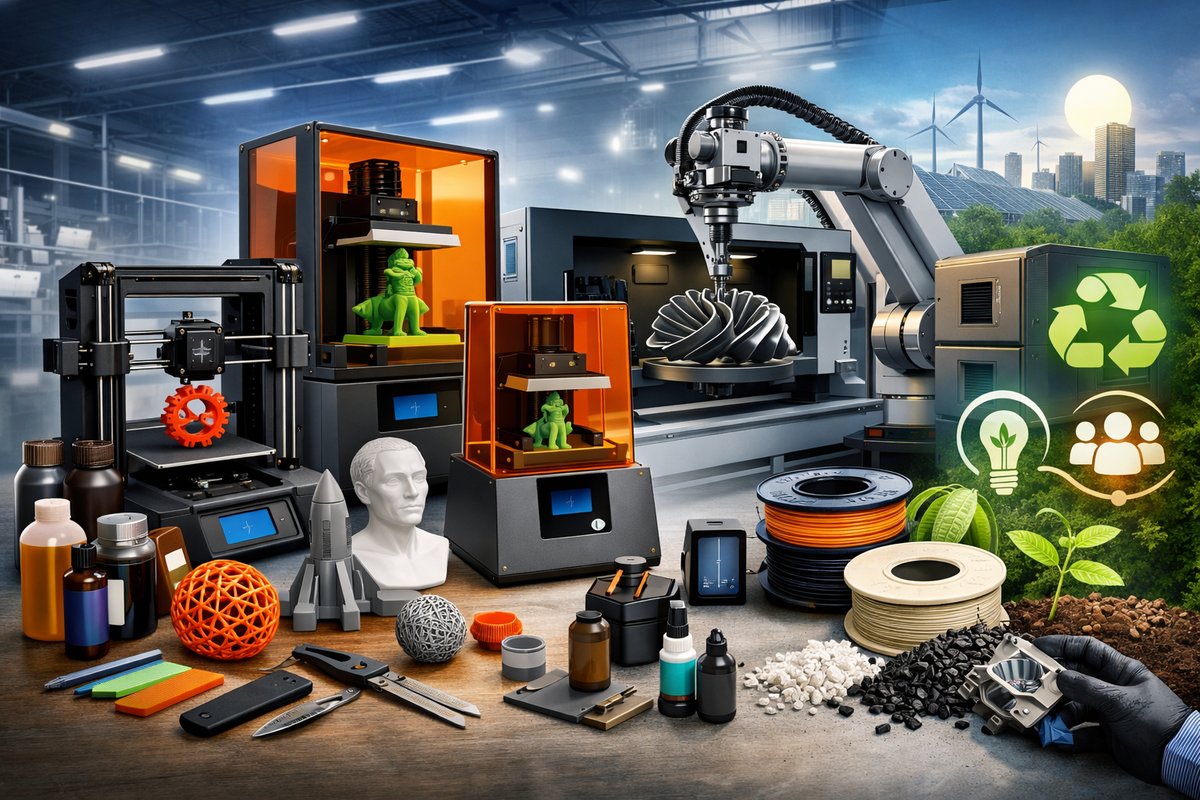

The rapid evolution of 3D printing has rewritten the rules of prototyping, manufacturing and even creativity itself. What once existed as a laboratory curiosity has now become an accessible desktop revolution. Whether you’re a hobbyist crafting intricate miniatures or an engineer iterating aerospace components, understanding the ecosystem of tools, materials and techniques is essential. This guide charts a clear path through the ever-expanding landscape, helping beginners find firm footing while inspiring seasoned makers to refine their workflow and explore new frontiers.
At its core, 3D printing follows a simple principle: build objects layer by layer from digital designs. A model created in CAD software is sliced into thin cross-sections that a printer then deposits in sequence. The most common approach-fused deposition modeling-melts thermoplastic filament and extrudes it through a heated nozzle onto a build plate. Photopolymer resin methods like stereolithography use light to cure liquid resin, while powder-based technologies fuse granular materials with lasers or binding agents. Each method carries its own requirements, strengths and limitations. By grasping the fundamental mechanics, users can match ambitions and budgets to the system best suited for their goals.
Desktop FDM setups remain the most widespread entry point. Compact printers featuring heated beds, filament trays and user-friendly interfaces have made plug-and-play operation possible. Modern extruders maintain consistent nozzle temperatures, minimizing jamming and improving layer adhesion. Automatic bed leveling sensors detect surface irregularities, adjusting the nozzle height in real time to ensure a uniform first layer. Modular hot ends that can accept different nozzle sizes enable fine detail or rapid deposition, and dual-extrusion heads open doors to multi-color or soluble support prints. Even budget machines now rival older professional models in reliability, giving newcomers confidence as they explore more advanced techniques.
Material choice is another critical dimension. Basic PLA (polylactic acid) remains popular for its low printing temperature, minimal warping and biodegradable origin. It’s ideal for decorative objects, educational projects or rapid prototyping when mechanical properties aren’t paramount. ABS (acrylonitrile butadiene styrene) offers superior impact resistance and higher heat tolerance, though it demands enclosed chambers to prevent cracking. PETG blends ease of printing with toughness and chemical resistance, striking a balance for functional parts. Beyond these staples, specialized filaments incorporate wood fibers, metal powders or carbon-fiber reinforcement for aesthetic effects, conductivity or stiff structural elements. Nylon delivers excellent strength and flexibility, but often requires a dry storage environment and precise temperature control.
Resin-based SLA and DLP printers present a different palette of materials and post-processing. Photocurable resins can yield surface finishes with fine feature resolution far exceeding typical FDM. Standard resins are ideal for jewelry prototypes and dental models, while engineering grades offer heat-resistance or biocompatibility. Users must handle resins with care, wearing gloves and ensuring proper ventilation. After printing, parts rinse in isopropyl alcohol to remove uncured resin, then cure under UV light to achieve full material properties. A dedicated curing station speeds this step and helps align mechanical characteristics across batches, ensuring consistency for functional testing.
Regardless of printing method, surface preparation and adhesion are key. FDM operators often apply glue sticks, specialized adhesives or painter’s tape to the build plate to prevent corners from lifting. Flexible build surfaces that flex open for easy removal save hours of frustration. Bed-calibration routines and occasional surface cleaning ensure repeatable first layers. Temperature control extends beyond the nozzle: maintaining a stable chamber environment reduces thermal stress and warping, especially for large or high-performance parts. For resin setups, filtering used alcohol and regularly replacing cleaning solutions prevents cured resin fragments from marring subsequent prints.
Once materials and surfaces are under control, mastering print profiles unlocks quality improvements. Layer height adjustments balance speed against resolution; finer layers reveal smoother curves but extend build times. Print speeds, infill patterns and support structures all influence final strength and aesthetics. Experimenting with nozzle temperature, cooling fan rates and retraction settings helps reduce stringing, blobs or poor layer adhesion. Many slicer programs offer built-in test patterns so users can benchmark different settings on a single print. Documenting these results builds a personalized profile library, accelerating future projects and reducing trial-and-error waste.
Troubleshooting common issues is part of the maker’s journey. Warping often results from uneven cooling-address it by slowing fan speeds, increasing bed temperature or enclosing the printer. Layer shifts may point to loose belts, misaligned rails or stepper motor skipping; routine maintenance and tension checks can nip these problems in the bud. Under-extrusion manifests as gaps or weak infill walls and can stem from clogged nozzles, misconfigured flow rates or worn drive gears. A nozzle cleaning kit and calibration filament strips help diagnose blockages, while routine nozzle swaps prevent long-term clog buildup and extend hardware life.
Post-processing elevates a printed part from prototype to polished final piece. Sanding with progressively finer grits removes layer lines, while filler primers and fine surface primers prepare models for paint or plating. Acetone vapor smoothing works on ABS to deliver glossy, seamless exteriors but demands careful handling in a controlled chamber. Resin prints might benefit from thin coats of clear sealant to protect against moisture and UV exposure. Assembly techniques such as press-fit joints, threaded inserts or snap-fit features can be integrated into the design stage to streamline later steps. These finishing touches reinforce the transition from laboratory curiosity to end-use component.
Software choices shape every stage of the workflow. Open-source slicers offer extensive community-developed plugins for support customization, variable layer heights and adaptive infill. Commercial packages may feature optimized slicing algorithms, integrated CAD tools or cloud-based collaboration for design reviews. Digital sculpting applications and parametric modeling software each serve different needs-organic forms excel in mesh-based tools, while mechanical parts benefit from constraint-driven sketches. Regardless of platform, file formats like STL, OBJ or AMF serve as universal intermediaries. Learning to pre-flight files in mesh repair utilities prevents hidden defects and ensures reliable builds.
Building an efficient ecosystem often means developing a routine. Start with a design checklist: verify dimensions, wall thickness and support positioning. Select materials based on mechanical or aesthetic requirements and pre-dry hygroscopic filaments when necessary. Calibrate your printer monthly and log maintenance activities. Organize your workspace with labeled filament storage, spare nozzles and cleaning supplies. Invest time in learning community forums and maker spaces where experienced users share failure case studies and novel techniques. Regular knowledge exchanges accelerate problem solving and spark fresh ideas for future projects.
Sustainability has become a focal point within the additive manufacturing community. Several services recycle failed prints into crushed pellets for industrial reprocessing. DIY filament extruders allow closed-loop reuse of PLA scraps, and compostable material options further reduce ecological impact. Energy efficiency improvements in newer printers lower operational costs and carbon footprints. Designers mindful of lattice structures and topology optimization can achieve lightweight parts with minimal material waste. As 3D printing becomes more embedded in supply chains, prioritizing circular economies and responsible material sourcing will drive the next era of innovation.
The maker community remains a wellspring of creativity and collaboration. Online repositories host thousands of free models for everything from mechanical hinges to cosplay props. Local hacker spaces and educational institutions often provide access to higher-end systems-metal printers, multi-material extruders and industrial-grade powder bed machines. Team projects unite designers, engineers and artists to tackle challenges in robotics, medical devices or sustainable architecture. Sharing successes and missteps alike builds collective wisdom that no single user could amass on their own.
Looking forward, emerging advances promise to reshape additive manufacturing once again. Multi-material printheads blend rigid and flexible polymers in a single build. In situ monitoring and machine-learning algorithms will adapt print parameters on the fly, reducing failures and enhancing quality. Bioprinting tissues, printing with conductive inks and embedding electronics directly in three-dimensional objects are moving from labs into pilot production. As affordability improves and hardware ecosystems mature, the boundary between digital concept and physical reality will continue to dissolve.
Whether you’ve just unboxed your first printer or you’re managing an industrial additive fleet, understanding the interplay of tools, materials and techniques unlocks new possibilities. Embrace experimentation, record your findings, and keep refining your workflow. From playful prototypes to mission-critical parts, 3D printing offers a unique lens on design, sustainability and collaboration. By mastering the essentials and staying curious about emerging trends, you’ll be well equipped to shape tomorrow-one layer at a time.