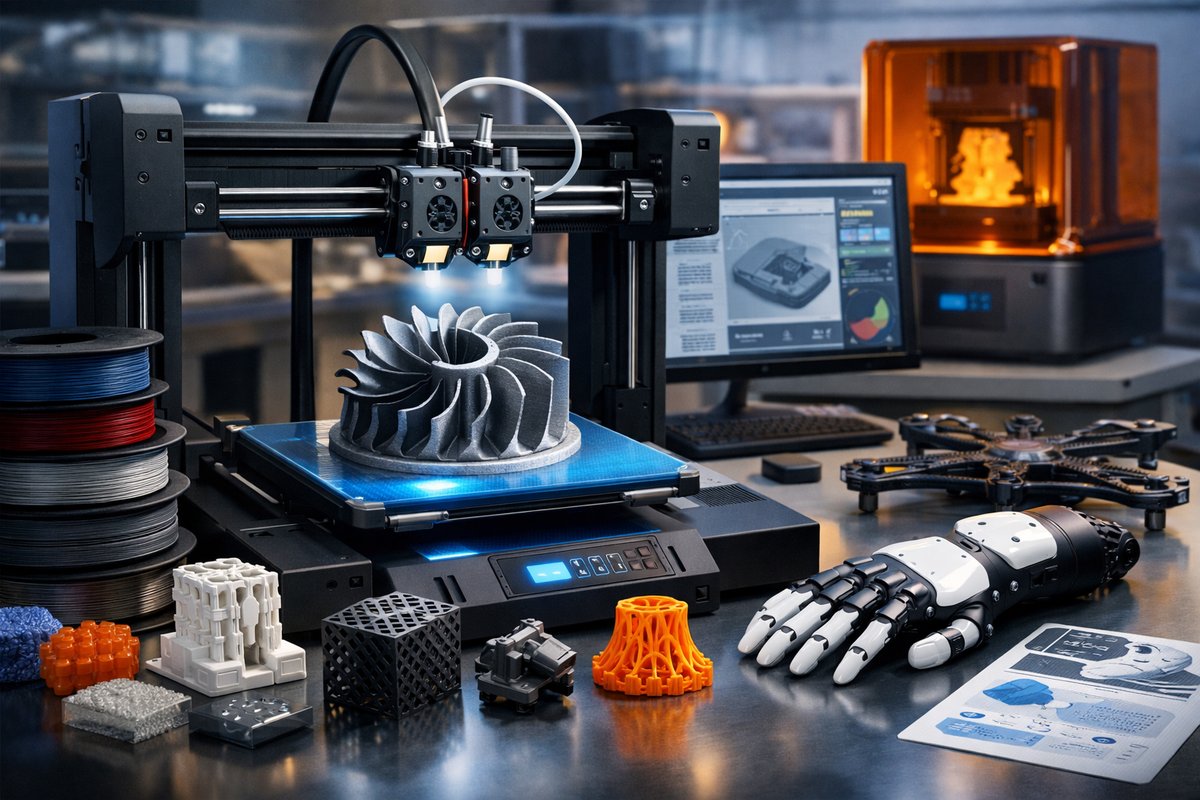

In the dynamic world of 3D printing, innovation never pauses. What began as a niche technology primarily for rapid prototyping has blossomed into a multi-faceted tool that bridges creativity and engineering. Today, 3D printing is increasingly economical, feasible, and successful thanks to breakthroughs in materials science, hardware design, and intelligent software. These advances not only reduce costs and improve precision but also expand the range of objects and industries that can benefit from additive manufacturing.
One of the most significant trends reshaping 3D printing is the development of new materials that balance affordability with performance. Traditional filaments such as PLA and ABS remain popular for their ease of use and low cost, but recent years have seen a surge in composite filaments infused with carbon fiber, metal powders, or biodegradable additives. These composites enhance mechanical strength, heat resistance, or environmental sustainability without requiring prohibitively expensive printers. For example, carbon fiber reinforced filaments enable the production of lightweight yet durable parts suitable for functional prototypes and end-use components, often rivaling injection-molded plastic in toughness.
Meanwhile, resin-based printing technologies, particularly those using photopolymerization methods like stereolithography (SLA) and digital light processing (DLP), have gained traction for their ability to produce highly detailed, smooth-surfaced models. Innovations in resin chemistry have led to formulations that cure faster, emit less odor, and offer improved mechanical properties such as flexibility or impact resistance. These improvements make resin printing more practical for applications ranging from dental molds to intricate artistic sculptures. Additionally, open-source and affordable resin printers have made this technology accessible to hobbyists and small businesses, democratizing precision manufacturing.
Hardware advancements are equally pivotal. The rise of multi-material and multi-color 3D printers allows users to combine different filaments or resins within a single print job, creating objects with varied textures, colors, or functional gradients. This capability reduces post-processing and assembly steps, streamlining production workflows. Moreover, the integration of real-time monitoring systems using cameras and sensors helps detect printing errors early, minimizing material waste and improving overall yield. Closed-loop feedback mechanisms adjust parameters like extrusion rate or laser intensity on the fly, ensuring consistent quality even in complex geometries.
Another key factor driving feasibility is the evolution of slicing software and design tools. Modern slicers incorporate artificial intelligence and machine learning algorithms to optimize print paths, support structures, and layer heights automatically. These intelligent adjustments can drastically reduce print times and material consumption while maintaining structural integrity. User-friendly interfaces and cloud-based platforms also facilitate collaboration and version control, enabling teams to iterate designs rapidly without extensive technical expertise. Furthermore, integration with generative design software empowers users to create organic, lightweight structures that traditional manufacturing could not realize, unlocking new possibilities in aerospace, automotive, and medical fields.
Cost reduction strategies have also played a vital role. The proliferation of desktop 3D printers with open-source firmware and modular components has driven down entry barriers, allowing more individuals and startups to experiment with additive manufacturing. Additionally, the adoption of recycled and bio-based materials aligns with growing environmental consciousness, making 3D printing a more sustainable option compared to subtractive methods that generate significant waste. Some companies have introduced filament recycling systems that convert failed prints and scrap plastic back into usable filament, closing the material loop and reducing expenses.
Beyond the technical realm, the community-driven culture surrounding 3D printing fosters continuous learning and innovation. Online repositories of free and open-source 3D models, forums, and maker spaces provide valuable resources for novices and experts alike. This collaborative environment accelerates the dissemination of best practices and novel techniques, further enhancing the technology’s accessibility and effectiveness.
Looking ahead, emerging technologies such as 4D printing-where printed objects can change shape or properties over time in response to stimuli-promise to add dynamic functionality to additive manufacturing. Advances in bioprinting and metal additive manufacturing are also expanding the frontiers of what can be fabricated layer by layer, from living tissues to complex aerospace components. These developments underscore the importance of adaptable, economical, and precise 3D printing methods that can meet diverse and evolving needs.
In essence, the quiet revolution of 3D printing continues to unfold as smarter materials, refined hardware, and intelligent software converge. This synergy is making the craft of turning virtual models into tangible objects more accessible, sustainable, and successful than ever before. Whether for playful prototyping, artistic expression, or critical industrial applications, 3D printing is proving that the future of making truly begins with a single layer.
-
Amazon.com: ELEGOO PLA-CF 3D Printer Filament 1.75mm Black ...
Superior Mechanical Properties - Reinforced with carbon fiber, ELEGOO PLA-CF delivers exceptional strength and rigidity, making it ideal for producing ... -
PETG Carbon Fiber 3D Printer Filament, 1.75mm, Carbon ... - Walmart
Buy PETG Carbon Fiber 3D Printer Filament, 1.75mm, Carbon Fiber Reinforced, Dimensional Stability,Sandy Beige at Walmart.com. -
ELEGOO Saturn 3 MSLA 12K 3D Printer - Amazon.com
ELEGOO Saturn 3 MSLA 12K 3D Printer | Desktop Resin Impresora with 10-Inch Monochrome LCD, Voxeldance Tango Slicer, Large Printing Size of 8.62 × 4.84 ... -
Onerbl 24V AC Adapter Compatible with ELEGOO Saturn 3 UItra ...
In Great Working Condition. Compatible with: ELEGOO Saturn 3 UItra MSLA 3D Printer Desktop Resin 3D Printer ... SLA Resin Printer 24VDC 4000mA Power Supply Cord ... -
FLASHFORGE AD5X Multi-Material 3D Printer 4-Color Printing ...
FLASHFORGE AD5X Multi-Material 3D Printer 4-Color Printing, 600mm/s Speed 1-Click Print with DIY IFS Creations, Full-Auto Calibration & Filament Backup, ... -
FLSUN S1 PRO High-Speed Delta 3D Printer,1200mm/s Printing ...
... , ≤55 dB Quiet FDM 3D Printers350°C All-Metal Hotend, ,Large Build Volume 320x320x430mm³,Multi-Material Support at Walmart.com.