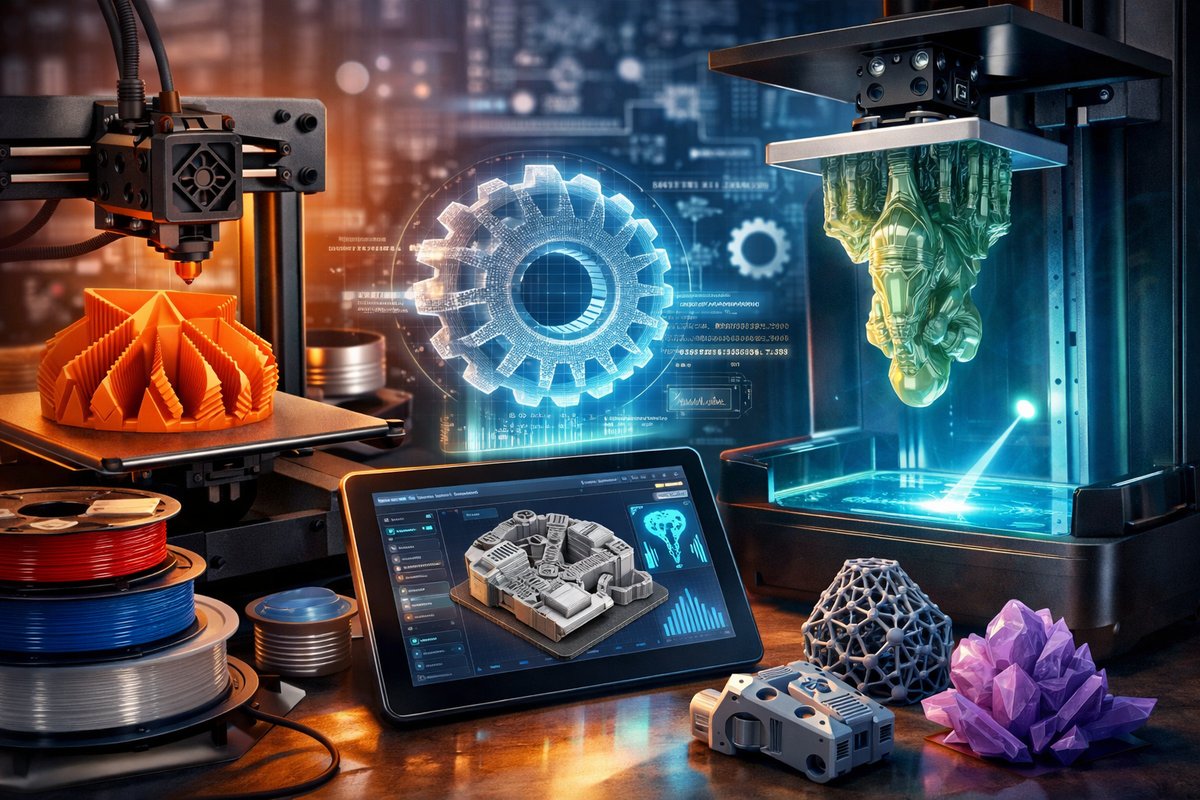

In a small workshop or a high-tech lab, the hum of a 3D printer marks the start of a transformation: digital geometry becomes tactile form, layer by layer. What once felt like science fiction now thrives in maker spaces, education centers, and production lines. But as adoption grows, so does the need to make each print more economical, more reliable, and more accessible. Let’s explore the wave of recent technologies and techniques that are reshaping the economics of additive manufacturing.
At the heart of accessible 3D printing lie materials that balance cost, performance, and sustainability. Traditional PLA remains popular for its low-temperature printing and biodegradable roots. Yet today’s enthusiasts can choose from filament sample packs that mix PLA, PETG, and ABS in a single bundle, letting users test strengths, flexibilities, and finish qualities without committing to 5-kilogram spools. Specialty blends now incorporate recycled PETG from water bottles or wood-filled PLA for a natural grain, all priced competitively with commodity plastics. Carbon fiber-infused filaments offer rigidity where load-bearing is needed, and even flexible TPU variants allow for dynamic prototypes without expensive tooling.
On the resin side, resin manufacturers have responded to calls for lower waste and larger build volumes. Bulk resin sample sets let artists and dental labs trial engineering, castable, and tough resins before scaling up. Meanwhile, MSLA (masked stereolithography) printers with removable vats and recyclable films reduce per-print cleaning time and resin exposure. By combining gravity-fed vats with replaceable film sheets, these systems minimize resin waste and cut resin-bed maintenance from hours to minutes.
But materials are only half the story. Software now plays a leading role in wringing efficiency from every print. Modern slicing engines employ adaptive infill strategies that concentrate material only where mechanical strength is needed. Instead of uniform honeycomb or grid patterns, these algorithms analyze load paths and generate organic, bone-like lattices that use up to 50 percent less plastic while maintaining structural integrity. Meanwhile, advanced support-generation modules refine breakaway supports that reduce post-processing time and material usage. By leveraging AI-driven prediction models, some slicers can even anticipate common print failures-warp, layer shifts, stringing-and automatically adjust cooling, extrusion rates, or infill patterns to compensate.
Cloud-based slicing services further democratize access to high-end optimization tools without hefty upfront software fees. Makers can upload a 3D model, choose from tiered service levels, and receive a fully optimized G-code package ready to print. This model shifts costs to usage, making professional-grade optimizations affordable for hobbyists and small workshops. For large print farms, API integrations let operators batch-process hundreds of designs overnight, ensuring that every spool of filament is pushed to its fullest potential.
Hardware vendors are answering the call for resilient, cost-effective machines. CoreXY and H-bot kinematics offer fast, rigid motion on compact frames, lowering maintenance and power consumption compared with large Cartesian setups. Closed-loop motor controls now come standard on many desktop printers, automatically adjusting for missed steps and ensuring dimensional accuracy across long prints. Hardened steel nozzles handle abrasive carbon fiber mixtures, and quick-swap hot ends let users switch from high-temperature industrial plastics to water-soluble support materials in minutes. Heated enclosures maintain optimal chamber temperatures for materials prone to warping, like nylon and polycarbonate, turning once finicky prints into reliable successes.
For resin enthusiasts, UV-LED arrays combined with high-resolution monochrome screens have reduced layer cure times to just a few seconds, while maintaining sub-50-micron precision. Modular build platforms enable peel-free printing, slashing the risk of layer delamination and boosting first-time-right rates. Paired with automated wash-and-cure stations, these systems streamline post-processing: objects come out fully cured, with minimal surface stickiness and no manual sanding or alcohol rinsing required.
Beyond individual tools and materials, many makers are discovering economies of scale through collaborative production models. Print farms-rows of identical machines queued with diverse orders-spread out fixed costs like workspace, electricity, and connectivity. Using open-source production management platforms, operators route jobs to the next available printer, track real-time progress, and dynamically reorder spares when wear parts run low. In educational settings, classroom clusters of budget printers let students share calibration lessons and design feedback, turning collective knowledge into better prints for everyone.
On the design front, generative modeling is rewriting the rules of shape. Rather than sketching boxes and cylinders, engineers input load constraints, thermal limits, and material costs into design software. The system then evolves topology-optimized structures that blend strength with minimal mass-ideal for drone components, robotic arms, and even custom bicycle parts. By printing only what’s truly necessary, these designs cut material usage by up to 60 percent, lower print times, and can outperform conventionally machined parts in stiffness-to-weight ratio.
Focusing on sustainability, some startups offer desktop filament recyclers that shred failed prints and old support rafts into uniform pellets. These pellets feed into compact extruder units, which remelt and reform them into fresh filament spools. While recycled filament often commands a slight price premium over bulk virgin pellets, the system slashes waste and closes the loop-perfect for socially conscious makers.
Calibration remains critical to harnessing all these advances. Investing in precision tools such as digital calipers, dial indicators, and bed-leveling sensors pays dividends. Automated bed-leveling probes and first-layer cameras detect adhesion issues in real time, pausing prints before hours of filament are lost. UV-resin monitors ensure that each pour matches the target viscosity, preventing over- or under-curing. And smart filament dryers maintain low-humidity environments that reduce brittle breaks and nozzle jams, especially in hygroscopic materials like nylon.
Emotional intelligence and community spirit fuel this layered revolution. Online forums and local maker meetups teem with tips on dialing in extrusion multipliers, tweaking retraction settings, or experimenting with paint-able primer coatings. As enthusiasts share successes and failures, they refine best practices that lift the entire ecosystem. Sustainability-minded groups organize filament swaps and resin drop-off stations, lowering barriers to entry for newcomers while reducing landfill waste.
For artists and designers, 3D printing has unleashed a new realm of surreal expression. Intricate, interlocking sculptures that would be impossible to carve now flow from digital pen to resin bath. Full-color binder jetting and multi-material extrusion systems open doors to functional prototypes that communicate form and function in a single print. From biocompatible implants to on-demand spare parts, additive manufacturing is no longer a novelty-it’s a practical, cost-effective reality.
Despite all these advances, successful 3D printing still depends on patient experimentation and incremental learning. Each new filament blend, updated slicer version, or hardware add-on invites fresh calibration cycles and unexpected quirks. But that spirit of playful prototyping, of learning from a stringy first layer and refining G-code until surfaces gleam, lies at the core of what makes additive manufacturing so magical.
Whether you’re an educator, a hobbyist, an engineer, or an artist, the path to more economical and feasible 3D printing travels through materials, software, and hardware innovations-fueled by community sharing and sustainable practices. Embrace the next wave of layered revolutions, and watch as your prints become lighter, stronger, and more reliable than ever before.
Final Thoughts
Each innovation, from adaptive infill to recycled filament, chips away at the cost and complexity of 3D printing. As makers share breakthroughs, as software gets smarter, and as materials diversify, additive manufacturing moves closer to being an everyday tool for creation. The quiet revolution of making continues, one layer at a time.