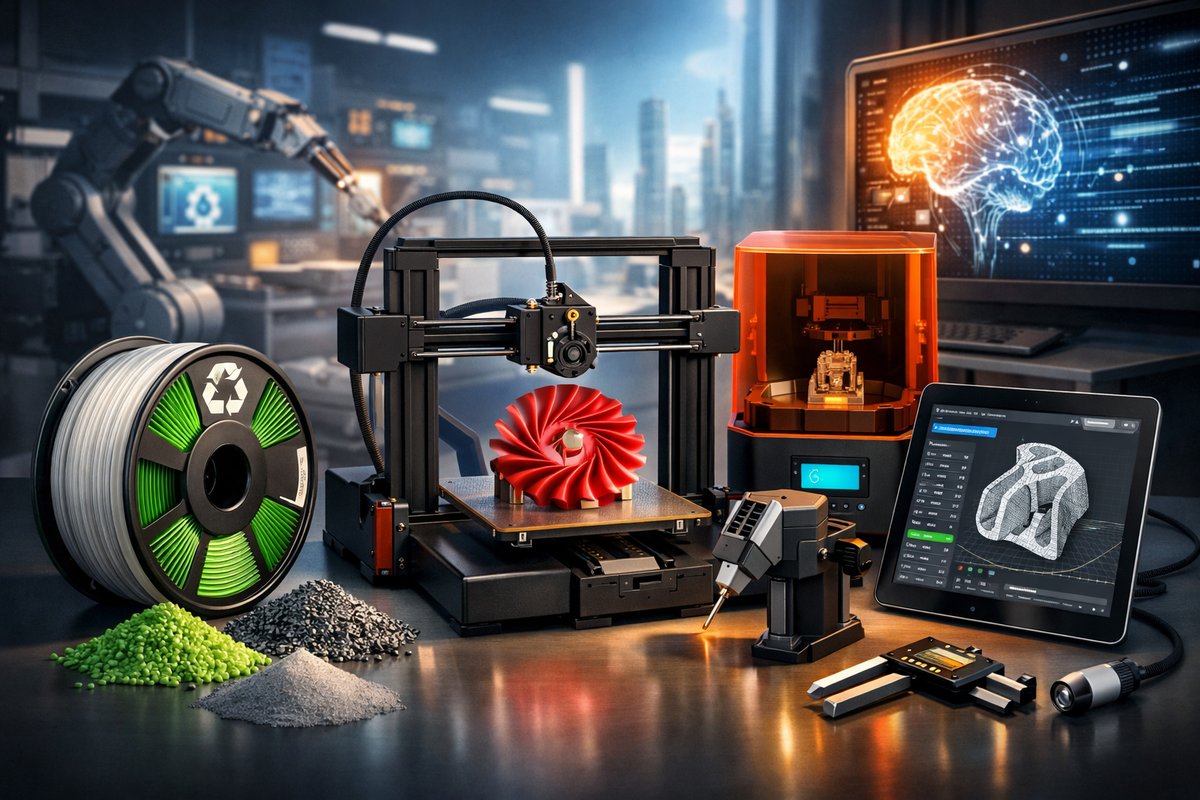

The world of 3D printing continues to evolve at a rapid clip, blending imagination and engineering in ways that were once the realm of science fiction. Today’s innovations aim not just to push the boundaries of what can be made, but to make the entire process more economical, more feasible, and more reliable. Whether you’re a hobbyist prototyping miniatures, an engineer crafting bespoke jigs, or a medical team modeling patient-specific implants, the drive toward affordability and success echoes across every layer.
One of the most impactful shifts in recent years has been the rise of sustainable and recycled filaments. While standard PLA and ABS remain workhorses for many projects, recycled PETG and bio-based polycarbonate blends are gaining traction. These materials not only divert plastics from landfills but often cost less per kilogram once you account for in-house pellet extrusion or community swap programs. DIY pellet extruders let makers turn raw pellets or reclaimed bottle flakes into consistent filament at a fraction of the retail price. Pairing these systems with inexpensive moisture sensors and filament dryers further extends material life and cuts waste.
On the hardware front, modular, upgradeable printer kits have democratized access. Open-source designs feature heated beds with infrared heating panels that reach target temperatures in minutes, reducing warm-up time and cutting energy use. Auto bed leveling sensors based on capacitive probes or strain gauges can be fitted onto legacy machines, eliminating tedious manual adjustments and slippage errors that kill prints after hours of work. Add a low-cost webcam or onboard camera with night-vision modes for remote monitoring, and you can catch layer shifts or filament jams in real time, pausing before disaster strikes.
Software innovations are just as revolutionary. AI-driven slicing engines now analyze geometry, print orientation, and stress points to generate variable layer heights and optimized infill patterns. This means the walls of a part can be thinner where they don’t bear load and thicker where strength matters most, reducing filament usage by up to 30 percent without sacrificing performance. Cloud-based slicing services let users tap GPU-accelerated tool paths instead of relying on desktop CPUs. For small shops or one-person teams, this translates to faster turnaround on complex jobs and a chance to scale capacity without costly hardware investments.
Multi-material printing has moved from novelty to practicality. Hotend assemblies that accommodate two or three filaments allow soluble supports during printing, making intricate overhangs and internal channels possible without manual removal. On the resin side, micro-stereolithography systems now support dual-wavelength curing, enabling faster layer polymerization and improved surface finish. Biocompatible resins formulated for dental models, surgical guides, or even tissue scaffolds are now available at prices that undercut traditional subtractive methods. By combining a desktop SLA unit with a small curing chamber and custom UV LEDs, makers can slice build times in half while maintaining medical-grade accuracy.
Integration of sensors and closed-loop feedback is turning hobbyist machines into reliable production workhorses. Filament flow meters detect under-extrusion in real time, triggering corrective nozzle temperature adjustments or print speed throttles. Vibration sensors mounted on the frame can alert operators if a loose belt or misaligned rail is about to ruin a long print. Some advanced setups even use optical coherence tomography (OCT) scanners above the build plate to map each freshly printed layer, comparing it against the original CAD model. Discrepancies trigger immediate pause commands, allowing corrective action before the error cascades into a failed part.
Workflow platforms have caught up to these hardware strides. Integrated print farm management suites offer drag-and-drop part nesting, automatically balancing build volume against print time and material cost. Automated queue management can route different jobs to specific machines based on calibration history, nozzle size, or material compatibility. This level of orchestration was once reserved for industrial additive manufacturers; now it’s within reach of small teams with just a few machines.
Community-driven libraries of print profiles and material settings further lower the barrier to success. Test artifacts-benchmarks for overhang tolerances, bridging performance, and surface finish-can be shared, rated, and iterated. Instead of spending hours tweaking extrusion multipliers or retraction distances, makers import proven profiles tuned for their exact printer model and filament brand. This crowdsourced calibration accelerates the path from digital model to finished object, minimizes failed prints, and maximizes material utilization.
The pursuit of economy isn’t limited to raw material and energy savings. Consumables like build-plate adhesives have evolved. From low-VOC spray adhesives to reusable magnetic build sheets and textured PEI films, adhesion can be dialed in once and left alone for dozens of prints. When the job’s done, parts pop off cold or peel away easily, saving time and reducing the chance of platform damage. Magnetic bed systems paired with flexible spring steel plates speed up build plate swaps, enabling continuous production cycles even for high-volume needs.
Beyond materials and machines, the labor of post-processing is also seeing cost-effective solutions. Automated wash-and-cure stations for resin prints can handle multiple trays at once, powered by enclosed LED arrays and spinning turntables. For filament parts, tumbling barrels filled with ceramic media smooth edges and remove support marks en masse, cutting manual sanding time from hours to minutes. These methods boost output quality while freeing hands for design and assembly tasks that add real value.
Allied with these technical advances is a growing ethos of sustainability and sharing. Maker spaces and co-working labs are investing in centralized recycling systems, offering members low-cost access to high-end filament extruders, resin filtration devices, and industrial dust collectors. This communal approach defrays the upfront cost of specialized equipment while promoting responsible waste management. Workshops, meet-ups, and online forums emphasize repair over replacement, encouraging users to fix hotends, swap broken parts, and collaborate on custom toolheads rather than discarding entire machines.
Of course, no single technique or machine upgrade can guarantee success. The most resilient strategy is a balanced workflow: choose sustainable materials, automate calibration, leverage AI-guided slicing, and adopt closed-loop sensing. Document each step, from stock rotation of filaments in low-humidity drawers to routine rail lubrication and belt tension checks. Keep a digital log of profile tweaks and print outcomes so you can quickly reproduce successes and avoid past mistakes.
When these elements align, both cost and failure rates plummet. A prototype that once consumed half a spool and required three attempts can be printed in a single pass using smart infill, soluble supports, and a tuned temperature map. A small production run of custom jigs or fixtures becomes more economical than outsourcing or CNC machining. In medical or dental offices, chairside model printing shifts turnaround from days to hours, improving patient experience without inflating budgets.
At the heart of this transformation is a culture of experimentation. Every maker, student, engineer, and artist can explore new combinations of hardware mods, eco-friendly materials, and software tools. By sharing results openly and iterating rapidly, the community fuels a cycle of continuous improvement. Each layer of filament laid down becomes a metaphor for collective progress: precise, robust, and open to revision.
Whether you’re setting up your first desktop machine or optimizing a fleet of industrial printers, the lessons are clear. Prioritize materials that align with sustainability goals, invest in simple automation that eliminates human error, and lean on collective intelligence for calibration shortcuts. The leading edge of 3D printing isn’t reserved for deep pockets or massive facilities. It belongs to anyone willing to blend creativity, curiosity, and methodical tuning. That quiet revolution begins with a single layer-and builds from there.
Embrace these advancements and watch your prints become leaner, greener, and more reliable. As costs drop and success rates climb, the true spirit of 3D printing shines through: transforming digital dreams into tangible reality, one layer at a time.