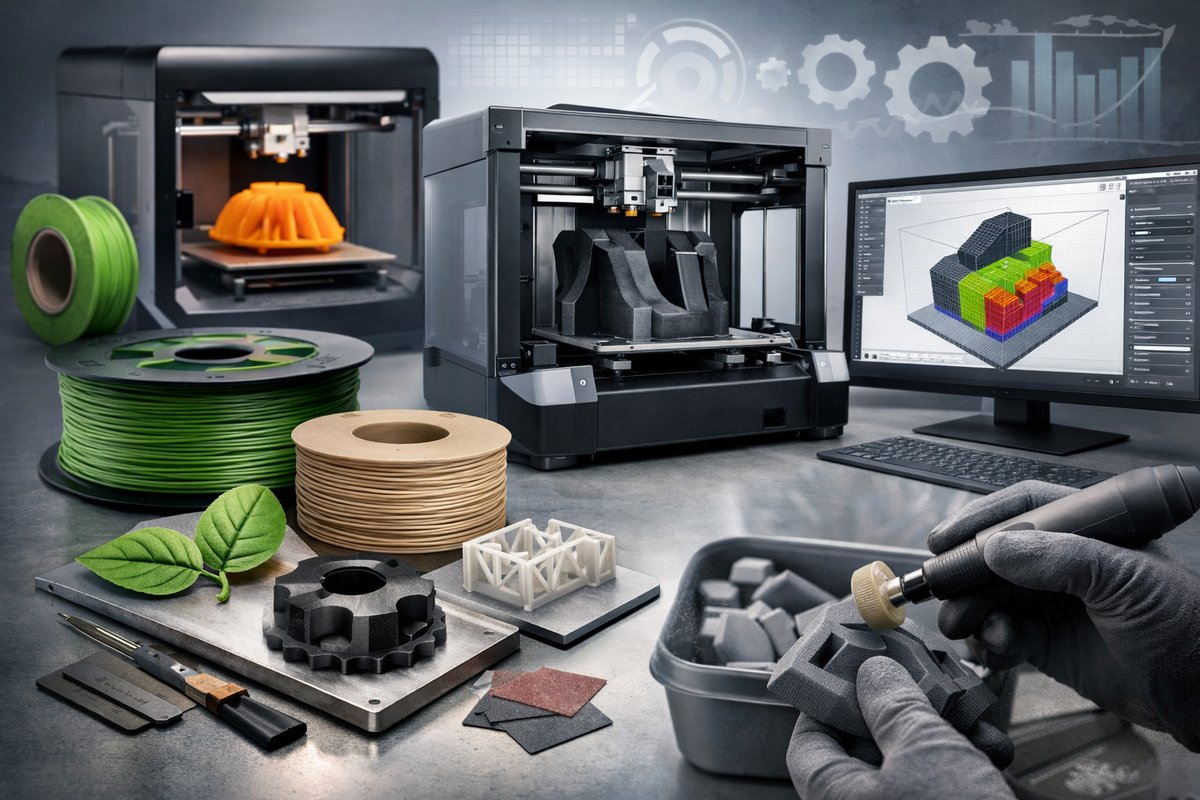

A New Era of Accessible Additive Manufacturing
What was once the preserve of industrial labs and multi-million-dollar machines now fits on a desktop, tucked into a corner of a garage or classroom. Thanks to breakthroughs in materials, hardware, software, and workflow, 3D printing has entered a phase where economy and performance go hand in hand. No longer is it necessary to choose between low upfront costs and reliable, high-quality output. Instead, makers are combining modular upgrades with smarter approaches to slicing and post-processing to squeeze more value from every filament roll or resin bottle.
In this article, we’ll unpack the latest techniques and technologies that make 3D printing more feasible and cost-effective than ever before. Whether you’re a hobbyist seeking cleaner prints, an engineer prototyping custom tools, or an educator equipping a maker space on a budget, these insights will help you optimize your workflow and reduce waste at every stage.
Emerging Materials: Ultralight, Recycled, and Composite Filaments
The foundation of any successful print is the material itself. Advanced filaments such as carbon-fiber reinforced PLA offer dramatically increased stiffness and dimensional stability, reducing warping and minimizing the need for support structures. At the same time, recycled-PETG blends are gaining traction for makers aiming to shrink their ecological footprint. By sourcing post-consumer plastic and re-extruding it into filament, community workshops and small studios can access budget-friendly spools that perform comparably to virgin materials.
For resin-based systems, fast-curing formulations that incorporate bio-based monomers are emerging. These new photopolymers achieve high detail, smooth surface finish, and reduced shrinkage while integrating plant-derived components. That means less energy spent on post-curing ovens and lower amounts of toxic waste to manage.
Hardware Upgrades: Enclosures, Nozzles, and Motion Kits
One of the simplest yet most effective cost-saving moves is to enclose your 3D printer. An insulated enclosure stabilizes internal temperatures, cutting down on warping for ABS and other high-temperature filaments. Commercial enclosure kits now feature quick-release doors, built-in filters to scrub ultrafine particles, and even humidity sensors to protect hygroscopic materials.
Nozzle upgrades are another low-cost improvement with high returns. Hardened steel, ruby-tipped, and ceramic nozzles extend service life when printing abrasive compounds like metal-filled or glowing filaments. Swapping nozzles can be done in minutes and slashes the per-print cost of wear and tear.
For motion systems, belt tensioners, linear rail conversion kits, and upgraded stepper drivers bring a level of precision once reserved for industrial machines. Many open-source communities share step-by-step guides to retrofit popular desktop models, enabling tighter layer registration and faster acceleration without introducing ringing.
Software and Workflow: Smarter Slicing, Predictive Maintenance, and Remote Monitoring
On the software front, advanced slicing engines now use adaptive layer heights to balance detail and speed. Rather than a uniform layer thickness, the slicer analyzes geometry and automatically varies layer height-thinner where curvature demands it, thicker where straight walls dominate. The result is prints that retain sharp features but finish in less time and with fewer extruder moves.
Predictive maintenance tools are also finding their way into budget setups. By monitoring nozzle temperature stability, bed adhesion trends, and motor current draw, these add-ons flag issues before they lead to failed prints. With early warnings, you can replace worn belts, realign axes, or clean a partially blocked nozzle, all of which saves filament that would otherwise end up in the recycle bin.
Remote monitoring solutions-built on Raspberry Pi or mini-computers-let you keep an eye on print progress via camera livestreams and temperature graphs. Interrupting a print in progress is never ideal, but catching a layer shift or cooling fan failure early can salvage hours of work and material.
Post-Processing and Finishing: Reducing Labor and Waste
Post-processing can often be the most time-consuming and less efficient stage of the workflow. Automated wash and cure stations for resin prints reduce handling time and ensure consistent photopolymerization. Cold wash solutions and ultrasonic cleaning tanks further minimize resin slurry waste, allowing spent cleaning fluid to be filtered and reused.
For FDM parts, solvent vapor smoothing stations eliminate the need for hand-sanding on ABS and ASA. When a uniform surface finish is essential, vapor smoothing creates near-polymer fusion, sealing layer lines and improving mechanical properties. Combined with in-filament color consistency, it makes painted or dyed parts look as if they were injection-molded.
Recycling failed prints and support structures on small-scale pelletizers lets users grind old parts into raw pellets, which can then be extruded into new filament. This closed-loop approach diverts plastic from landfills and reduces the per-part material cost by up to 30 percent.
A Lean, Green 3D Shop: Putting It All Together
By layering these strategies-material selection, hardware retrofits, software intelligence, and streamlined post-processing-you can build a lean additive-manufacturing setup that punches well above its weight class. Sustainability doesn’t mean sacrificing quality or speed; rather, it’s about smarter use of resources and embracing modular upgrades that deliver the best return on investment.
Start with one improvement at a time: swap in a composite filament for key projects, add an enclosure to stabilize prints, or install a moisture absorber to keep your spools dry. Each incremental change compounds the next, turning a basic desktop printer into a reliable workhorse. Ultimately, these steps empower creators to explore more ambitious designs without breaking the bank.
Whether you’re printing jigs, end-use parts, or expressive sculptures, the quiet revolution of making layer by layer continues. With every upgrade, you gain confidence that your prints will succeed, your material waste will shrink, and your creative possibilities will expand.
-
Amazon.com: ELEGOO PLA-CF 3D Printer Filament 1.75mm Black ...
Superior Mechanical Properties - Reinforced with carbon fiber, ELEGOO PLA-CF delivers exceptional strength and rigidity, making it ideal for producing ... -
Flashforge Carbon Fiber PLA Filament 1.75mm, 1KG/2.2lbs PLA ...
Buy Flashforge Carbon Fiber PLA Filament 1.75mm, 1KG/2.2lbs PLA Carbon 3D Printer Filament, Black at business.walmart.com Facilities Maintenance, ... -
Amazon.com: SUNLU 3D Printer Resin 1kg, Fast Curing Standard ...
Amazon.com: SUNLU 3D Printer Resin 1kg, Fast Curing Standard 3D Resin for LCD DLP SLA 3D Printers, 395 to 405nm UV Curing 3D Printing Liquid Photopolymer ... -
3D Printer Resin, SUNLU Fast Curing Standard 3D Resin for LCD ...
Buy 3D Printer Resin, SUNLU Fast Curing Standard 3D Resin for LCD DLP SLA Resin 3D Printers, 395-405nm UV Light Curing 3D Printing Liquid Photopolymer Resin ... -
FLASHFORGE Adventurer 5M 3D Printer Enclosure kit, DIY Design ...
DIY Enclosure: The exterior color can be customized according to your needs, meeting personalized requirements and showcasing a unique style. -
Seagate, 2TB External Hard Drive, Backup Plus Slim USB 3.0, Black
Modern Aesthetic Design. Features a textured metal finish that blends with modern lifestyles. View all item details. Generated by AI ...