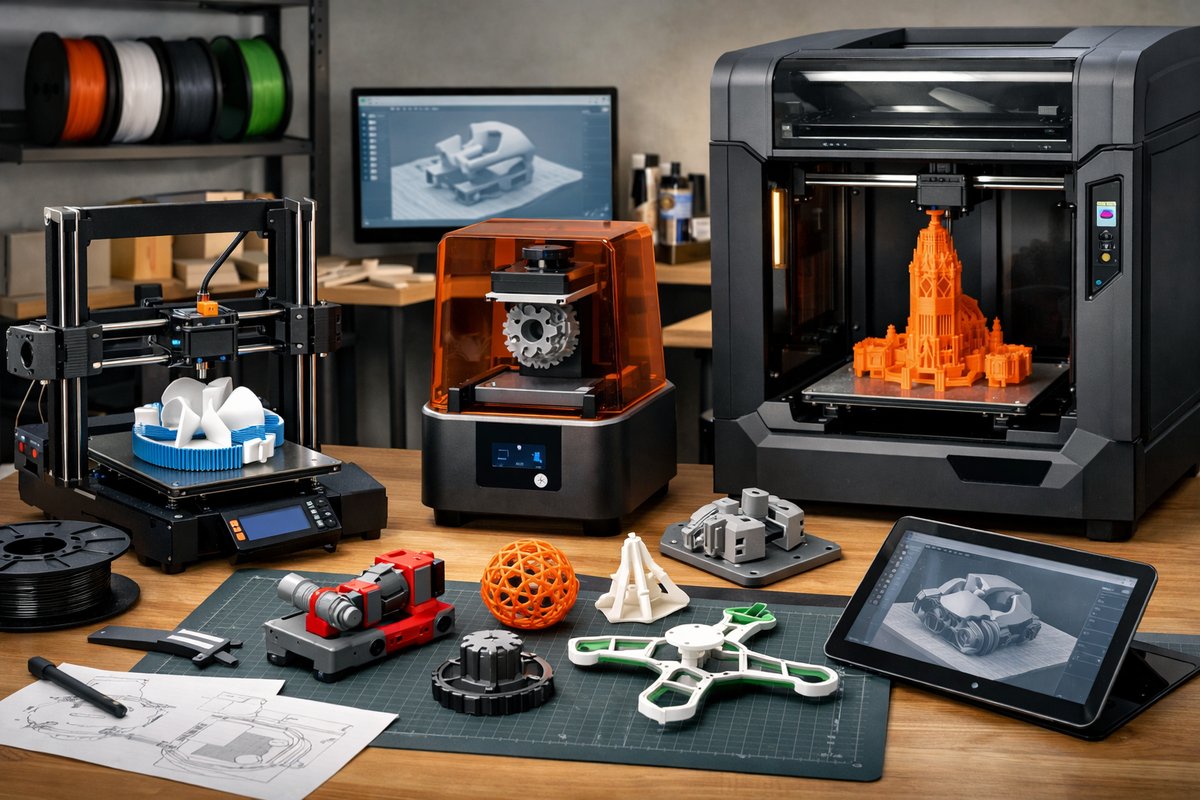

The magic of 3D printing lies in transforming digital ideas into tangible objects one layer at a time. What once required expensive industrial machines has gradually shifted into home workshops and small studios, driven by open-source designs, smarter slicers, and a flood of new materials. Today’s challenge is no longer simply making parts at all, but making them more economically, reliably, and at higher quality than ever before.
Early desktop printers often struggled with inconsistent extrusion, brittle filaments, and brittle resin cures. Material costs and wasteful support structures added to the expense of each prototype. But recent breakthroughs are turning that story around. Composite filaments infused with recycled plastics, shortwood fibers, or carbon strands now rival legacy materials in strength and surface finish, all while lowering per-kilogram expenses. Likewise, plant-based and low-odor resins have made high-resolution stereolithography more user-friendly and sustainable.
One of the most significant cost-slashing advances is the adoption of pellet-extrusion systems. By feeding standard plastic pellets directly into a hot end, makers can sidestep pricey filament spools altogether. Pellet extruders boast print speeds up to ten times faster when paired with larger nozzles and can leverage bulk raw materials used in injection molding. Combined with open-source control boards and shipping-container-sized filament dryers, these setups are ushering in a new era of affordable large-format printing.
Software has taken center stage as well. AI-powered slicers analyze geometries, pinpoint weak zones, and automatically optimize infill patterns to shave off weight and material consumption. Real-time feedback loops between the printer and slicer adjust temperatures and flow rates on the fly, compensating for ambient shifts or layer adhesion issues before they ruin a build. Cloud-based slicing services make high-end algorithms available on modest hardware, so a laptop in a garage can now access the kind of support-minimizing strategies once locked inside expensive workstations.
Resin printing has likewise seen a surge of innovation. Continuous layership approaches eliminate the stop-start motion of conventional vat systems, boosting throughput by up to five times. Tanks coated with flexible membranes allow cured bits to peel off without physical agitation, dramatically extending resin life and reducing waste. Paired with LED arrays fine-tuned for specific photopolymers, these machines can crank out intricate medical models, jewelry masters, or microfluidic parts faster than ever while consuming fewer liters of resin per build.
Multi-material heads bring color, rigidity, and flexibility into single prints. Imagine a hinge with rigid bones and rubbery ligaments printed in place, or a prototype housing that shows exact color tones without manual painting. Modular tool heads swap in filament dryer modules, dual-gear extruders for abrasive composites, or high-flow nozzles for large parts. These plug-and-play upgrades stretch budgets further by letting one base machine handle a spectrum of tasks.
Beyond the typical three axes, five-axis and robotic-arm printers are emerging to conquer support nightmares. By tilting the print head dynamically, these systems print overhangs without sacrificial scaffolding, drastically cutting post-processing time and material use. Though still pricier upfront, their unique ability to produce near-complete parts in one shot is appealing to aerospace, automotive, and medical users who prize weight reduction as much as cost efficiency.
Even metal printing has become more attainable. Binder jetting techniques fuse powdered metals with inkjet binders at room temperature, then sinter parts in a furnace. While industrial selective laser sintering remains expensive, emerging community labs are sharing low-cost furnace designs, powder sieving rigs, and standardized safety protocols. Small-batch metal parts for tooling, jigs, or art projects can now be printed for a fraction of earlier expenses.
Workflow enhancements are just as crucial. Print-farm management software tracks machine health, queues jobs, and routes parts to the best bed size. Remote monitoring apps send real-time alerts for spools running out, failed layers, or bed adhesion issues. Automated post-processing stations wash and cure resin prints in consistent cycles, eliminating manual guesswork and freeing up operators to focus on design.
Quality control has matured, too. Affordable digital calipers and microscope attachments inspect features down to 0.1 millimeters. Thermal imaging cameras identify cold spots and layer delamination. Process data logged to a central dashboard reveals correlations between ambient humidity, nozzle wear, and finished part strength, unlocking continuous improvement across hundreds of prints.
Sustainability is now baked into the ecosystem. Closed-loop recycling machines shred failed PLA prints and remanufacture them into fresh spools. Biodegradable resins formulated from plant oils break down in industrial composting. Filament manufacturers partner with recycling centers to reclaim ocean plastics, turning environmental cleanup into a source of raw material.
Open-source communities remain the beating heart of low-cost innovation. DIY printer kits and 3D printer farms in schools introduce students to additive methods without huge capital. Crowdsourced mods circulate for bed-leveling sensors, silent stepper drivers, and variable-temperature chambers. Shared firmware updates optimize acceleration profiles and vibration damping on dozens of machine models simultaneously.
Applications for economic printing continue to expand. Rapid prototypes go from napkin sketch to functional test piece in hours. Surgical teams use affordable desktop SLA printers to model patient-specific anatomy. Architects print scale models complete with lighting, paint them in miniature detail, and iterate design sequences on the fly. Artists embed electronics into prints for interactive sculptures.
Looking ahead, generative design tools will co-develop geometries with slicing software, automatically accounting for the printer’s unique strengths and weaknesses. Distributed manufacturing networks will route jobs to the nearest capable machine, slashing shipping times and costs. Advanced composites and hybrid materials promise parts that can self-heal or adapt their stiffness under load.
Across hobby shops, startups, and industrial labs, the quiet revolution of layer-by-layer making shows no sign of slowing. As materials, software, and hardware converge on ever-leaner budgets, anyone with curiosity and a CAD file can become a digital fabricator. Economical, feasible, and successful additive manufacturing is no longer a distant goal-it’s the new normal for creative problem-solvers everywhere.