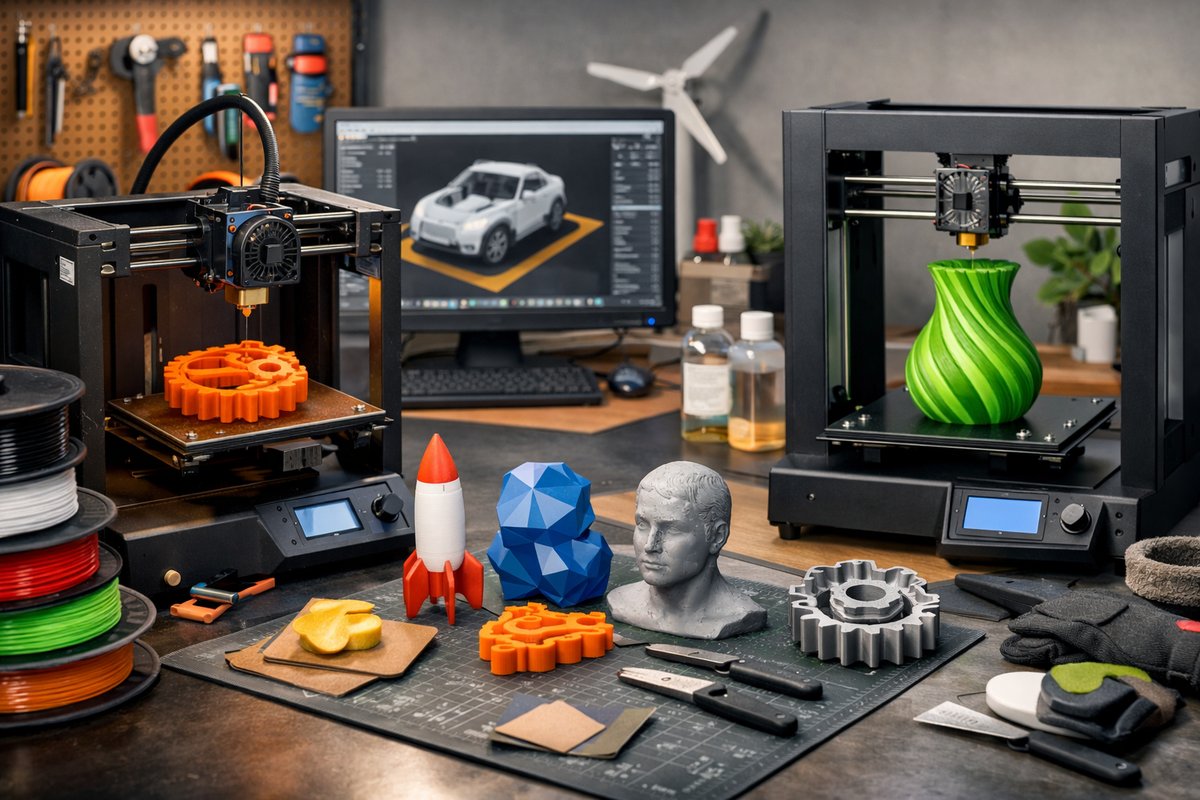

Imagine designing a custom gadget on your computer, pressing a button, and watching it emerge layer by layer in front of your eyes. That’s the magic of 3D printing: a blend of engineering, craftsmanship, and boundless creativity that has transformed industries and home workshops alike. What began as an expensive industrial process has blossomed into an accessible tool for educators, tinkerers, entrepreneurs, and artists. Today, a growing community of curious learners is discovering how this modular technology can solve problems, foster innovation, and even spark new careers.
The journey of additive manufacturing began decades ago with technologies like stereolithography (SLA) and selective laser sintering (SLS), which used lasers to cure liquid resins or fuse powdered materials. Early machines were massive and cost prohibitive, limiting use to research labs and industrial prototyping centers. Over time, desktop fused deposition modeling (FDM) emerged as a more affordable alternative, forcing open-source pioneers to refine hardware and software. The rise of hobbyist printers in the late 2000s ignited a grassroots movement, supported by online forums and open repositories of printable designs. Today’s machines trace their lineage to those early innovators, marrying precision mechanics with user-friendly interfaces.
Although FDM remains the most common desktop approach, the 3D printing landscape now hosts a diverse family of technologies. FDM machines extrude melted thermoplastic filament through a heated nozzle, building parts layer by layer on a heated bed. SLA and digital light processing (DLP) printers use ultraviolet light to solidify liquid resin, delivering higher resolution at the cost of more involved post-processing. Industrial systems add techniques like selective laser melting (SLM) for metal powder or multi-jet fusion (MJF) for nylon parts. Each method has its sweet spot: FDM for cost-effective prototypes, resin for intricate miniatures, and powder-based systems for functional engineering components.
Material choice lies at the heart of every successful print. For most beginners, PLA (polylactic acid) is the go-to: it’s easy to print, biodegradable, and comes in a rainbow of colors. ABS (acrylonitrile butadiene styrene) adds toughness and temperature resistance but demands an enclosed build chamber to prevent warping. PETG strikes a balance between the two, offering durability and chemical resistance while retaining good adhesion. Flexible TPU filament opens doors to bendable hinges and wearable parts. On the resin side, standard photopolymer blends yield fine detail, while engineering blends add heat resistance or impact toughness.
Beyond the basics lie specialty filaments that blur the lines between plastic and art. Wood-filled filaments embed cellulose fibers for a grainy, sandable finish that looks like real timber. Metal-filled blends contain fine powder for a metallic sheen and the option to polish or patina. Carbon-fiber-reinforced materials boost stiffness and reduce weight, making them ideal for structural components. Even bio-based filaments derived from agricultural waste are entering the market, promising more sustainable prints. Experimenting with these blends can feel like alchemy-dialing in temperatures and speeds to coax out the perfect surface.
Turning a digital model into a printable file requires slicing software. Tools like Cura, PrusaSlicer, and Simplify3D translate 3D geometry into a sequence of machine commands. Within these applications, you set layer height, wall thickness, infill density, and support structures. Many slicers now include adaptive infill patterns that reduce material waste while preserving strength. Whether you’re printing a functional bracket or a figurine for display, tweaking these parameters can mean the difference between success and a failed tower collapse.
Print settings are an art in themselves. Layer height determines vertical resolution-finer layers yield smoother surfaces but add time. Infill percentage defines interior solidity: 100% infill for load-bearing parts, 10-20% for decorative pieces. Nozzle and bed temperatures must match the filament’s properties; too cold and layers won’t bond, too hot and material can string or burn. Adhesion aids like brim, raft, or a glue stick can save prints from peeling off the build plate. Filament diameter calibration and proper extrusion multiplier settings ensure you get accurate dimensions and avoid under- or over-extrusion.
Advanced techniques elevate routine prints into polished creations. Custom support strategies, like tree supports in resin printing, minimize scarring and reduce cleanup. Multi-material systems let you embed conductive filament for simple circuits or combine flexible and rigid materials in a single part. Experimenting with variable layer heights can optimize print time, using coarse layers on flat sections and fine layers for intricate regions. Some users even integrate pause-and-insert workflows to embed nuts, magnets, or other components mid-print, creating ready-to-assemble modules straight from the machine.
Post-processing transforms a raw print into a finished object. Resin parts need washing in isopropyl alcohol and a final UV cure to achieve full strength. FDM prints benefit from light sanding with fine-grit paper, followed by priming and painting for smooth, long-lasting surfaces. Acetone vapor smoothing works wonders on ABS, melting outer layers to reveal a glossy finish. For structural assemblies, solvent welding or cyanoacrylate glue can bond parts seamlessly. And if you’re building multi-component models, designing custom jigs or alignment features in your CAD software accelerates precise assembly.
Maintaining your 3D printer ensures consistently high-quality results. Regularly clean and level the build plate to avoid adhesion failures. Clear clogged nozzles by performing cold pulls or using specialty cleaning filaments. Lubricate linear rails and lead screws with light machine oil to reduce friction and noise. Check belts for tension and pulleys for wear. Periodic firmware updates can unlock new features or improve motion accuracy. Keeping a maintenance log helps you track changes and spot recurring issues before they become print-ruining problems.
As awareness of environmental impact grows, sustainable practices are finding their way into maker spaces. Several companies now offer recyclable or plant-based filaments, and upcycling failed prints into filament pellets is becoming easier thanks to desktop recyclers. Printing only what you need, optimizing infill patterns, and reusing support material help reduce waste. Solar-powered printing setups and energy-efficient machines lower the carbon footprint of at-home fabrication. By combining conscious design with green materials, the community is carving a path toward more responsible additive manufacturing.
The applications of 3D printing span far beyond hobby projects. In education, classrooms use entry-level printers to teach geometry, engineering, and problem-solving. Architects create scale models that bring designs to life in minutes. Medical professionals craft custom surgical guides or prosthetic devices, improving patient outcomes. Small businesses produce on-demand parts, reducing inventory costs and lead times. Artists and designers explore forms that would be impossible with traditional manufacturing, pushing the boundaries of sculpture, jewelry, and fashion.
A thriving community supports every maker’s journey. Online forums, social media groups, and regional meetups offer troubleshooting tips, design critiques, and inspiration galleries. Open-source model repositories provide thousands of free designs, from functional tools to whimsical art pieces. Collaborative projects often spring from these networks-a hobbyist’s upgrade to a popular printer can become an official firmware release used worldwide. Sharing failures and lessons learned propels the entire ecosystem forward.
Looking ahead, the frontier of additive manufacturing continues to expand. Metal printing is becoming more accessible for small shops, enabling end-use parts for aerospace, automotive, and tooling applications. Bioprinting holds the promise of printing living tissues, while concrete printers may one day erect buildings on-site. Advances in materials science-such as self-healing polymers and smart composites-will unlock new performance parameters. Integration with artificial intelligence could automate slicing optimization and predictive maintenance, making 3D printing even more user-friendly.
Ready to embark on your own 3D printing adventure? Start with a simple digital design-perhaps a custom wall hook or a small gear-and choose a familiar material like PLA. Set moderate infill and layer height, and watch as your concept becomes an object you can hold. Each success builds confidence; each failure offers a lesson. With a constellation of tools, materials, and techniques at your fingertips, you’ll discover how additive manufacturing can amplify your creativity, solve real-world problems, and transform ideas into impact.
Print by print, layer by layer, the world of 3D printing invites you to explore uncharted design territory. From prototyping functional parts to crafting one-of-a-kind art pieces, every step opens doors to new skills and unexpected possibilities. Cultivate curiosity, embrace experimentation, and join a community united by the thrill of making. Your next breakthrough might be just a slice away.