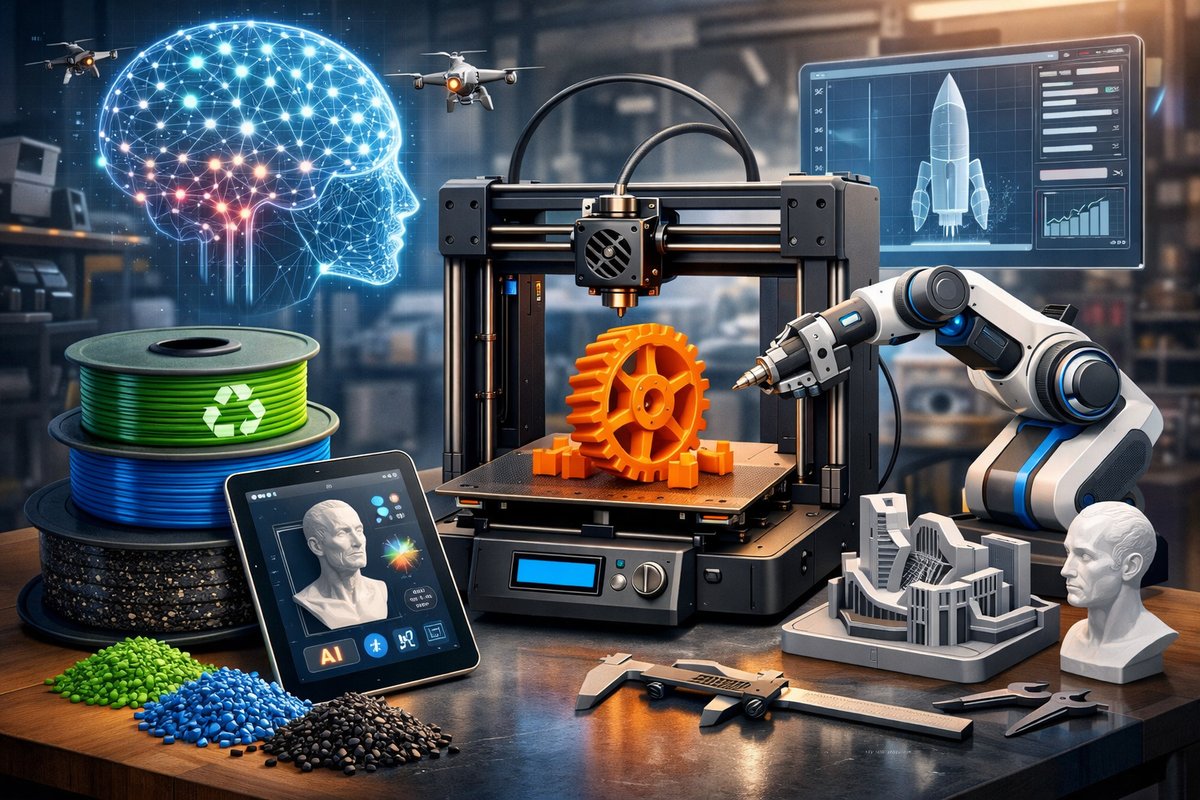

In a workshop bathed in soft morning light, a single robotic arm glides along precise axes, depositing molten plastic in a dance of layer upon layer. This quiet choreography is the heart of 3D printing, a craft where virtual sketches evolve into tangible forms. Yet behind the mechanical hum lies a dynamic landscape of technologies and techniques relentlessly driving down costs, boosting feasibility, and raising the bar on success rates.
Multi-material extrusion heads have emerged as a game-changer for creative experimentation. No longer confined to a single filament type, modern hot ends now swap seamlessly between plastics, flexible rubbers, and even conductive composites mid-print. Makers can embed soft grips in rigid tools or trace delicate copper paths in functional prototypes-all within a single build cycle. This versatility not only adds design freedom but also minimizes the need for post-production assembly, saving time and reducing overhead.
On the resin side, continuous film stereolithography (CF-SLA) is rewriting the rules of speed and resolution. By employing a moving film that transports cured layers away from the build platform, CF-SLA printers eliminate the start-stop cycle of traditional vat systems. The result: smoother surfaces, faster layer times, and dramatically improved throughput. Hobbyists racing through miniature armies and dental labs printing crowns in hours can both benefit from this leap in efficiency.
Cost consciousness extends beyond hardware. Pellet extruder attachments now let users repurpose recycled plastic pellets-industrial off-cuts or post-consumer packaging-into feedstock. By sidestepping the premium charged for filament spools, experienced operators can shrink material costs by up to 70 percent. And as more communities form pellet-sharing co-ops, a circular economy ethos takes hold, aligning the maker movement with sustainability goals.
On the software front, intelligent support-generation algorithms are slashing waste. By analyzing overhang angles and object geometry, these tools sculpt minimal, lattice-style supports that are easier to remove and require less filament. Dynamic layer-height adjustment refines layer thickness on the fly-thicker layers on straight walls for speed, ultra-thin layers on curved sections for detail-optimizing print time without sacrificing quality. Open-source slicers continue to innovate at pace, empowering users to tailor profiles for specific machines and materials, and share those profiles freely across global maker communities.
Feasibility for newcomers has never looked brighter. All-in-one starter kits combine a robust gantry system, touchscreen controls, basic filament assortments, and web-based tutorials into a single package. Plug-and-play calibration routines walk users through bed-leveling and nozzle height setup with guided prompts and live camera feedback. Cloud-based slicing platforms eliminate local software installs, letting users queue prints from a browser or even a smartphone app. This level of integration lowers the barrier to entry, inviting educators and hobbyists to focus on design rather than tedious setup.
Reliability in production environments hinges on continuous monitoring. Today’s printers are outfitted with infrared bed sensors, onboard humidity detectors for hygroscopic materials, and optical filament run-out switches. When something goes awry-a warped first layer or a filament jam-the machine signals for human intervention before hours of material and time vanish. For larger operations, fleet-management dashboards aggregate data from dozens of printers, flagging maintenance needs and predicting part-failure rates based on historical trends.
Learning from failures is as important as celebrating successes. AI-driven print-quality analysis tools now scan time-lapse videos of prints, identifying anomalies like layer shifts, under-extrusion zones, or warp initiation. By cross-referencing thousands of past prints, these systems recommend calibration tweaks or suggest alternative material profiles. As machine-learning models grow, they’ll someday be able to forecast print outcomes before a single filament strand hits the nozzle.
Sustainability remains a guiding principle. Bio-based filaments derived from corn starch, algae, or recycled fishing nets are moving from niche to mainstream. Water-soluble supports, soluble build plates, and eco-friendly wash stations reduce chemical waste in post-processing. Some designers even explore low-impact build strategies-printing hollow or lattice-reinforced parts that use up to 80 percent less material without compromising strength.
Real-world case studies underscore the impact. In remote clinics, low-cost 3D printers produce customizable prosthetic sockets tailored to each patient’s anatomy at a fraction of industrial lab costs. Small aerospace firms fabricate lightweight drone parts with carbon-fiber-reinforced filaments, cutting fuel consumption and extending flight times. Art collectives collaborate on scanning local artifacts and recreating them in new media-blurring lines between conservation, reinterpretation, and accessible public exhibits.
Looking ahead, metal additive manufacturing is shedding its industrial mystique. Binder jetting systems that fuse powdered metals with binding agents are finding purchase in small-batch production, delivering complex geometries once reserved for castings or CNC. Ultrasonic 3D deposition is printing electronics directly into substrates, promising self-aligned circuit traces within structural parts. Even cell-based bioprinting teases the prospect of living tissues grown layer by layer for medical research-though widespread clinical applications remain on the horizon.
At its core, 3D printing remains a profoundly human endeavor. Each failed print is a lesson in resilience. Every new filament color sparks a fresh riff on form. Communities gather online to share tips, remix designs, and celebrate breakthroughs, knitting a global network of curious problem-solvers. As the next generation of machines debuts-with smarter sensors, new materials, and ever-leaner workflows-the spirit of playful experimentation will keep the revolution alive.
Beyond the prototyping benches and production floors, a quiet creative renaissance is unfolding. Whether you’re a classroom explorer scanning your first fossil, an engineer fine-tuning a performance car part, or an artist pushing the limits of sculpture, the additive future is yours to shape. The starting point is simple: fire up the slicer, load the filament, and let imagination chart the course, one layer at a time.