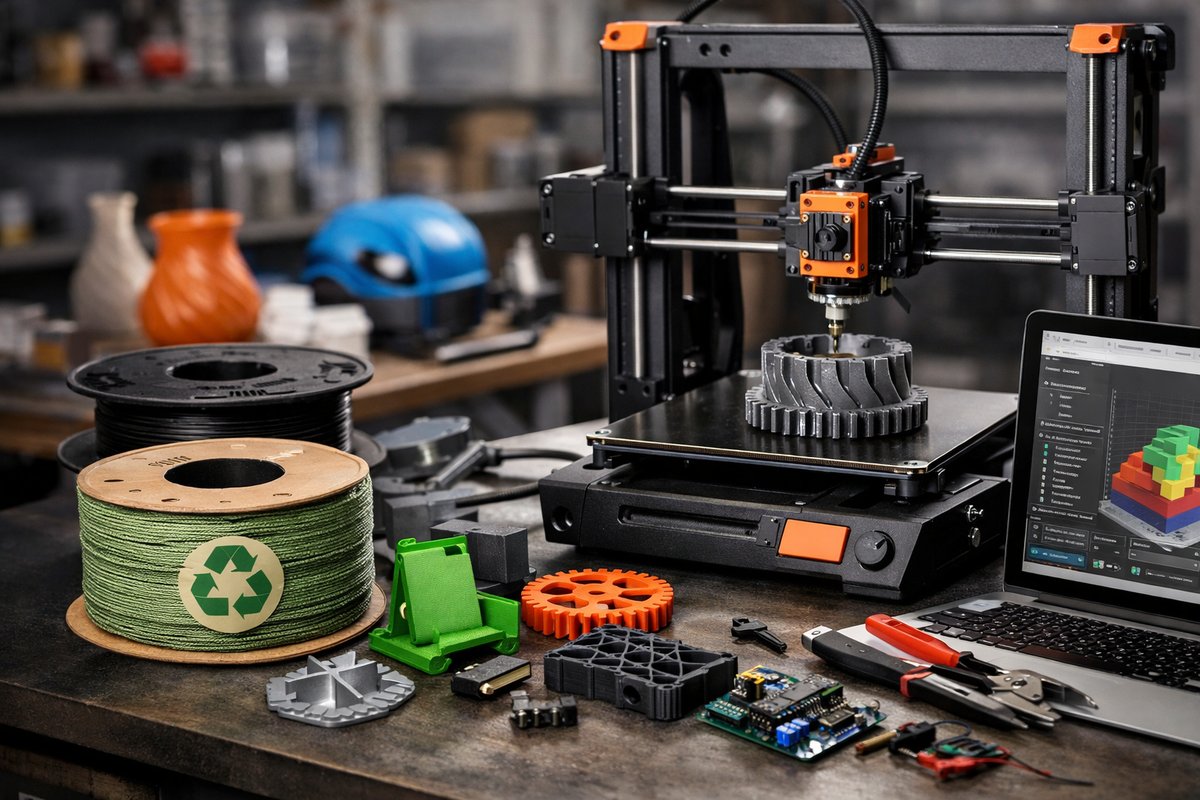

Three-dimensional printing has evolved from a niche prototyping tool into a versatile manufacturing platform that spans hobbies, research labs, and small-batch production. Yet while the promise of digital fabrication remains vast, many users confront persistent challenges: material costs, failed prints, and complex tuning procedures that can turn a weekend project into an exercise in frustration. Recent innovations across consumables, mechanics, and software are now converging to make additive manufacturing more economical, feasible, and reliable. Whether you’re experimenting with miniature terrain pieces or fabricating custom tools, these approaches can help you get more parts in hand while spending less time and money.
On the materials front, filament formulations have become both more affordable and more capable. Standard PLA and ABS spools have seen price drops thanks to domestic production scaling and more efficient extrusion processes. Meanwhile, ever-expanding blends-mixing recycled plastics, wood fibers, and metal powders-open new doors for makers seeking unique finishes without premium markups. Composite filaments reinforced with carbon fiber or glass beads deliver improved stiffness and thermal resistance, often at a fraction of the cost of engineering-grade polymers. Even biodegradable options have hit price points that rival lower-end consumer grades, empowering eco-minded creators to experiment without a hefty investment.
Advances in resin-based printing have followed a similar trajectory. Once prohibitively expensive, plant-derived and water-washable resins now compete on cost per liter with legacy photopolymers. Entry-level digital light processing (DLP) printers, previously confined to artisanal studios, are now packaged in compact benchtop form factors with integrated curing stations. Powder-based systems using nylon or composite blends have also migrated toward desktop footprints, employing low-power lasers and granular bed recycling techniques to tame both energy use and material waste. The result is a full spectrum of additive processes-FDM, SLA, DLP, and SLS-accessible to creators on tighter budgets.
Hardware makers have responded in kind, offering modular printer kits that reduce the barrier to entry. Core components like all-metal hotends and hardened nozzles once reserved for industrial machines are finding their way into open-source Cartesian and delta frames. These upgrades maintain nozzle tolerances at higher temperatures, allowing users to experiment with advanced filaments without constant nozzle swaps. Direct-drive extruders, long favored for flexible materials, have become available as plug-and-play modules that snap onto standard X-carriage mounts. Meanwhile, auto-leveling bed probes and motorized z-end stops simplify the once-daunting task of first-layer calibration, slashing setup time and shrinking the trial-and-error cycle.
One of the most transformative mechanical developments is the introduction of chipset-driven motion controllers that can run high-precision stepper motors at micro-stepping resolutions without overheating. By smoothing motor current and employing closed-loop feedback on stall detection, these controllers boost print fidelity at faster travel speeds. In practice, this means fine features print as sharply at 80 millimeters per second as older systems achieved at half that pace. The combination of upgraded electronics and enhanced motion planning algorithms also reduces ringing artifacts along corners, elevating the overall surface quality of printed parts.
Multi-material printing has traditionally demanded specialized hotends and complex filament switching setups. New tool-head designs now automate the purge towers and filament change sequences with onboard sensors and streamlined firmware. These innovations minimize purged waste and keep print jobs running unattended for hours at a time-ideal for small-batch color inserts or soluble support scaffolding. For those who love to hack, plug-and-play add-on boards let existing machines take on second extruders or material feeders, extending capabilities without requiring a full new printer purchase.
Software improvements have played a leading role in lowering project failure rates. Modern slicers incorporate adaptive slicing, which adjusts layer height dynamically based on model curvature. This delivers smooth slopes where it matters while speeding through flat sections. Bridge-infill heuristics and support-placement optimizers have matured, resulting in fewer orphaned strands and less manual support cleanup. Mesh repair engines embedded in slicing software can automatically close holes, align normals, and scale parts to exact target dimensions. Together, these digital tools help ensure that the G-code sent to your machine translates precisely into the object you envisioned, with minimal user intervention.
Infill strategies have likewise been refined for cost-effectiveness. Beyond basic grids and triangles, honeycomb and gyroid patterns deliver superior strength-to-weight ratios while using up to 30 percent less filament. Experimental lattice structures tune compressive and bending properties on the fly, ideal for functional prototypes such as brackets or gait analysis models. Users can now import custom infill patterns or let the slicer apply function-driven presets, such as high-density stress rails around screw bosses and low-density cores where minimal support is required.
Fine-tuning print settings remains as essential as ever, but the process is faster when tackled systematically. Temperature towers and retraction towers, once printed by experts, are now generated automatically through profile-tuning features in client software. Bed adhesion tests can run overnight with multiple surface treatments-glue stick, textured PEI sheets, and adhesive tapes-displayed side by side on a single build plate. Digital microscopes aid in examining extrusion consistency at 0.1-millimeter increments, revealing under-extrusion or filament grinding before it ruins a large print. These diagnostic tools not only safeguard filaments from becoming waste, they also empower new users to learn the ropes quickly.
Sustainability advocates are also championing closed-loop recycling systems that turn failed parts and support structures back into filament. Desktop shredders crush scrap prints into uniform flakes, which feed into small-batch extrusion machines. The resulting filament can be blended with virgin pellets for consistent quality or used on its own for less critical prints. This recycling approach slashes material costs and contributes to a circular-economy mindset. It resonates with educators teaching environmental stewardship through hands-on fabrication projects, as well as with startups that bundle recycled materials into beginner-friendly filament sample packs.
The maker community continues to share open-source profiles, calibration guides, and post-processing techniques. Digital repositories host thousands of tested settings for specific printer models, filaments, and environmental conditions. Crowd-sourced dial-in wikis detail everything from bridging speed recommendations to best gasket materials for filament dry boxes. Organized tuning jams, online hackathons, and library-maker space workshops enhance collective know-how, ensuring that newcomers can stand on the shoulders of a global network of tinkerers.
Specialty tools for post-processing have become more accessible, too. Compact resin-curing stations combine ultraviolet LEDs with rotating turntables, automating the final hardening of SLA parts. Sanding and polishing kits tailored for 3D prints include precision files, wet-dry sandpaper sets, and ultrasonic cleaners that remove residual supports and surface oils. Even color-coding jig kits exist to help users align multiple components accurately during assembly, a nod to the growing trend of functional, multi-piece printable products. Together, these devices complete the workflow from raw digital file to finished, display-quality object.
Behind the cost-cutting and quality gains is a shared ethos: experimentation fuels improvement. With more economical materials, affordable hardware upgrades, and smarter software, creators at every budget level can iterate faster and learn more. Whether pursuing a side-hustle product run or teaching the next generation of engineers, the evolving additive-manufacturing ecosystem empowers everyone to turn virtual visions into tangible reality. As the price of admission continues to fall, the real abundance lies in the layers of human creativity waiting to be printed.