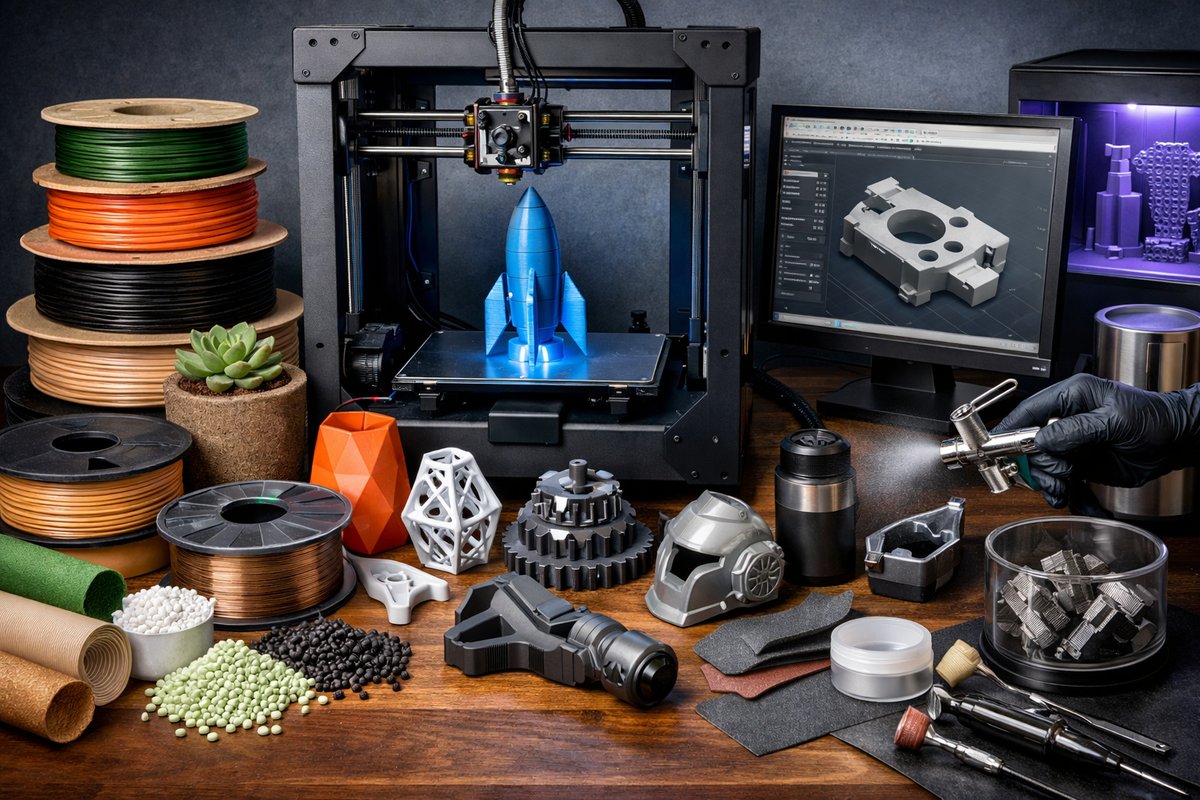

Three-dimensional printing has evolved from a niche prototyping tool into a creative catalyst, democratizing manufacturing for hobbyists, small businesses, and research labs alike. What once required a fully equipped workshop can now emerge from a desktop device, layer by layer, guided by open-source code and a reel of thermoplastic or resin. This article takes a holistic look at every stage of the 3D printing journey-from choosing the right material and calibrating your hardware to slicing software settings and post-processing finishes. Whether you’re a curious beginner or a seasoned tinkerer, you’ll uncover strategies to optimize quality, reduce waste, and push the boundaries of what’s possible with additive manufacturing.
At the heart of any 3D print lies the material. Common thermoplastic filaments include PLA (polylactic acid), prized for its low warp and eco-friendly sourcing, and ABS (acrylonitrile butadiene styrene), known for impact resistance and heat tolerance. PETG offers a middle ground, combining strength and ease of use, while flexible TPU expands possibilities into wearables and soft robotics. Specialty blends-wood-filled PLA, metal-infused composites, and carbon-fiber-reinforced filaments-unlock textures and mechanical properties that suit artistic sculptures, engineering prototypes, or lightweight structural parts. On the photopolymer side, liquid UV-curable resins achieve ultrafine detail for miniatures or dental applications, but require careful handling, washing, and post-curing under controlled light sources.
The printer itself is your digital factory. Fused deposition modeling (FDM) machines extrude melted filament through a nozzle in precision paths, building each layer atop a heated bed that minimizes warping and promotes adhesion. Resin-based stereolithography (SLA) systems use a UV laser or LCD panel to selectively cure liquid resin within a vat, producing smooth, high-resolution surfaces at the cost of slower build volumes. Key hardware considerations include nozzle diameter (0.2-0.8 mm for standard FDM), bed leveling mechanisms (manual adjustment versus automatic mesh leveling), and enclosure design to maintain temperature consistency-especially when working with nylon or ABS. Proper calibration of steps per millimeter, filament flow rate, and bed leveling can mean the difference between a flawless print and a frustrating failure.
On the software front, slicing applications translate your 3D model into machine instructions. Open-source slicers let you fine-tune layer height (commonly 0.1-0.3 mm), print speed, infill density, and support structures. Infill patterns-grid, gyroid, or honeycomb-balance strength against print time and material usage, while adjustable wall thickness and top/bottom layers influence rigidity and surface finish. Support settings determine how easily you can remove scaffold material from overhangs or complex geometries. Learning to modify retraction distance and speed helps tame stringing and blobbing, whereas temperature towers can reveal the optimal nozzle and bed temperatures for each filament type.
Innovative techniques continue to expand the 3D printing toolkit. Multi-part assemblies allow large objects to be printed in smaller sections, then bonded with adhesives or mechanical fasteners. Dual-extrusion setups enable simultaneous printing of soluble support filaments-such as water-soluble PVA-which dissolve away to reveal complex internal channels or moveable joints. Filament runout sensors, filament-drying enclosures, and time-lapse cameras integrate seamlessly into modern workflows, automating pauses for color swaps or alerts for maintenance. Creative makers also experiment with clay extruders for ceramic printing, bioinks for living tissue constructs, and paste material systems for food-safe or conductive prints.
Every print demands post-processing to achieve professional polish. FDM parts often benefit from gentle sanding with progressively finer grits, followed by a thin coat of primer to fill layer lines. Acetone vapor smoothing can fuse ABS layers into a glossy shell, while resin prints require an alcohol wash to remove uncured resin before a final UV cure. For both processes, safety matters: disposable nitrile gloves, proper ventilation, and eye protection guard against chemical exposure. Paints, dyes, and surface treatments-from metallic sprays to hydrophobic coatings-unlock aesthetic customization and functional surface properties.
3D printing’s sustainability profile hinges on mindful practices. PLA’s compostable nature makes it a go-to for eco-conscious projects, but requires industrial composting to fully break down. Recycling initiatives can collect empty spools and failed prints for re-extrusion into new filament, reducing landfill waste. Spoolless filament systems and bulk pellet feed extruders aim to eliminate plastic packaging entirely. Even energy consumption can be lowered by printing at moderate temperatures and leveraging standby modes between builds. By embracing circular design-minimizing support structures, optimizing infill, and reusing scraps-makers can shrink their environmental footprint.
Turning an idea into a physical object follows a structured workflow. Start by iterating your digital design in CAD software or by scanning a real-world object with a handheld 3D scanner. Export an STL or OBJ file, then import it into your slicer. Generate supports only where necessary, preview the toolpath layer by layer, and export G-code. Before printing, verify bed leveling with a paper test or automated sensor, load the filament or resin, and monitor the first few layers to confirm adhesion and flow. Once the print finishes, remove it gently using a spatula or magnetic build plate. Time your prints, record failures, and tweak one variable at a time to systematically improve results.
Quality assurance extends beyond visual inspection. Digital calipers, micrometers, and gauge blocks provide precise measurements, ensuring that parts meet dimensional tolerances for snap-fit assemblies or mechanical fixtures. Test cubes and temperature towers serve as calibration benchmarks, diagnosing under-extrusion, over-extrusion, or inconsistent layer bonding. By keeping a print journal that tracks filament batch, nozzle age, and environmental conditions, you’ll develop a deeper understanding of how each factor influences performance.
The community around 3D printing thrives on shared knowledge and open collaboration. Online repositories host thousands of user-generated models, from tabletop game pieces to robotic grippers. Local maker spaces and hacker workshops often provide hands-on workshops where you can test different machines, materials, and finishing stations. Participating in forums or social channels invites feedback on troubleshooting warping, bridging gaps, or optimizing cooling shrouds. The collective spirit fosters rapid innovation-new slicer features, filament formulations, and hybrid techniques emerge weekly as enthusiasts push the envelope.
Looking to the horizon, emerging trends promise to reshape how we print. Carbon-fiber-reinforced filaments yield parts that rival injection-molded strength while remaining lightweight. Biodegradable polymers and recycled feedstocks move additive manufacturing closer to a circular economy. Composite printing-mixing metal powder with plastic for post-print sintering-blurs the line between desktop fabrication and industrial metal parts. Meanwhile, multi-axis and robotic-arm printers break free from the flat build plate, enabling complex 3D toolpaths that eliminate layer lines entirely. As equipment becomes more affordable and accessible, expect 3D printing to weave itself into product design, construction, healthcare, and even food preparation.
Whether your next project is a functional prototype, an art installation, or a customized gadget, understanding the interplay between materials, tools, software, and finishing elevates your craft. By mastering calibration, experimenting with advanced techniques, and embracing sustainable practices, you’ll transform digital aspirations into tangible realities that endure. The layered future of manufacturing is yours to explore-one filament, one resin droplet, one curated workflow at a time.
The intersection of creativity and engineering that defines 3D printing rewards curiosity and perseverance. Embrace failures as learning moments, celebrate each dimensionally accurate print, and share your successes with a global community. As material science, machine design, and software algorithms advance in concert, expect to see more applications that were once the realm of science fiction: personalized healthcare devices, rapid disaster relief structures, and bioengineered tissues. By staying informed, experimenting responsibly, and refining your skills, you’ll be ready to harness the full potential of additive manufacturing-layer by layer, innovation by innovation.