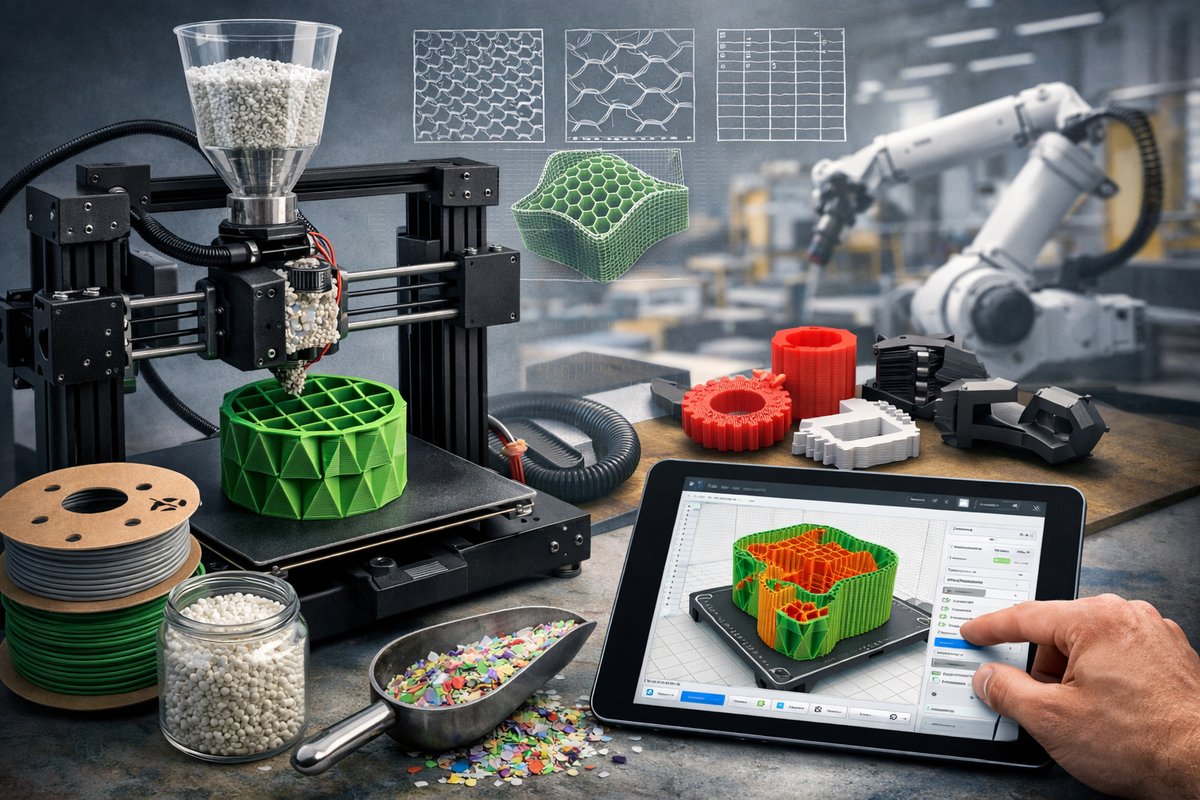

What began as a desktop novelty has grown into a global wave of digital fabrication. Today’s small-format machines can produce functional parts for home workshops, medical prototypes in clinics, and end-use components on factory floors. Yet so many makers still wrestle with failed prints, expensive resins, and materials that put a strain on budgets. A new generation of techniques and technologies is changing the calculus: reducing waste, shrinking material costs, and boosting first-time success.
A key frontier lies in software. Traditional slicers once treated each layer the same, but modern engines use adaptive infill and variable wall thickness guided by stress-analysis data. By running a quick finite-element simulation inside the slicer, the software reinforces only high-stress zones and thins out areas under low load. The result is strong parts with up to 60 percent less filament usage. Meanwhile, specialized “tree-style” supports branch outward, touching the model only at critical anchor points. These organic, fractal supports use far less material and break away cleanly, cutting post-processing time.
Artificial intelligence has also found its way into slicing. Neural-network-powered tools can predict where overhangs will fail and automatically adjust layer orientations by a few degrees. This reduces the need for bulky support scaffolds and keeps surfaces smooth. Some open-source slicers now detect bridging angles and fine-tune print speeds on the fly, slowing down precisely where droop risk is highest and accelerating over rigid sections. The payoff: prints that finish faster and with fewer air gaps or stringing artifacts.
On the hardware side, cost-driven innovation is everywhere. Pellet extruders-once the domain of industrial machines-are now available as DIY attachments. By feeding loose pellets instead of filament spools, users tap into polymer manufactured in bulk at a fraction of the price per kilogram. For makers, that means engineering-grade plastics like ABS, nylon, and even specialized flame-retardant blends can be printed without breaking the bank. Print heads built to tolerate abrasive fillers-like carbon-fiber-reinforced nylon-give strength and stiffness once reserved for CNC-machined parts.
Filament itself is going green. Recycled and post-consumer PLA spools are now widely offered, often at price points competitive with virgin plastics. These filaments are produced by grinding old prints or ready-made plastic waste and repurposing it for printing. Many come with certificates verifying a minimum recycled content. Beyond environmental benefits, they can yield surprisingly uniform results, especially when paired with hardened-steel nozzles that resist wear from microscopic contaminants.
Resin printing is undergoing a similar revolution. Hybrid systems that combine low-cost masking LCDs with LED arrays can cure resin with layer times under 5 seconds. Resin recyclers-vats equipped with fine filters-capture leftover liquid and particulate so the same batch can be used through multiple jobs. Any sediment collected in a disposable mesh bag can be pressed out and dried, then reused in non‐critical builds like supports or concept models. Post-cure chambers with adjustable UV intensity and temperature control ensure that parts attain full material properties without overbaking and warping.
Even powder-bed processes have become more accessible. Desktop systems using fused-powder jets and infrared lamps can fuse nylon powders layer by layer, yielding parts with isotropic strength. While these machines can’t match industrial metal sintering systems, they open the door to true nylon, TPU, and even ceramic composites at small scale. Users report that careful temperature control-keeping the build chamber warm enough to prevent thermal gradients-drastically reduces warping or delamination.
Beyond new machines, simple workflow tweaks can improve reliability and economy. Automated bed-leveling sensors-once premium upgrades-come built into many budget machines today. These optical or contact probes map the build surface, allowing firmware to compensate for slight angle and height variations. A magnetically detachable spring-steel build plate then removes easily, so parts can be flexed free instead of pried off, preserving edges and nozzle health.
Nozzle geometry has received its own makeover. Volcano-style hot ends with extended melt zones allow higher flow rates at moderate temperatures, speeding up large prints without sacrificing layer adhesion. At the other end of the scale, micro-nozzles under 0.2 mm are becoming standardized, letting you resolve tiny cavities and delicate lattice structures previously only possible on resin machines. Swapping nozzles takes minutes and opens a spectrum between brute-force speed and precision dialing.
Software-driven quality control is also catching on. Some printers now embed cameras to perform time-lapse monitoring. If a layer shift or extrusion clog is detected, the machine pauses and alerts the operator over Wi-Fi rather than continuing a doomed build. Networked setups let small shops manage dozens of machines from a single dashboard, queuing jobs based on priority and material compatibility.
We’re also seeing materials that blur lines. Flexible filaments with shore hardness around 90A now print from stock hot ends, thanks to improved polymer formulations that resist buckling in the feed tube. Composite resins that mix ceramic or glass microbeads with photosensitive polymers yield parts that can be sintered after printing, resulting in truly rigid ceramic artifacts with fine feature reproduction.
Ultimately, what makes these innovations powerful is their modularity. You can mix and match a recycled-PLA filament spool, an adaptive infill slicer profile, a pellet extruder attachment, and a magnetized flexible bed into a custom printing ecosystem tuned for your needs. Someone focused on prototyping functional enclosures might skip resin altogether. A small studio making artistic miniatures could prioritize a high-resolution micro-nozzle and a post-cure chamber. At every step, the ability to swap components and dial in parameters democratises processes that once required large capital investments.
At its heart, 3D printing still celebrates playful experimentation. Yet as the bar for reliability and cost-effectiveness keeps rising, what was once a novelty is swiftly maturing into an indispensable manufacturing tool. By adopting intelligent slicing, embracing sustainable materials, and modularizing hardware upgrades, makers of all stripes can push the boundaries of what’s possible-without watching their budgets melt away.
In the months ahead, look for deeper integration between sensors, AI-driven print optimizers, and cloud-based material profiles. Expect more open-source firmware forks to add features like real-time thermal compensation and embedded safety checks. And behind the scenes, material scientists will refine bio-based resins and engineering polymers that cure faster at lower energies.
The future of layered making is shorter lead times, lighter environmental footprints, and ever-higher success rates. Whether you’re printing a custom tool jig, a medical model, or a one-off artistic sculpture, the next wave of affordable innovations ensures that your vision can emerge from the digital realm in record time-layer by precise layer.