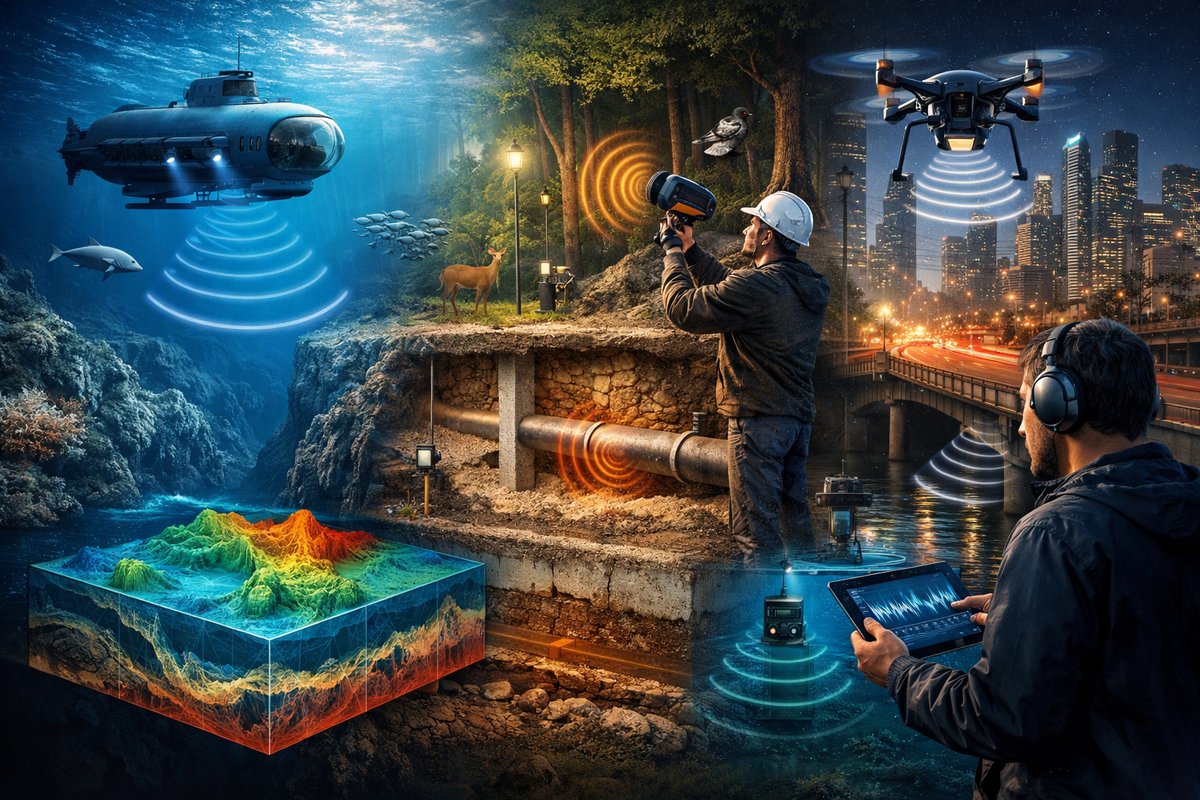

Humans have long relied on sight to explore the world, but sound can travel where light cannot. From the deep ocean to the inner workings of a bridge, acoustic technologies are extending our senses and turning inaudible vibrations into rich data. This field blends physics, engineering, biology, and environmental science, driven by engineers designing sensors, field researchers deploying recorders, and hobbyists building DIY hydrophones. Each advance reflects a core value of scientific curiosity, emotional intelligence toward living systems, and a commitment to sustainability as we monitor and protect fragile environments.
In oceanography, sonar systems have transformed our understanding of seafloor landscapes. Multibeam echosounders sweep acoustic pulses across wide swaths of the bottom, generating high-resolution maps that reveal undersea mountains, hidden canyons, and hydrothermal vent fields teeming with life. Researchers use these maps to identify biodiversity hotspots, track tectonic activity, and assess mineral deposits. Acoustic mapping is also more sustainable than disruptive physical sampling, since it leaves habitats intact and reduces fuel consumption by shortening survey durations.
Bioacoustics applies similar principles on a biological scale. In forests, lakes, and grasslands, arrays of passive acoustic recorders capture bird calls, frog croaks, and insect stridulations. Machine learning algorithms then classify species by their unique sound signatures, enabling large-scale population monitoring without direct human presence. Community-driven initiatives have turned backyard birders and hikers into citizen scientists, contributing millions of recordings to open databases. These soundscapes offer a low-impact way to track migrations, detect invasive species, and even pinpoint illegal logging, supporting both conservation and local communities.
Structural health monitoring leverages acoustic emission techniques to detect microcracks in bridges, pipelines, and wind turbine blades. Tiny bursts of ultrasonic waves emit as materials undergo stress, and sensitive sensors pick up these signals before visible damage appears. Engineers analyze the frequency and amplitude patterns to locate potential failure points, scheduling repairs proactively and avoiding costly downtime or catastrophic collapse. This preventive approach exemplifies responsible stewardship of infrastructure and public safety.
In medicine, ultrasound imaging has become indispensable for noninvasive diagnostics. Advances in portable ultrasound scanners and high-frequency transducers now allow clinicians to visualize soft tissues, blood flow, and organ structures with unprecedented clarity. Emerging techniques like acoustic elastography measure tissue stiffness, improving early detection of tumors and liver fibrosis. Researchers are even exploring microscale acoustic devices that could one day image individual cells, further bridging the gap between physics and health care.
Urban planners and public health officials increasingly rely on noise mapping to assess soundscapes in cities. Networks of digital sound level meters, mounted on streetlights or mobile vehicles, gather data on traffic, construction, and industrial noise. These datasets inform zoning regulations, guide the design of noise barriers, and shape community outreach around well-being. Privacy considerations arise when acoustic sensors pick up conversations or private gatherings. Best practices include using directional microphones, limiting sampling durations, and anonymizing recordings to balance data utility with individual rights.
Archaeologists have also adopted acoustic tools to peer beneath the ground without digging. Ground-penetrating radar and seismic reflection use acoustic pulses to detect buried structures, cavities, and stratigraphic layers. In cave systems, sonar can map labyrinthine passages in complete darkness, guiding exploration teams safely and preserving delicate archaeological artifacts. These noninvasive methods protect cultural heritage sites and reduce environmental impact compared to large-scale excavations.
The frontier of acoustic research is expanding with quantum acoustics and acoustic metamaterials. Scientists are designing materials that steer sound waves in unusual ways, enabling acoustic cloaking devices and vibration-free enclosures. Quantum acoustic sensors promise extreme sensitivity, capable of detecting minute vibrations from faint signals such as dark matter interactions or nanoscale mechanical resonances. While still experimental, these technologies illustrate how fundamental curiosity can spark innovations with broad societal implications.
Citizen science platforms make acoustic exploration accessible to anyone with a smartphone and an inexpensive microphone attachment. Backyard enthusiasts can record bat echolocation calls at dusk, identify tree species by their resin flow vibrations, or monitor urban wildlife corridors. Open-source software packages provide tools for signal analysis and species classification, fostering a collaborative environment where amateurs and professionals learn from one another. This inclusive approach nurtures emotional intelligence by valuing diverse perspectives and promotes sustainability by decentralizing environmental monitoring.
Ethical considerations surround the collection and use of acoustic data. Recording in public spaces can inadvertently capture personal conversations, raising privacy concerns. Researchers and hobbyists must adhere to local regulations, obtain necessary permissions, and implement data management policies that anonymize sensitive information. Transparent communication with communities about research goals and data usage builds trust and ensures that acoustic projects serve the common good.
As acoustic technologies evolve, they offer powerful tools for understanding-and protecting-complex systems. Whether mapping deep-sea ecosystems, diagnosing medical conditions, or preserving cultural heritage, sound science reveals hidden dimensions of our world. By embracing curiosity, collaboration, and ethical practices, researchers and citizens alike can listen more closely, learn more deeply, and contribute to a more informed and sustainable future.
-
Hydrophone Testing Hazard Stay Clear Attention Folding ...
Double-Sided Display – Features two 23"x23" sign panels for maximum visibility from both directions, making it ideal for sidewalk advertising, storefront ... -
Hydrophone Testing Hazard Stay Clear Warning Folding ...
Double-Sided Display – Features two 23"x23" sign panels for maximum visibility from both directions, making it ideal for sidewalk advertising, storefront ... -
Underwater Sounds of Nature for Relaxation Meditation
7. Sea Shore Underwater Sounds - Hydrophone Stereo 3D Recordings for True Relaxation Meditation and Deep Sleep. Sea Sound Massage for Ocean Massage Therapy ... -
ELEGOO UNO R3 Smart Robot Car Kit V4 for Arduino ... - Amazon.com
Under this mode the ELEGOO robot car will automatically detect obstacles ahead of it no matter which direction it is from with the ultrasonic sensors on the ... -
LOUYTW Ultrasonic Flowmeter Handheld Ultrasonic ... - Amazon.com
Buy LOUYTW Ultrasonic Flowmeter Handheld Ultrasonic Flow Meter Kit Ultrasonic Meter Tester Flowmeter DN50 to DN700 Ultrasonic Flow Tester Portable Clamp on ... -
LAFVIN Smart Robot Car Kit Include Ultrasonic ... - Amazon.com
Amazon.com: LAFVIN Smart Robot Car Kit Include Ultrasonic Sensor,R3 Board Compatible with Arduino IDE with Tutorial : Electronics.