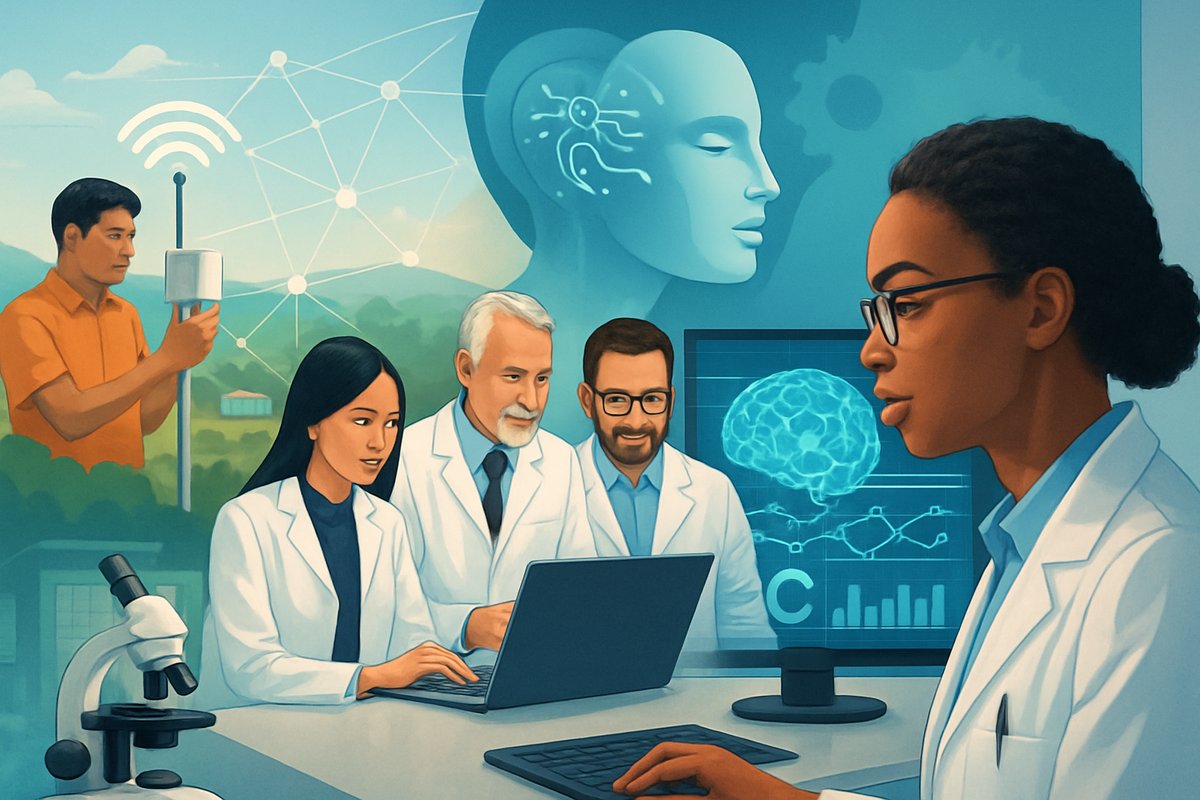

Under a canopy of tents in a city park, a group of volunteers gathers around a row of compact air-quality sensors they’ve built themselves. Nearby, a microscope station streams live images of urban pollen and airborne particulates to an eager audience. At the same time, researchers in a distant lab feed massive climate datasets into machine-learning algorithms to forecast extreme weather events. These scenes underscore a profound shift in how scientific breakthroughs emerge: not solely from elite institutions but from a dynamic network of professionals, hobbyists, activists, and students united by curiosity.
The spark of scientific inquiry often begins with a simple question: What happens when two chemicals mix? How does a cell repair its DNA? What drives a storm? At its core, curiosity fuels the quest for understanding the unknown. Historical milestones-from the discovery of penicillin to the unveiling of cosmic microwave background radiation-were catalyzed by individuals daring to ask new questions. Today, researchers build on that legacy, pursuing fundamental studies in fields like synthetic biology, quantum materials, and deep-sea ecology. These spheres share a mindset: embrace uncertainty, design controlled experiments, and follow the data wherever it leads.
Yet no discovery stands in isolation. Modern science thrives on interdisciplinary collaboration. A materials scientist might team with a computer engineer to develop self-healing polymers. An ecologist joins forces with a data scientist to model migration patterns under shifting climate regimes. Even the humanities contribute-philosophers help clarify research ethics, and artists translate complex findings into intuitive experiences. Collaborative grants, shared lab spaces, and international consortiums dissolve traditional silos, accelerating progress and triggering innovations that a single field could not achieve alone.
In parallel, open science and citizen science movements are democratizing research. Open-access journals, public data repositories, and transparent protocols invite anyone to inspect, reuse, or build upon existing work. Citizen scientists-with smartphones, backyard telescopes, or homemade sensors-contribute millions of data points covering bird migrations, air pollution, and far-off exoplanets. These inclusive platforms not only expand the scale of research but also foster a sense of collective ownership over scientific knowledge.
Reproducibility stands as a central pillar of credibility in science. In recent years, initiatives promoting open data and rigorous methods have emerged to ensure that experiments yield consistent results when repeated. Version-controlled code repositories, electronic lab notebooks, and shared metadata standards make it simpler for peers to validate findings. This transparency not only reduces costly errors but also strengthens public trust by demonstrating that science is a self-correcting enterprise.
Technology continues to reshape the research landscape. Artificial intelligence and deep learning accelerate image analysis in fields ranging from histology to particle physics. Automated robotics handle repetitive lab tasks, freeing researchers to focus on interpretation and creative problem-solving. Cloud computing offers virtually limitless processing power for large simulations, while remote instruments allow scientists to control telescopes, gene sequencers, or ocean drones from anywhere in the world. These digital tools multiply human ingenuity, turning once-tedious workflows into high-throughput pipelines.
Alongside high-end instruments, the maker movement has sparked a DIY revolution in laboratory hardware. Microcontrollers and open-source electronics platforms enable scientists and enthusiasts to design custom sensors for water quality, soil moisture, or plant growth. 3D printers produce bespoke labware-holders, adapters, even flow reactors-at a fraction of the cost of commercial equipment. This trend empowers small labs, startups, and citizen groups, lowering barriers to entry and cultivating ingenuity at every scale.
Collecting data is only half the story. Data visualization and computational modeling breathe life into raw numbers. Interactive dashboards reveal trends in real time, while virtual reality environments let researchers explore molecular structures at the nanoscale. Statistical tools help identify hidden patterns, quantify uncertainties, and guide decision-making. In fields like epidemiology or climate science, these models inform policy by projecting outcomes under different scenarios, reinforcing science’s role as a navigator for society’s challenges.
Sustainability has become a guiding principle in contemporary research. Green chemistry seeks to eliminate hazardous reagents and reduce waste in chemical processes. Circular-economy thinking encourages recycling and reuse of materials in manufacturing and electronics. Renewable energy labs explore novel solar materials and battery designs for a low-carbon future. Even lab practices adapt: plastic-free workstations, solvent recycling systems, and digital data sharing reduce environmental footprints. By aligning scientific ambition with planetary stewardship, researchers ensure that discovery does not come at the earth’s expense.
Science is also a profoundly human endeavor, woven with ethical decisions and emotional intelligence. From securing informed consent in clinical trials to safeguarding personal data in genomics research, researchers must balance innovation with respect for individual rights. Teams that foster open communication, cultural awareness, and psychological safety build environments where diverse perspectives flourish. Mentorship programs and inclusive policies help nurture the next generation of scientists, ensuring that the community remains vibrant, empathetic, and just.
Public engagement and science education form the bridge between researchers and society. Museums, science festivals, podcasts, and online platforms demystify complex topics, inviting everyone to join the conversation. Hands-on workshops let students build simple spectrometers or program autonomous rovers. Storytelling techniques make abstract concepts tangible, forging emotional connections that inspire lifelong curiosity. When communities see science as accessible and relevant, it strengthens collective resilience in facing issues like pandemics or climate emergencies.
Looking ahead, new frontiers beckon. Quantum biology explores how quantum phenomena might influence processes like photosynthesis or animal navigation. Astrobiology pushes the boundaries of life, searching for biosignatures on distant worlds. Bioinformatics and synthetic genomics open pathways to custom-designed organisms for medicine or environmental cleanup. Meanwhile, planetary science missions probe icy moons, and gravitational-wave detectors listen to the fabric of spacetime. Each domain beckons with unanswered questions and the promise of transformative breakthroughs.
Amid these lofty ambitions, individual curiosity remains the compass guiding exploration. A chance observation in a home lab can spark a career-defining idea. A late-night coding session may reveal a pattern hidden in terabytes of data. A community science project can empower neighbors to monitor local air quality or protect endangered species. By cultivating wonder in daily life-reading a science journal, attending a talk, or tinkering with an experiment-anyone can tap into the creative energy that propels discovery.
Science is not a solitary pursuit confined to ivory towers; it’s a collective journey driven by questions, fueled by collaboration, and powered by technology. As we navigate the challenges and opportunities ahead, embracing openness, responsibility, and interdisciplinary imagination will be key. Every hypothesis tested, every dataset shared, and every mind engaged brings us closer to understanding the world and shaping a sustainable future for all.
No affiliate links found for this post.