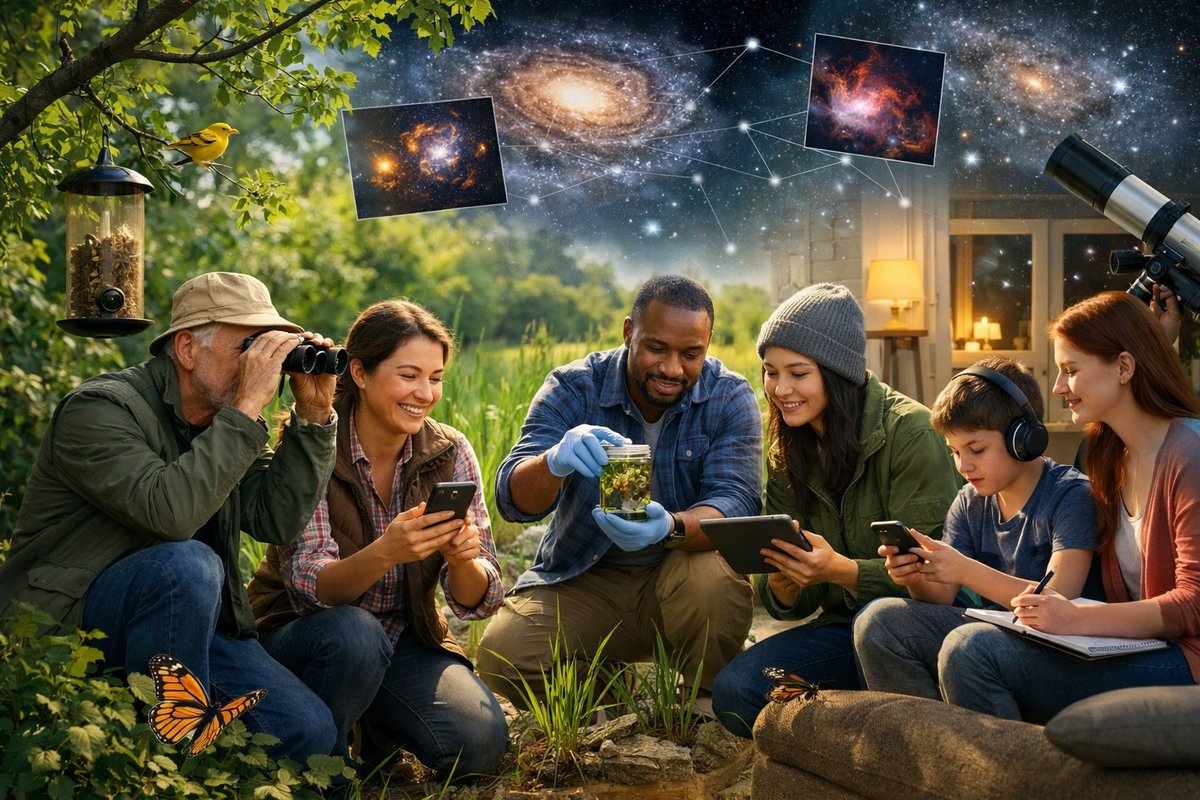

In the early hours of a summer morning, a retired schoolteacher steps into her backyard armed with nothing more than a simple rain gauge and a notebook. Over the next month, she records precipitation levels daily, uploads the readings to an online portal, and watches as her data becomes part of a regional climate survey. Meanwhile, across town, a high-school student snaps photos of insects visiting her flowering garden, tags them in a mobile app, and joins thousands of volunteers helping entomologists map pollinator populations. These stories illustrate a movement quietly reshaping scientific research: citizen science.
Citizen science invites enthusiasts of all ages and backgrounds to partner with professional researchers, extending the reach of projects in ecology, astronomy, public health, and beyond. Tools once locked away in laboratories are now accessible from smartphones, home telescopes, and DIY sensor kits. The result is a sprawling network of observers, recorders, and classifiers generating datasets on a truly global scale.
One of the longest-running initiatives in this space is bird monitoring. In recent years, a platform that lets birdwatchers log sightings has grown to over a million registered participants, collecting more than a hundred million observations annually. Ornithologists use these reports to identify population shifts, migration delays, and the emergence of invasive species. A sudden surge in observations of a particular warbler might flag a change in breeding grounds, prompting field teams to investigate habitat conditions. No single lab or research institute could match that volume of data without the community’s involvement.
Astronomy, too, has embraced the crowd. Amateur stargazers armed with backyard telescopes and off-the-shelf cameras collaborate on galaxy classification projects. Volunteers examine millions of images, distinguishing spiral from elliptical galaxies in far less time than it would take a small group of specialists. Remarkably, this effort has led to the discovery of rare phenomena-hidden rings, stripped galaxies, and even unknown gravitational lenses-each finding published in peer-reviewed journals. Citizen astronomers report transient events like supernovae and play a crucial role in alerting observatories to fleeting cosmic explosions.
Beyond these headline-grabbing examples lie countless smaller initiatives tackling local environmental issues. Urban air quality monitoring networks rely on compact, low-cost sensors that residents install on their balconies. Data aggregated from dozens of these units paints a far more detailed picture of pollution hotspots than a handful of government stations. In one city, community-deployed monitors revealed unusually high nitrogen dioxide levels near a busy intersection, sparking a campaign to adjust traffic flows and plant roadside vegetation. Citizens didn’t just observe pollution-they drove the conversation on mitigation.
Digital tools have lowered the barrier to entry for anyone eager to contribute. Mobile apps guide users through data collection protocols, embed built-in tutorials on species identification or instrument calibration, and sync results in real time to open portals. Many platforms gamify participation: users earn badges for consecutive entries, unlock achievement levels for identifying rare species, or compete in friendly ranking boards. These design elements tap into intrinsic motivations-curiosity, mastery, and community-transforming dry observation tasks into engaging challenges.
Quality and reliability, of course, remain vital concerns. Professional teams invest in training materials, cross-validation processes, and statistical filters to flag anomalies. In biodiversity surveys, for instance, expert reviewers verify a subset of submissions, while machine-learning algorithms screen for outliers. These safeguards ensure that volunteer-generated data not only expands coverage but also meets the rigorous standards scientists demand.
The power of citizen science extends beyond data collection; it fosters scientific literacy and emotional investment. Participants gain firsthand experience with experimental design, learn to spot patterns, and develop an appreciation for the uncertainties inherent in measurement. A community mapping local groundwater levels becomes more attuned to water conservation issues. A group charting urban heat islands endorses green infrastructure projects. In each case, engagement with science leads to informed advocacy and sustainable choices.
One inspiring example comes from a coastal town where volunteers monitored beach sand temperatures to track the nesting success of sea turtles. By recording hourly readings with handheld thermometers, they discovered that sand temperatures at certain sites exceeded thresholds known to bias hatchling sex ratios. Armed with this insight, the community organized shade-netting initiatives, relocating eggs to cooler nests and helping restore a balanced population.
In another project, residents living near a set of abandoned wells assembled a neighborhood drilling log. Using basic water-quality test strips and GPS-enabled devices, they identified wells with elevated arsenic levels. The compiled data prompted local authorities to issue alerts and provide remediation grants. Here, citizen science translated directly into public health interventions.
As these stories show, participation in citizen science can start small-measuring rainfall, classifying a handful of images, logging a garden plant. Yet each individual contribution joins others to form a mosaic of insight that professional researchers alone could never achieve.
Getting started is easier than you might think. First, explore online portals or mobile apps dedicated to community science. Look for projects that match your interests: wildlife surveys, air-quality monitoring, light-pollution mapping, or even genome annotation puzzles. Next, review any training materials or tutorials to ensure accurate observations. Invest in basic tools if necessary-a field notebook, a thermometer, a smartphone mount for your backyard telescope, or a simple microscope. Then, set a realistic goal: commit to an hour of data collection each week or to identifying ten specimens per session. Finally, engage with online forums or local meetups to swap tips, share discoveries, and stay motivated.
In this age of large datasets and powerful algorithms, it’s easy to assume that science belongs to specialists in white coats. Yet citizen science reminds us that discovery is, at its heart, a human endeavor driven by wonder and community. Whether you’re counting clouds, classifying galaxies, or testing local water, your observations matter. By joining thousands of fellow explorers, you amplify collective knowledge, drive policy changes, and spark innovations that shape our future. The next breakthrough could begin right in your backyard-so pick up your notebook, calibrate your sensor, and join the adventure.
No affiliate links found for this post.