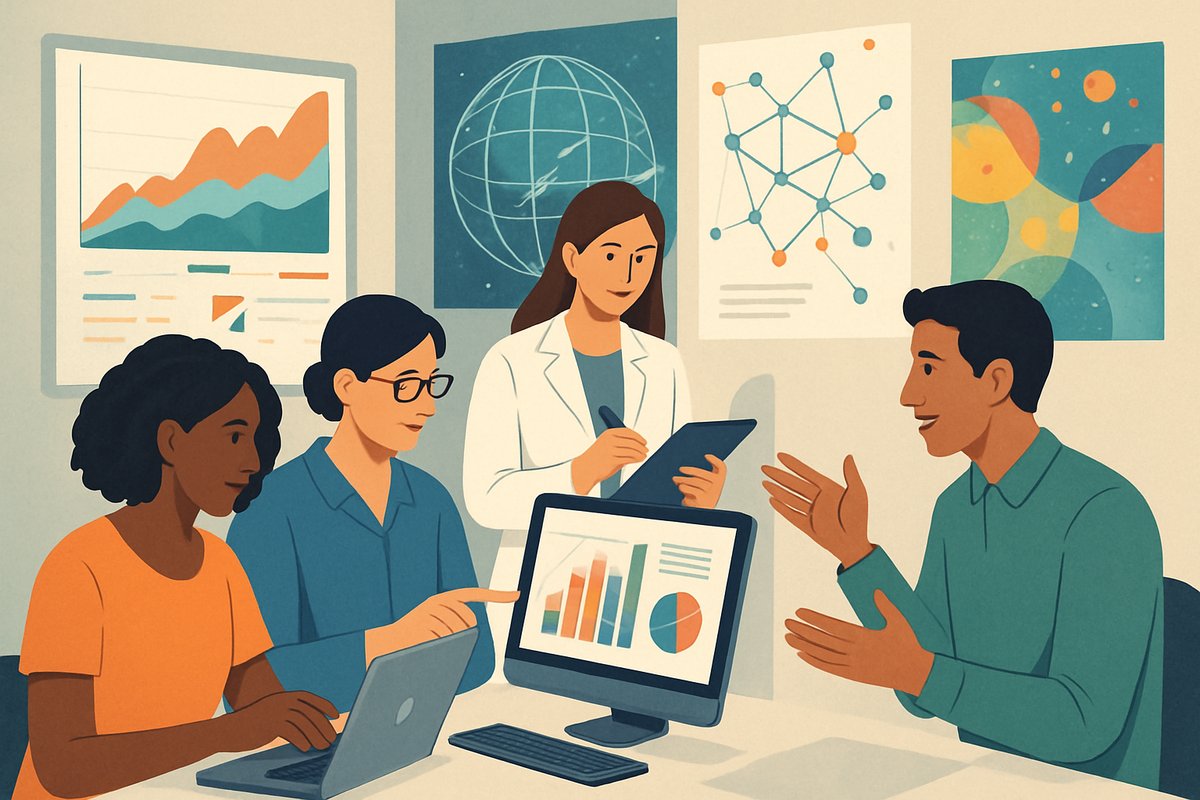

In a dimly lit community center, a group of volunteers gathers around a poster displaying satellite images of coral reefs. Armed with smartphones, they zoom in on bleached patches, logging observations in real time. Elsewhere, a handful of artists collaborate with ecologists to turn raw climate data into immersive installations that speak to the heart as much as the mind. These scenes capture a fundamental shift in how science is practiced. No longer confined to ivory towers or specialized laboratories, discovery now thrives on openness, diversity, and connection.
The era of siloed disciplines is giving way to interconnected networks. Biologists share genetic sequences through open repositories, physicists post preprints online for community review, and citizen scientists contribute millions of data points from backyard bird feeders or backyard stargazing sessions. This democratization of research accelerates progress in ways that once seemed unimaginable. When a rare astronomical event appeared on a researcher’s calendar, an international community of amateur astronomers trained their backyard telescopes to capture fleeting images. Within hours, professionals and hobbyists alike had assembled a high-resolution composite that provided new insight into stellar evolution.
Digital infrastructure plays a central role in this transformation. Cloud-based analysis tools make it simple to run complex simulations on thousands of virtual cores, and collaborative platforms allow teams spread across continents to annotate datasets, troubleshoot code, and coauthor papers. Machine learning pipelines that once required specialist hardware can now be spun up on demand, enabling small labs and even individual hobbyists to tackle challenges ranging from drug discovery to climate modeling. In the push to develop clean energy solutions, open-source electrochemistry kits let makers experiment with novel battery chemistries and electrode materials, accelerating the search for safer, more efficient storage systems.
Yet technology alone doesn’t guarantee progress. The human element-empathy, creativity, and resilience-remains essential. Interdisciplinary teams report that achieving genuine breakthroughs often hinges on cultivating an environment where all voices are heard. A marine biologist and a sculptor might initially speak different technical languages, but when they engage in hands-on workshops together, they learn to translate concepts and ask fresh questions. Over time, this shared vocabulary sparks ideas that neither would have conceived alone, such as bio-inspired architectural structures that mimic coral resilience under wave forcing.
In parallel, data literacy programs are equipping non-experts with the skills to analyze and interpret open datasets. In some cities, libraries offer free classes in statistical analysis and data visualization software. Community labs supply microscopes and reagents for citizen biology projects, where urban gardeners test soil health and track microbial communities in compost piles. The insights gleaned inform municipal composting policies and urban agriculture initiatives, demonstrating how grassroots research can shape local sustainability strategies.
Case studies abound. In one striking example, an online platform invited volunteers worldwide to classify snapshots of microscopic plankton. Within weeks, millions of images were categorized, revealing shifts in plankton populations linked to ocean temperature changes. Those shifts prompted further field expeditions and fed into climate models that underpinned regional fishing quotas. This chain reaction-from crowd labeling to policy adjustment-illustrates how collective curiosity can translate into tangible impact.
Still, open science faces hurdles. Concerns around data privacy, equitable access to resources, and the reproducibility crisis persist. Researchers grappling with sensitive medical data must balance open collaboration against patient confidentiality. In response, privacy-preserving algorithms are emerging that allow analysts to extract meaningful trends without exposing individual records. At the same time, funders and institutions are piloting grant programs that incentivize replication studies and mandate public sharing of code and methods.
Ethical considerations extend beyond privacy. Who owns the results of a collaborative art-science installation? Who benefits when a citizen scientist’s observation leads to a high-profile publication? Models for credit and authorship are evolving, with some journals endorsing contributor taxonomies that specify each person’s role. This transparency ensures that recognition flows to everyone involved, whether they provided data, developed algorithms, or crafted visual narratives.
Looking to the horizon, emerging fields promise to deepen the collaborative ethos. Synthetic biology startups are co-designing microbes with local communities to biodegrade pollutants, while open-hardware initiatives distribute blueprints for low-cost environmental sensors. Even space exploration is taking a more inclusive approach. A growing number of universities and nonprofits have built backyard radio telescopes and CubeSat kits that students and amateur clubs can launch. By feeding back data into shared archives, these small launches expand coverage of atmospheric phenomena and near-Earth debris tracking.
The shift toward integrative research also challenges how we teach the next generation of scientists. Universities are experimenting with project-based curricula where students from computer science, humanities, and life sciences form teams to tackle grand challenges. In one program, literature majors study historical narratives of disease outbreaks while engineering students develop low-cost diagnostic devices. The cross-pollination cultivates not only technical expertise but also an appreciation for social context, ethics, and communication-skills often overlooked in traditional STEM training.
Ultimately, science’s strength lies in its capacity to adapt. As global challenges-from pandemics to climate change-grow more complex, no single discipline or institution can go it alone. The breakthroughs that matter most will arise from networks that bridge sectors, geographies, and backgrounds. When an immunologist in Brazil, a data scientist in Kenya, and a nurse in Canada collaborate on an open dashboard for tracking vaccine distribution, they demonstrate the power of shared purpose and decentralized problem-solving.
Despite the buzz around artificial intelligence and big data, the most profound resource remains human curiosity. It’s the spark that compels a child to peer through a telescope, a retiree to sequence backyard soil bacteria, or a team of strangers to rewrite the rules of academic publishing. By nurturing that curiosity, providing accessible tools, and fostering cultures of trust, we unlock potential that transcends individual expertise.
As you read this, a network of makers, hobbyists, teachers, and professionals is probably gathering knowledge that could reshape our understanding of health, environment, or the cosmos. You might contribute by sharing a photograph of migrating birds, annotating satellite imagery, or simply by asking a bold question. The canvas of science is vast and ever-expanding-and its true frontiers are being drawn where collaboration, compassion, and creativity meet.
Let this be an invitation. Whether you’re conducting experiments in a garage lab or supervising a classroom project, remember that science flourishes when doors are open and minds are unguarded. The next breakthrough could spring from a notebook scribble, a shared line of code, or a community-organized stargazing event. In embracing the collective spirit of discovery, we chart a course to a future where knowledge is not a scarce resource but a common good, fueling progress that belongs to all of us.
No affiliate links found for this post.